Theory 1
Certain algebraic expressions have a secret meaning that comes from the Pythagorean Theorem. This meaning has a very simple expression in terms of trig functions of a certain angle.
For example, consider the integral:
Now consider this triangle:
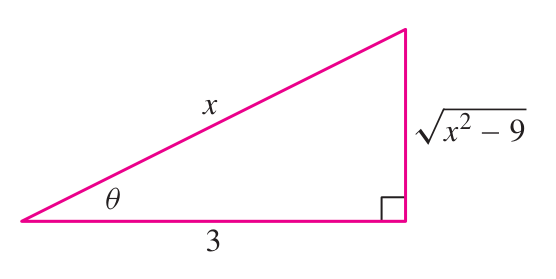
The triangle determines the relation , and it implies .
Now plug these into the integrand above:
Considering that , we obtain a very reasonable trig integral:
We must rewrite this in terms of using to finish the problem. We need to find assuming that . To do this, refer back to the triangle to see that . Plug this in for our final value of the integral:
Here is the moral of the story:
Pythagorean expressions
Re-express the Pythagorean expression using a triangle and a trig substitution.
In this way, we are able to eliminate square roots of quadratics.
There are always three steps for these trig sub problems:
- (1) Identify the trig sub: find the sides of a triangle and relevant angle .
- (2) Solve a trig integral (often a power product).
- (3) Refer back to the triangle to convert the answer back to .
To speed up your solution process for these problems, memorize these three transformations:
(1)
(2)
(3)
For a more complex quadratic with linear and constant terms, you will need to first complete the square for the quadratic and then do the trig substitution.