CoM of a parabolic plate
Find the CoM of the region depicted:
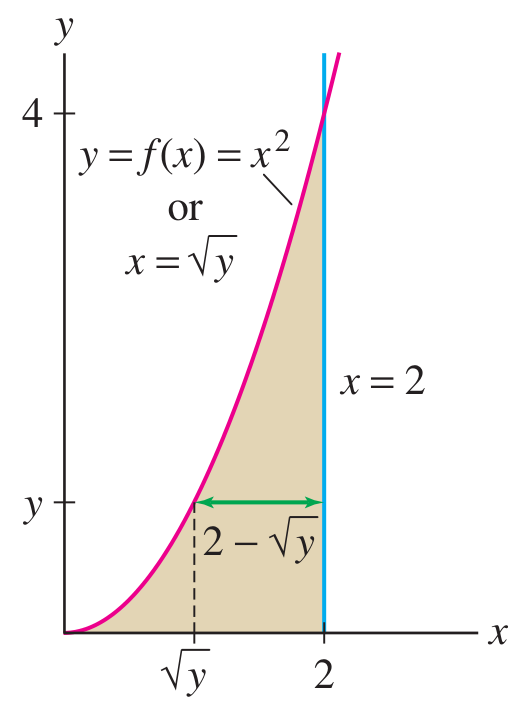
Solution
(1) Compute the total mass:
Area under the curve with density factor :
(2) Compute :
Formula:
Interpret and calculate:
(3) Compute :
Formula:
Width of horizontal strips between the curves:
Interpret :
Calculate integral:
(4) Compute CoM coordinates from moments:
CoM formulas:
Insert data:
Computing CoM using only vertical strips
Find the CoM of the region:
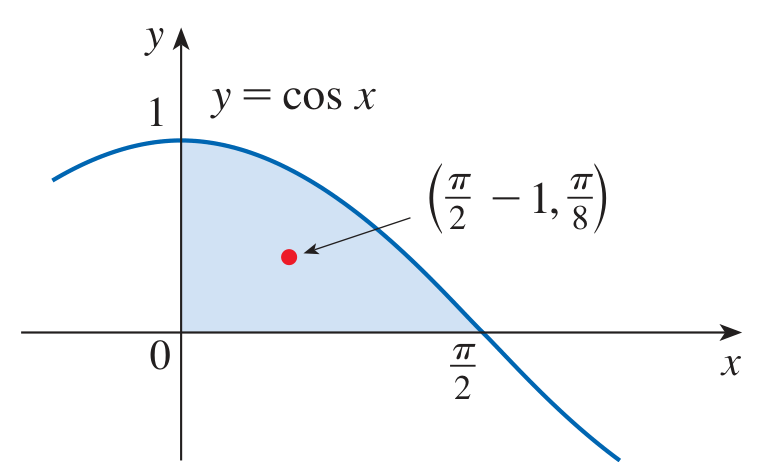
Solution
(1) Compute the total mass :
Area under the curve times density :
(2) Compute , using vertical strips and the ‘midpoints’ method:
Plug and into formula:
Integration by ‘power to frequency conversion’:
(3) Compute using vertical strips and the regular method:
Plug into formula:
Integration by parts. Set , and so , :
(4) Compute CoM:
CoM formulas:
Plug in data:
CoM of region between line and parabola
Compute the CoM of the region below and above with .
Solution
(1) Compute total mass :
Name the functions: (lower) and (upper) over .
Mass is area (between curves) times density:
(2) Compute using vertical strips:
(3) Compute also using vertical strips:
(4) Compute CoM using moment formulas:
Center of mass using moments and symmetry
Find the center of mass of the two-part region:
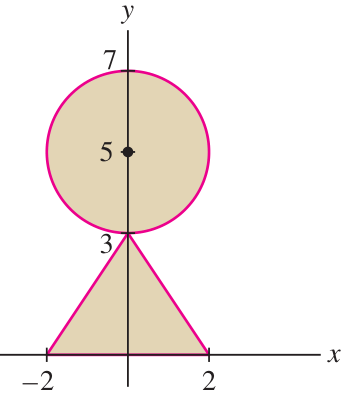
Solution
(1) Symmetry: CoM on -axis
Because the region is symmetric in the -axis, the CoM must lie on that axis. Therefore .
(2) Additivity of moments:
Write for the total -moment (distance measured to the -axis from above).
Write and for the -moments of the triangle and circle.
Additivity of moments equation:
(3) Find moment of the circle using Symmetry:
By symmetry we know .
By symmetry we know .
Area of circle with is , so total mass is .
Centroid-from-moments equation:
Solve the equation for :
(4) Find moment of the triangle using Symmetry and the “ trick”:
By Symmetry, the CoM of the triangle must lie on the vertical line .
By the “ trick,” the CoM of the triangle must lie on the horizontal line at . In this case , so it lies on the line .
Therefore the triangle CoM is:
To get moments, multiply by mass :
(5) Apply additivity:
(6) Total mass of region:
Area of circle is . Area of triangle is . Thus .
(7) Compute center of mass from total and total :
We have and . Plug into formula:
Center of mass - two part region
Find the center of mass of the region which combines a rectangle and triangle (as in the figure) by computing separate moments. What are those separate moments? Assume the mass density is .
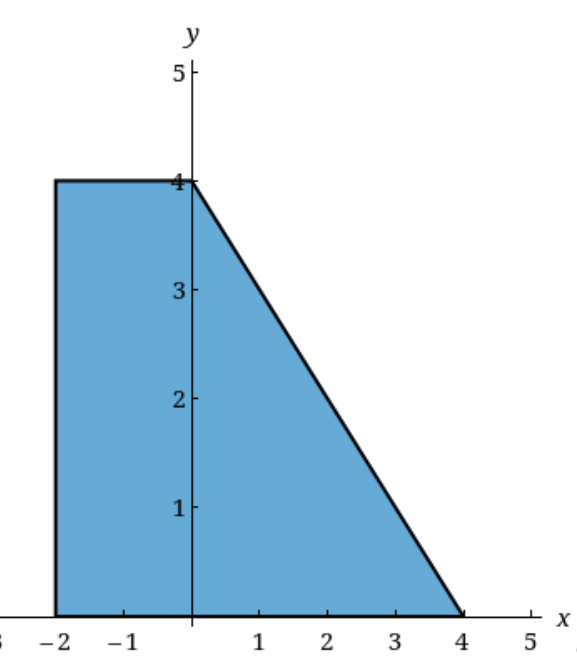
Solution
(1) Apply symmetry to rectangle:
By symmetry, the center of mass of the rectangle is located at .
Thus and .
(2) Find moments of the rectangle:
Total mass of rectangle . Thus:
(3) Find moments of the triangle:
CoM of triangle using “ trick:”
From the base on the -axis, we have so the CoM lies on the line .
From the base on the -axis, we have so the CoM lies on the line .
Multiply by the triangle’s mass to get its moment:
Therefore:
(4) Add up total moments:
General formulas: and
Plug in data: and
(5) Find center of mass from moments:
Total mass of triangle .
Total combined mass .
Apply moment relation: