Theory 1
A sequence is a rule that defines a term for each natural number :
So a sequence is a function from to .
Geometric sequence
A sequence is called geometric if the ratio of consecutive terms is some constant , independent of :
The defining relation of a geometric sequence is equivalent to .
By plugging into , we have . This plugging can be repeated -times to get a formula for the term:
Therefore , and we have a formula for the general term of the sequence (the term with index ).
Starting point of a sequence
Note that sometimes the index (variable) of a sequence starts somewhere other than . Most common is but any other starting point is allowed, even negative numbers.
Sometimes is used instead of in the formula for the general term of a sequence, thus . The ‘’ notation is useful when the sequence starts from .
Extra - Fibonacci sequence
The Fibonacci sequence goes like this:
The pattern is:
This formula is a recursion relation, which means that terms are defined using the values of prior terms.
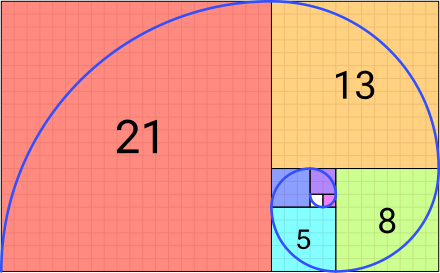
The Fibonacci sequence is perhaps the most famous sequence of all time. It is related to the Golden Ratio and the Golden Spiral: