Parametric circles
The standard equation of a circle of radius centered at the point :
This equation says that the distance from a point on the circle to the center point equals . This fact defines the circle.
Parametric coordinates for the circle:
For example, the unit circle is parametrized by and .
Parametric lines
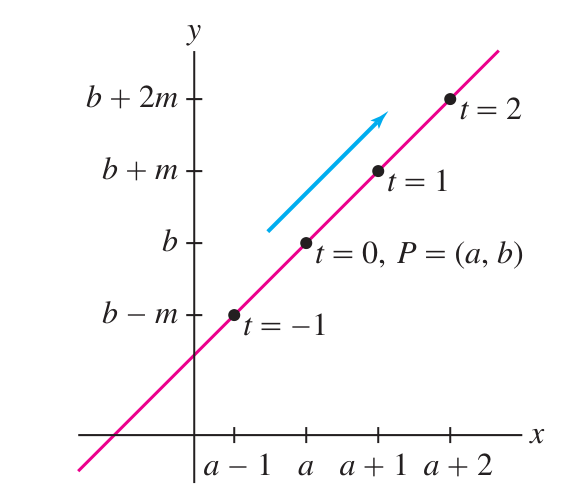
(1) Parametric coordinate functions for a line:
Compare this to the graph of linear function:
Vertical lines cannot be described as the graph of a function. We must use .
(2) Parametric lines can describe all lines equally well, including horizontal and vertical lines.
A vertical line is achieved by setting and .
A horizontal line is achieved by setting and .
A non-vertical line may be achieved by setting and , and .
(3) Assuming that , the parametric coordinate functions describe a line satisfying:
and therefore the slope is and the -intercept is .
(4) The point-slope construction of a line has a parametric analogue:
Parametric ellipses
The general equation of an ellipse centered at with half-axes and is:
This equation represents a stretched unit circle:
- by in the -axis
- by in the -axis
Parametric coordinate functions for the general ellipse:
Parametric cycloids
The cycloid is the curve traced by a pen attached to the rim of a wheel as it rolls.
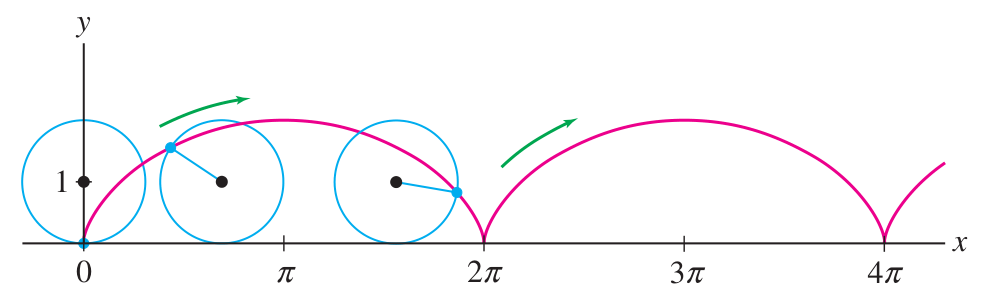
It is easy to describe the cycloid parametrically. Consider the geometry of the situation:
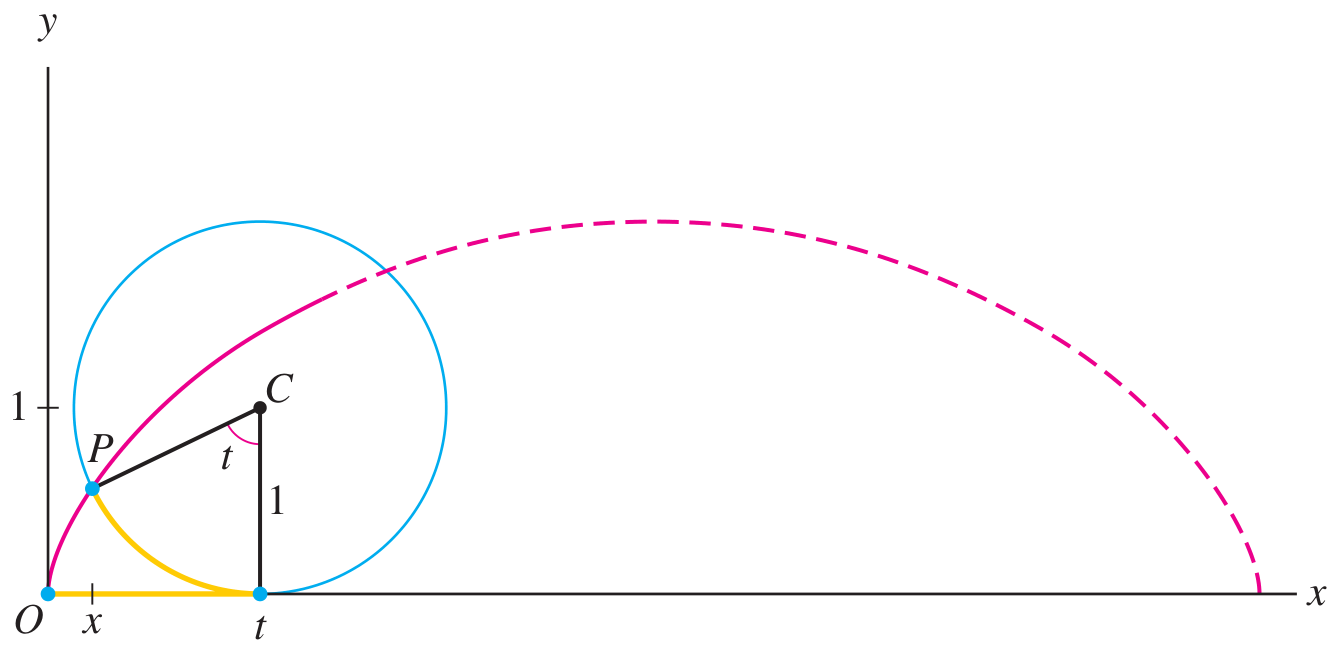
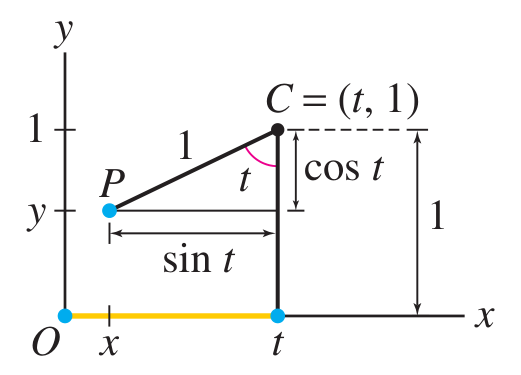
The center of the wheel is moving rightwards at a constant speed of , so its position is . The angle is revolving at the same constant rate of (in radians) because the radius is .
The triangle shown has base , so the coordinate is . The coordinate is .
So the coordinates of the point are given parametrically by:
If the circle has another radius, say , then the parametric formulas change to: