Finding vertical tangents to a limaçon
Let us find the vertical tangents to the limaçon (the cardioid) given by .
Solution
(1) Convert to Cartesian parametric using and :
(2) Compute and :
(3) The vertical tangents occur when . We must double check that at these points.
Substitute and observe quadratic:
Solve:
Then find :
(4) Compute the points. In polar coordinates:
In Cartesian coordinates:
At :
At :
At :
(5) Correction: is a cusp!
The point at is on the cardioid, but the curve is not smooth there, this is a cusp.
Still, the left- and right-sided tangents exists and are equal, so in a certain sense we could say the curve has vertical tangent at .
Length of the inner loop
Consider the limaçon given by .
How long is the inner loop? Set up an integral for this quantity.
Solution
The inner loop is traced by the moving point when . This can be seen from the graph:
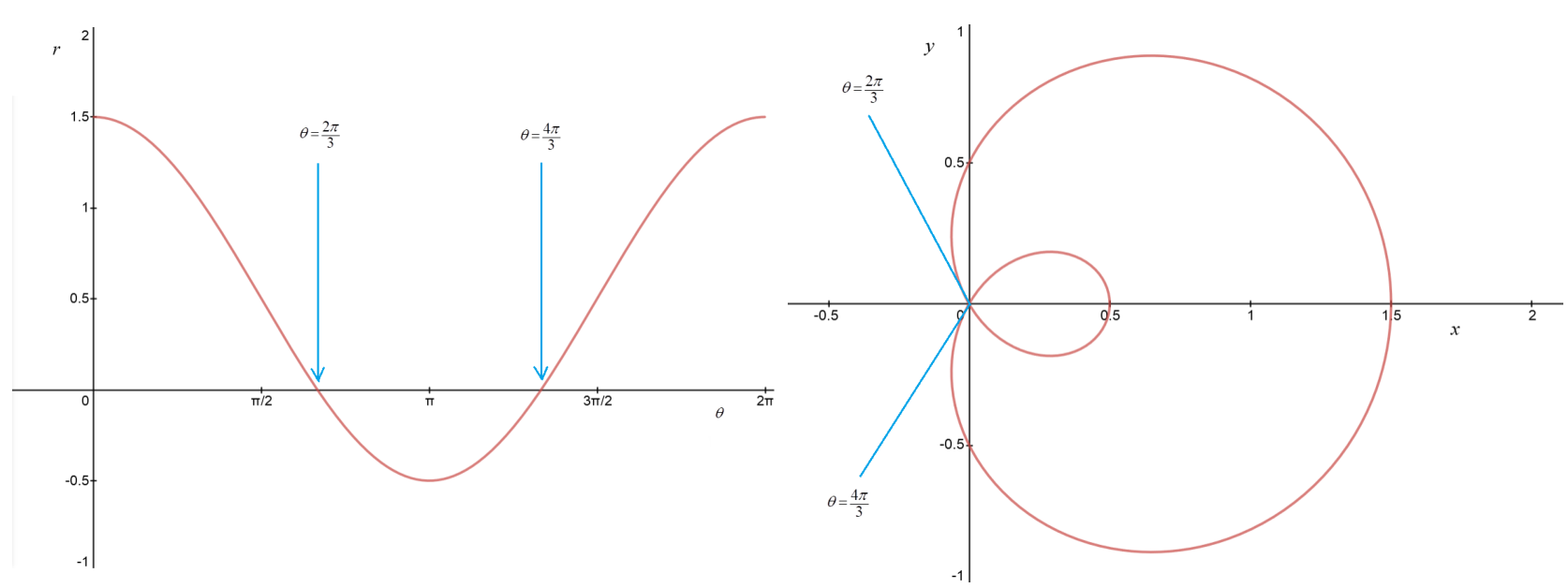
Therefore the length of the inner loop is given by this integral:
Area between circle and limaçon
Find the area of the region enclosed between the circle and the limaçon .
Solution
First draw the region:
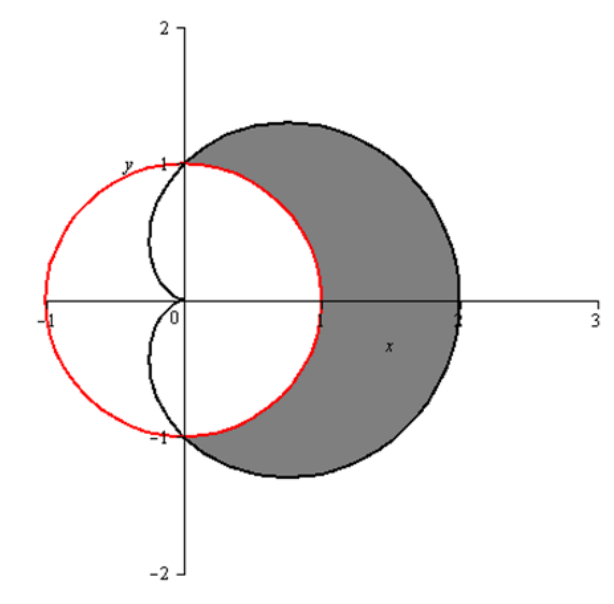
The two curves intersect at . Therefore the area enclosed is given by integrating over :
Area of small loops
Consider the following polar graph of :
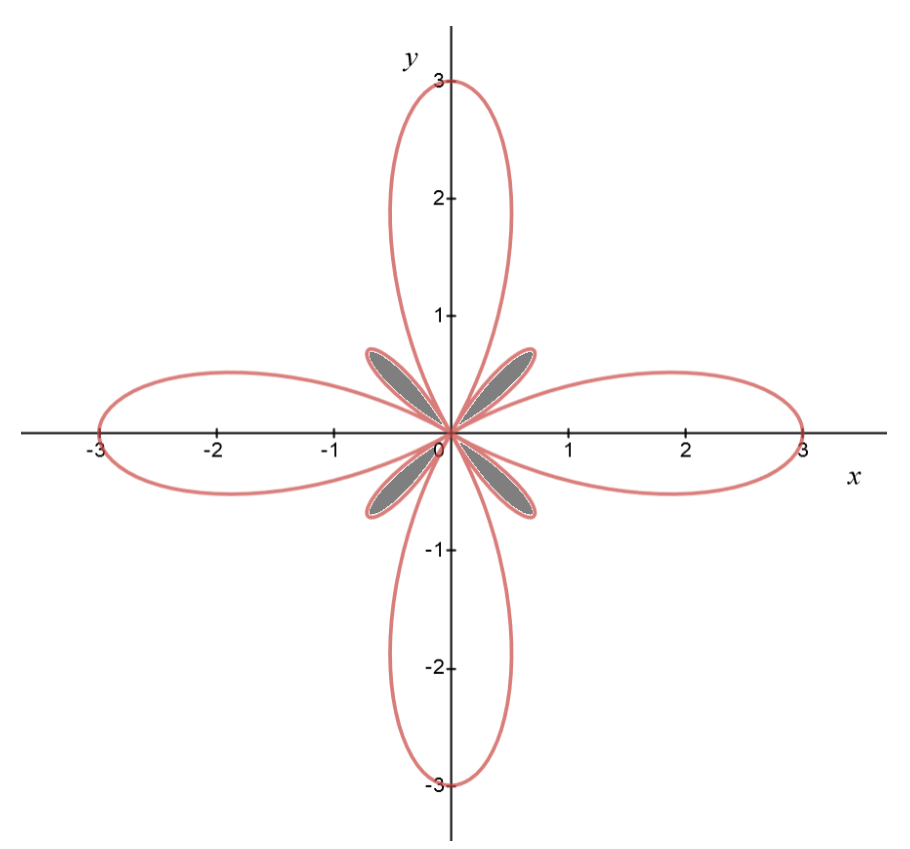
Find the area of the shaded region.
Solution
Find bounds for one small loop. Lower left loop occurs first. This loop is when .
Now set up area integral:
Power-to-frequency conversion: with :
Overlap area of circles
Compute the area of the overlap between crossing circles. For concreteness, suppose one of the circles is given by and the other is given by .
Solution
Drawing of the overlap:
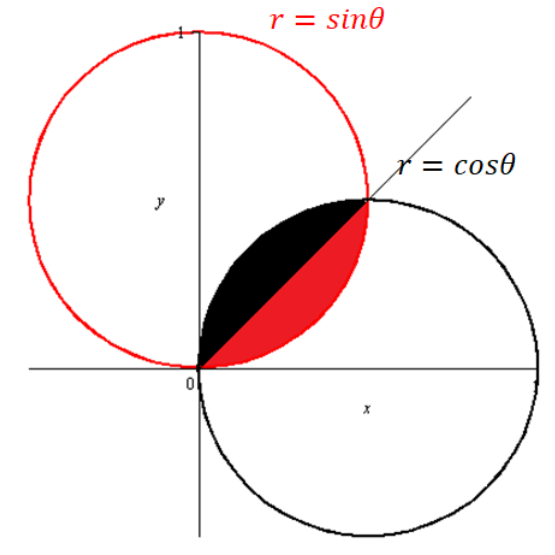
Notice: total overlap area = area of red region. Bounds for red region: .
Area formula applied to :
Power-to-frequency: :