01
Polar curve - Vertical or horizontal tangent lines
Find all points on the given curve where the tangent line is horizontal or vertical.
Hint: First determine parametric Cartesian coordinate functions using
as the parameter.
Solution
03
Observe that this parametric curve is a circle centered at
with radius . So we expect vertical tangents at and horizontal tangents at . Treat
as the parameter. We always have . This equals here because . Since we can further simplify to . Then
. Also
.
To find vertical tangents, solve for
: Check that
is not also zero at these points, else they would be stationary points: Now find the Cartesian coordinates for these points:
To find the horizontal tangents, solve for
: Check that
is not also zero at these points, else they would be stationary points: Now find the Cartesian coordinates for these points:
Link to original
02
Arclength of one loop of a rose
Consider the graph of the polar curve
. Set up an integral which computes the arclength of one loop of this curve.
Solution
06
Solve for consecutive (in
) solutions to to get the starting and ending for a single loop: Integrate:
Link to original
03
Polar curve - Slope of tangent line
Find the slope of the tangent line to the given polar curve:
Hint: First determine parametric Cartesian coordinate functions using
as the parameter.
Solution
03
First convert this polar curve to a parametric curve using
and : Then use
. Differentiate: Therefore:
Link to original
04
Polar coordinates - lunar areas
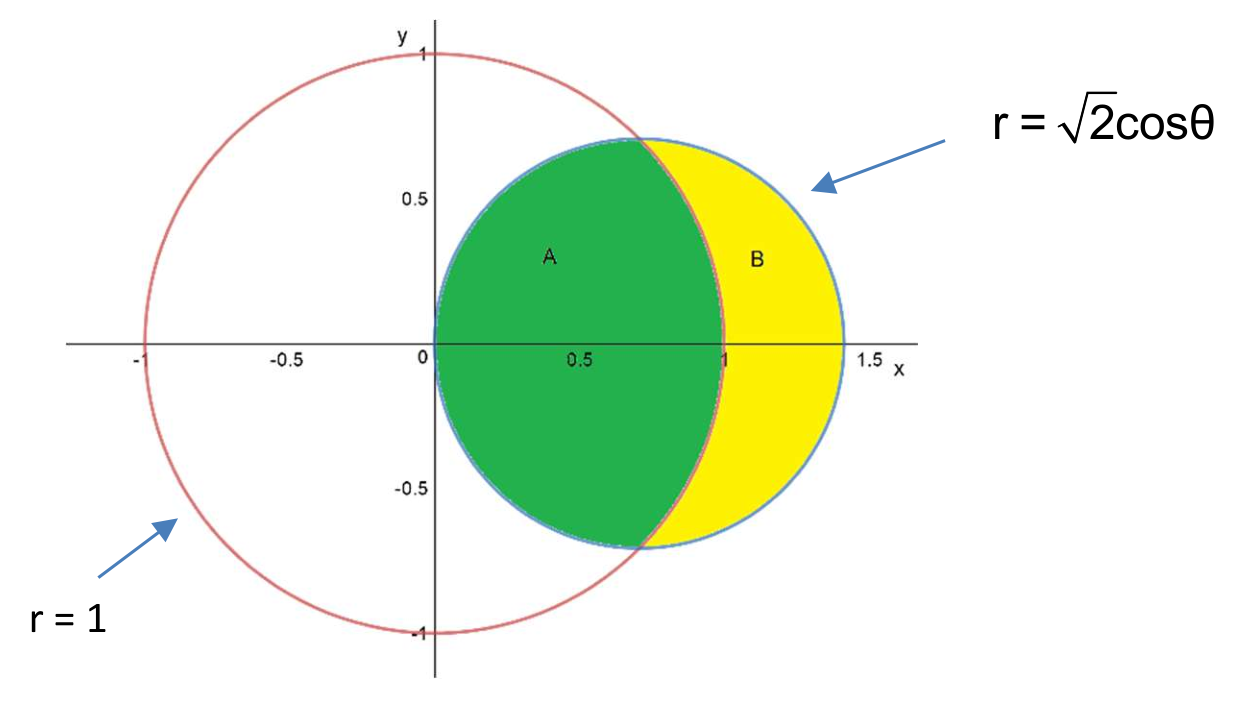
(a) Find the area of the green region.
(b) Find the area of the yellow region.
(You can find these in either order.)
Solution
04
(a) Find the angle of the line from the origin to the point of intersection of the two curves (in Quadrant I):
Compute the area below this line, inside the larger circle, and above the
-axis: (This circular sector is also just
of the whole disk area, which is .) Compute the area above the line and inside the smaller circle:
Combined area in green above the
-axis is . Double this for the total green area:
(b) Notice that green and yellow combine to give the area of the smaller circle. The area of the smaller circle is
. Therefore, the yellow region has area:
Note: It is also reasonable to find the yellow region first, using this formula:
Link to original
05
Pickup region of a microphone - limaçon area
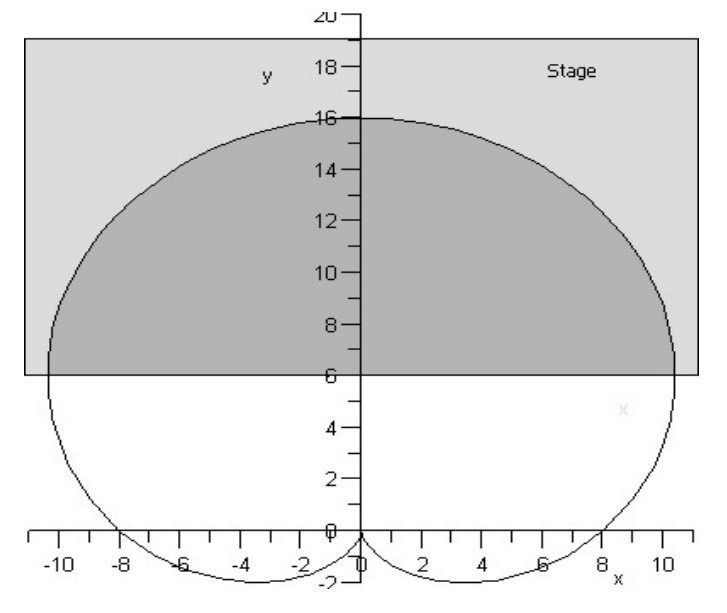
The pickup region of a microphone is described by a limaçon with equation
, and part of the region is on a stage. Find the area of the part of the region on the stage.
Solution
05
Find the intersection between the line
and the curve, in Quadrant I: Of course
, so we have and (in Quadrant I) therefore . To get the answer, we double the area from this angle up to the vertical : Link to original
06
Area of an inner loop
A limaçon is given as the graph of the polar curve
. Find the area of the inner loop of this limaçon.
Solution
07
Solve for consecutive (in
) solutions to to get the starting and ending for a single loop: The interval
corresponds to the inner loop. To see this, draw a graph of the limaçon: Link to original

