Theory 1
Polar arclength formula
The arclength of the polar graph of , for :
To derive this formula, convert to Cartesian with parameter :
From here you can apply the familiar arclength formula with in the place of .
Extra - Derivation of polar arclength formula
Let and convert to parametric Cartesian, so:
Then:
Therefore:
Therefore:
Theory 2
Sectorial area from polar curve
The “area under the curve” concept for graphs of functions in Cartesian coordinates translates to a “sectorial area” concept for polar graphs. To compute this area using an integral, we divide the region into Riemann sums of small sector slices.
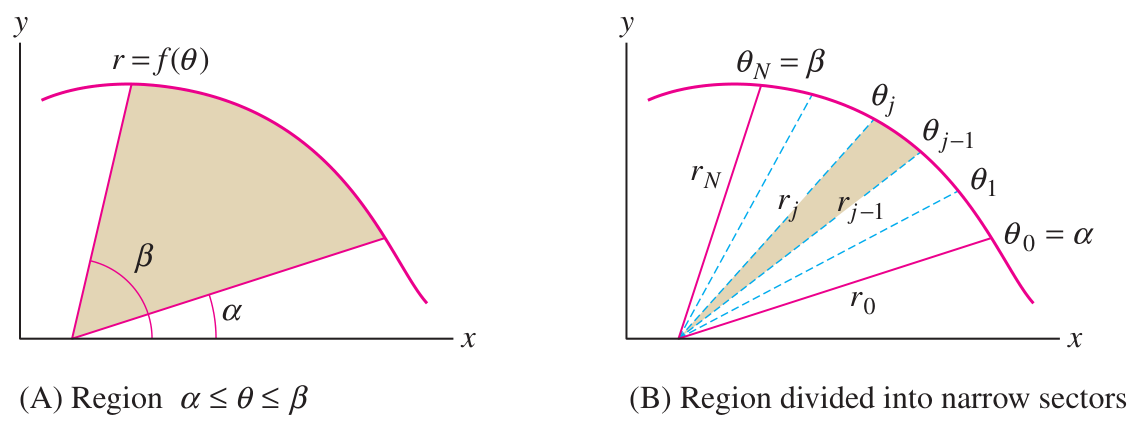
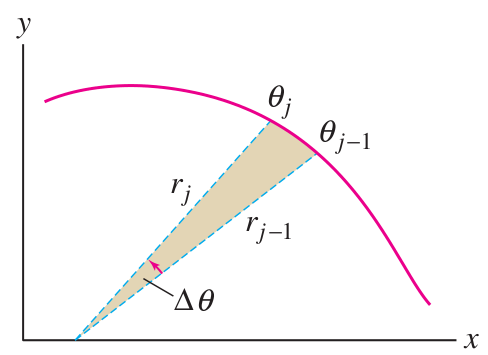
To obtain a formula for the whole area, we need a formula for the area of each sector slice.
Area of sector slice
Let us verify that the area of a sector slice is .
Take the angle in radians and divide by to get the fraction of the whole disk.
Then multiply this fraction by (whole disk area) to get the area of the sector slice.
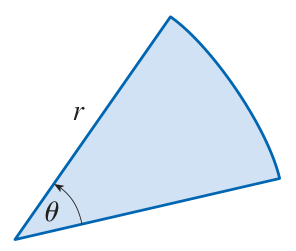
Now use and for an infinitesimal sector slice, and integrate these to get the total area formula:
One easily verifies this formula for a circle.
Let be a constant. Then:
The sectorial area between curves:
Sectorial area between polar curves
Subtract after squaring, not before!
This aspect is not similar to the Cartesian version: