Joint and marginal PMFs - Smaller and bigger roll
Roll two dice, and let indicate the smaller of the numbers rolled, and let indicate the bigger number.
Make a chart showing the PMF. Compute the marginal probabilities, and write them in the margins of the chart.
Solution
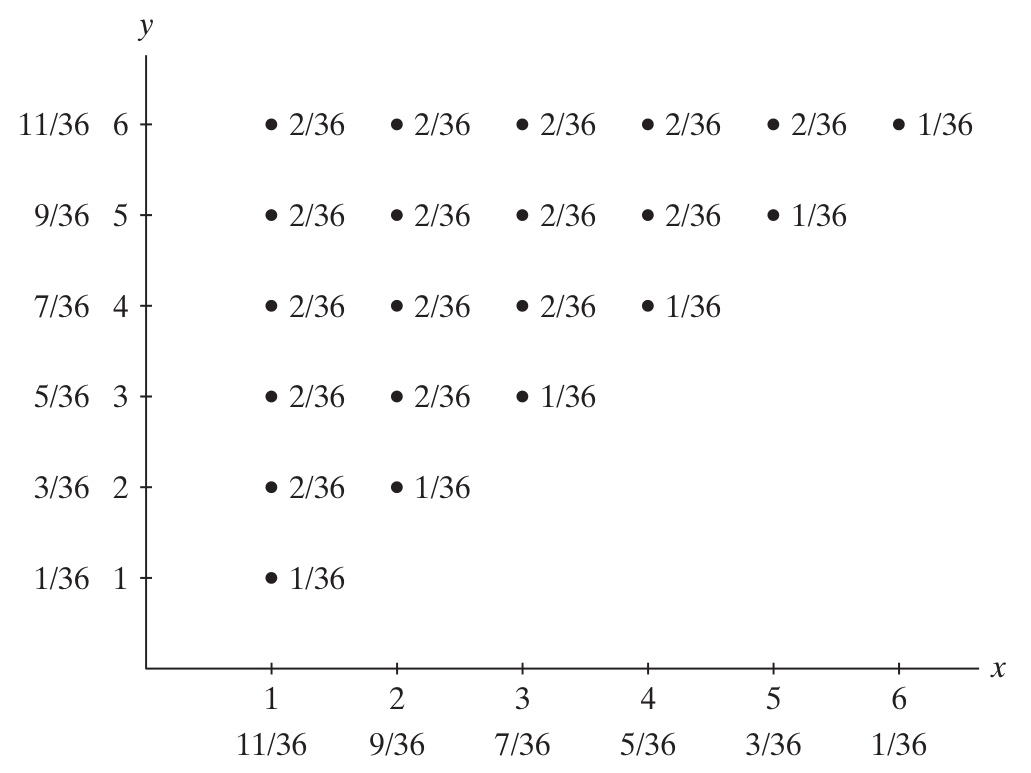
Event probabilities by reading PMF table
Here is a joint PMF table:
Using the table, compute the following event probabilities:
(a) (b) (c) (d)
Joint and marginal PMFs - Coin flipping
Flip a fair coin four times. Let measure the number of heads in the first two flips, and let measure the total number of heads.
Make a chart showing the PMF. Compute the marginal probabilities, and write them in the margins of the chart.
Marginal and event probability from joint density
Suppose the joint density of and is given by:
Find (a) and (b) .
Solution
(a)
When , the range is to :
When , the range is to :
Therefore:
(b)
Find probability of the event :
Marginals from joint density
The joint PDF for and is given by:
Find and .
Event probability from joint density
The joint PDF for and is given by:
Compute .
Properties of joint CDFs
(a) Show with a drawing that if both and , we know:
(b) Explain why:
(c) Explain why: