Sum of parabolic random variables
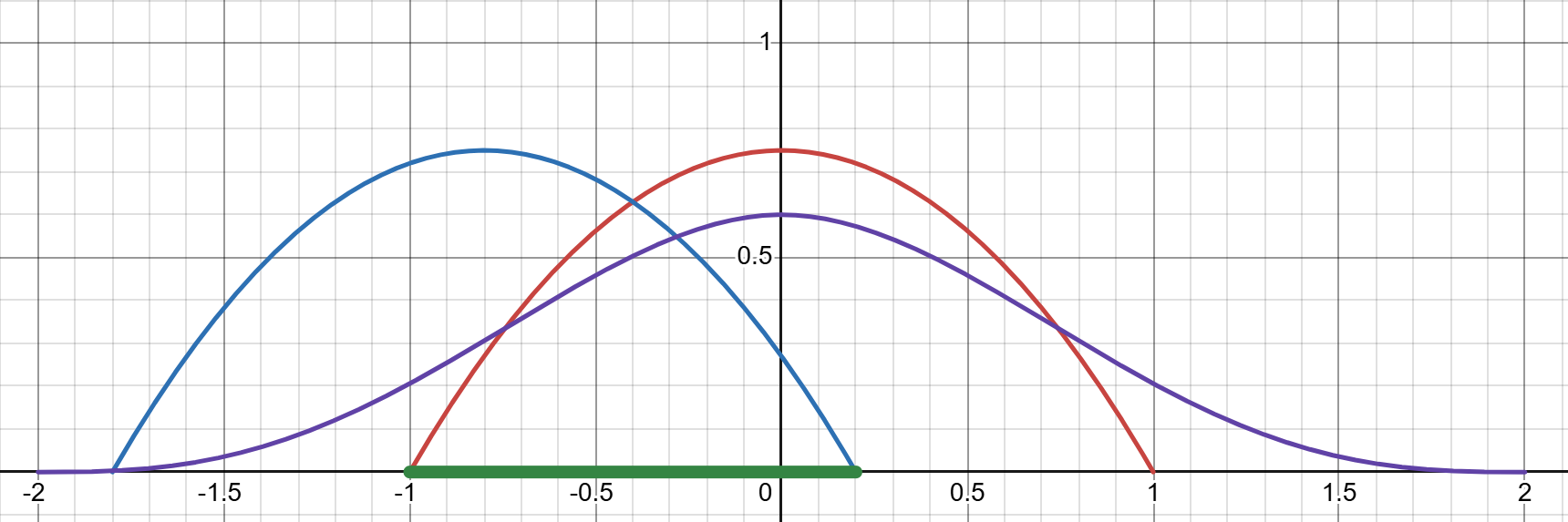
Suppose is an RV with PDF given by:
Let be an independent copy of . So , but is independent of .
Find the PDF of .
Solution
The graph of matches the graph of except (i) flipped in a vertical mirror, (ii) shifted by to the left.
When , the integrand is nonzero only for :
When , the integrand is nonzero only for :
Final result is:
Discrete PMF formula for a sum
Verify the discrete formula for the PMF of a sum. (Apply the general formula for the PMF of .)
Vandermonde’s identity from the binomial sum rule
Show that this “Vandermonde identity” holds for positive integers :
Hint: The binomial sum rule is:
Set . Compute the PMF of the left side using convolution. Compute the PMF of the right side directly. Set these PMFs equal.
PDF of sums practice
Suppose is an RV with density:
Suppose is uniform on and independent of .
Find the PDF of . Sketch the graph of this PDF.
Solution
(1) Write the CDF of as a double integral:
The joint density on the unit square is:
There is positive density in the region only for (otherwise ).
- When , there is positive density in the region (only) when .
- When , there is positive density in the region whenever .
(2) Evaluate for :
Here and , so .
Differentiate:
(3) Evaluate for :
Now ranges over . Split by whether the -bound is or :
- : , so
- : , so
(4) Differentiate for the final PDF:
Therefore:
Convolution practice
Suppose is an RV with density:
Suppose is uniform on and independent of .
Find the PDF of . Sketch the graph of this PDF.
Solution
(1) Set up the convolution integral:
Since on , this reduces to . The integrand is nonzero when , i.e. . Intersecting with gives the limits of integration.
(2) Evaluate for :
Integration region: .
(3) Evaluate for :
Integration region: .
(4) Write the final piecewise PDF:
Exp plus Exp equals Erlang - Without Convolution
Let us verify this formula by direct calculation:
Solution
Let be independent RVs, and let .
Therefore:
(1) Write the CDF as a double integral over the region :
For , the region is , .
(2) Evaluate the inner integral:
(3) Evaluate the outer integral:
(4) Differentiate for the PDF:
This is the density function:
Exp plus Exp equals Erlang - With Convolution
Let us verify this formula by direct calculation:
Solution
Let be independent RVs.
Therefore:
Now compute the convolution, assuming :
This is the Erlang PDF:
Combining normals
Suppose , . Find the probability that .
Solution
Define . Using the formulas above, we see , or for a standard normal . Then: