Parametric curves in 2D
Parametric curve
A parametric curve or parameterized curve in the plane is a function from an interval to the plane, given with coordinate functions by .
The data of a parametric curve includes the parametrization, not just the set of points in the image.
Example
The parametric curve determines a line in . Solve for in terms of :
The slope is and the -intercept is .
Observe that by setting , the image is a vertical line in intersecting the -axis at .
Warning!
The image of is the same vertical line!
Warning!
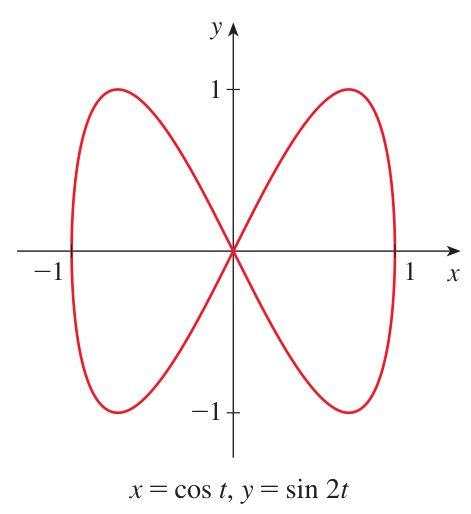
This “Lissajous figure” shows that parametric curves can intersect themselves!
Example
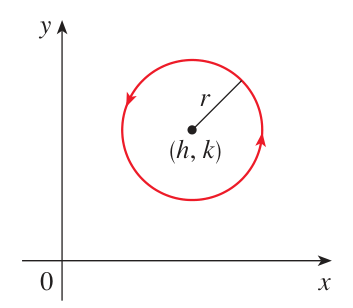
Circle, radius , center
Example
Example
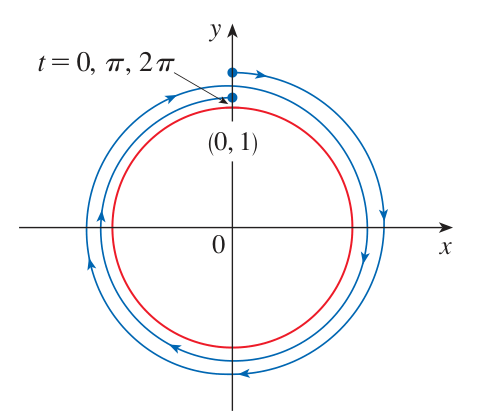
The image curve satisfies .
Warning!
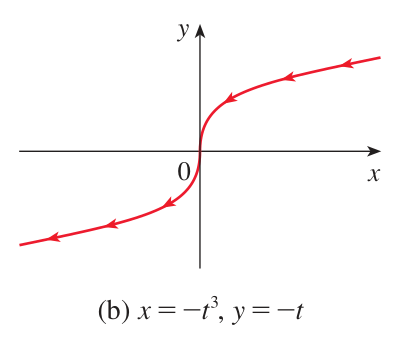
In the upper quadrant, this curve has the same image: Check:
Exercise 02A-01
Sketch the curve given by .
Exercise 02A-02
Describe the parametric curve as the graph of a function.
Exercise 02A-03
Consider the curve . Find the point on this curve with largest -value.
Exercise 02A-04
[Already done in class.] Points satisfying lie on an ellipse. Find a parametric curve that covers this ellipse.
Exercise 02A-05
Find a parametric curve that is a line passing through with slope .
Exercise 02A-06
Eliminate to find an equation satisfied by alone for the following two parametric curves: a. b.
Exercise 02A-07
Describe the image of the curve parametrized by .
Exercise 02A-08
One particle has position , a second particle has position . Calculate the two points of intersection of the image curves determined by these formulas. Do the particles collide at those intersection points?
Calculus with parametric curves in 2D
Traditional derivatives (unnatural)
Example
Find a general formula for the slope of the tangent line to a parametric curve at the point determined by . Solution: Consider as a function of . Remember the formula when so . (Think about implicit differentiation.) Then using the Chain Rule and this formula, we have:
so the answer is .
Warning!
This quantity is unnatural!
- From the point of view of graphs of functions, is natural and important. For a graph, space portrays the relation between input and output.
- From the point of view of parametric curves, it is unnatural. Here and should be treated on the same footing. Space portrays the output only.
Soon we consider more natural derivative operations in the parametric setting.
Warning!
Example
A cycloid is given by the parametric curve with formula . Find the tangent line to this cycloid at . Solution: Using the formula for , obtain:
Then we have:
The image point when is . After solving for the -intercept we obtain the final equation:
Exercise 02B-01
Find the equation of the tangent line to the parametric curve at the point given by . Where is the tangent line horizontal?
Distance traveled
The distance traveled by a particle whose position is given parametrically by , as increases from to , is computed using this integral:
The formula is quickly derived from the usual one for arc length of the graph of a function:
by using the formula for together with the fact that .
It is better to see the formula as the summation of infinitesimal elements of distance , computing these with the Pythagorean Theorem:
so the formula is really just:
Exercise 02B-02
Find an integral formula for the length of the circumference of a general ellipse (centered at the origin). (Do not try to evaluate the integral!)
Length function
Given a parametric curve , the formula for distance traveled can be used to define a length function . It is simply the distance traveled from to the time itself. To write this we need a new dummy variable:
Speed
The speed is the rate of distance traveled per unit time: . From the Fundamental Theorem of Calculus, we have:
Exercise 02B-03
Suppose a particle traces the graph of a parabola with its position given parametrically by . How fast is the particle moving at time ? What is its acceleration at ?
Curvature
The curvature of a parametric curve in the plane may be defined as the rate of change of the angle of inclination per unit of arc length.
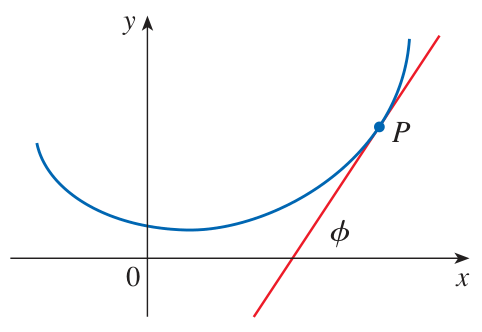
We can find a formula for this. Let the curve be given by . Clearly so . Using the quotient rule we have:
Then
Exercise 02B-04
Compute the curvature function for the circle given parametrically by . Is the answer what you should have expected?
Polar coordinates
The polar coordinate system uses parameters instead of to identify points in the plane. These coordinates are useful in problems having rotational symmetry. The two coordinate systems are related by these equations:
Example
The points whose polar coordinates satisfy define a circle:
 We can verify this by converting to Cartesian coordinates:
so
Exercise 02B-05
Find the polar form of the equation of a vertical line passing through .
Area under polar graphs
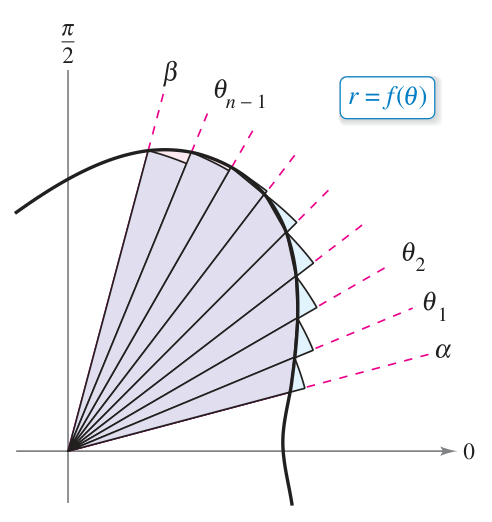
There is a formula to compute the area of the “sector sum” formed by a polar graph.
The area of a sector is , so the area of an infinitesimal sector is , and the formula just sums these.
Example
Find the area of one loop of the four-leafed rose .
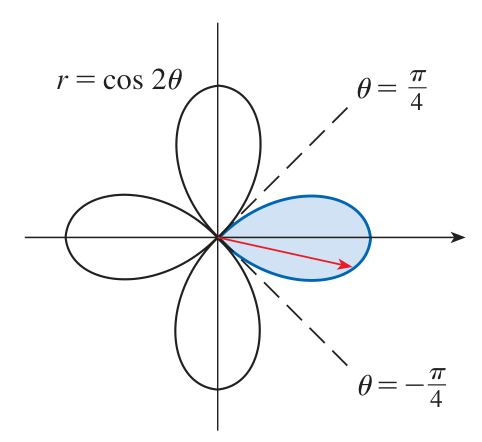 Solution: Plug into the formula, and use , obtaining:
Exercise 02B-06
Find the area inside the region bounded by .
Problems due 02 Sep 2023, 8:00pm
Problem 02-01
Find the self-intersection point of the curve parametrized by .
Problem 02-02
For a given parametric curve , there is a formula for the second derivative:
Show how to derive this formula. Verify the formula for the parametric curve using the fact that this curve is the graph of a function. (You know how to find for graphs of functions.) Now compute for the parametric curve , which has the same image.
Problem 02-03
Draw the graph of the limaçon given in polar coordinates by . Find the area of the region lying between its two loops.
Problem 02-04
Do all 5 parts of the “Discovery Project” about Bézier Curves (p. 684 of 9e, 697-8 of 8e, 677-78 of 7e).