Iterated integrals
Rectangular domains
Suppose we are given a function , written in terms of components by for each . Now let the second coordinate remain some arbitrary fixed value . This determines a function of one variable, , for each possible chosen .
We can integrate in just as any other function of :
The resulting quantity depends on the chosen , so we call it a function of , and it also depends on the chosen interval .
Now we can let vary again, and integrate the function :
It is reasonable to notate the composite process with two integration symbols:
There is no reason we couldn’t integrate first, and this raises an obvious question that is answered by Fubini’s Theorem:
Fubini’s Theorem
Provided is continuous on , the order of integration doesn’t affect the result:
Example
Double integral calculation
Problem: Compute .
Solution: Compute the inner integral first, treating as a constant:
Exercise 08B-01
Reversing integration order
Check that Fubini’s Theorem holds: evaluate .
Non-rectangular domains
Notice that the first integral places constants and as limits of integration, but is also considered a constant with regard to integration by . So, we can allow the limits to depend upon in a non-trivial fashion: we can let them be functions of the chosen and write: , .
Now let us incorporate these functions in the double integral notation. Instead of using the symbol , we can write , remembering that in the first integral is treated as a constant, on a par with and :
Example
Iterated integral, parabolic boundary
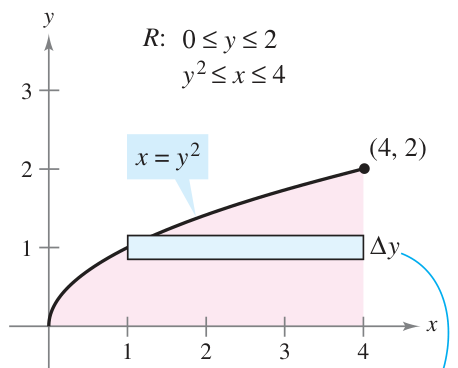
Problem: Let and , , and . Compute:
Solution: We have:
Exercise 08B-02
Iterated integral practice
Evaluate the iterated integrals:
- (a)
- (b)
- (c)
- (d) Extending to 3D:
Volume under a surface
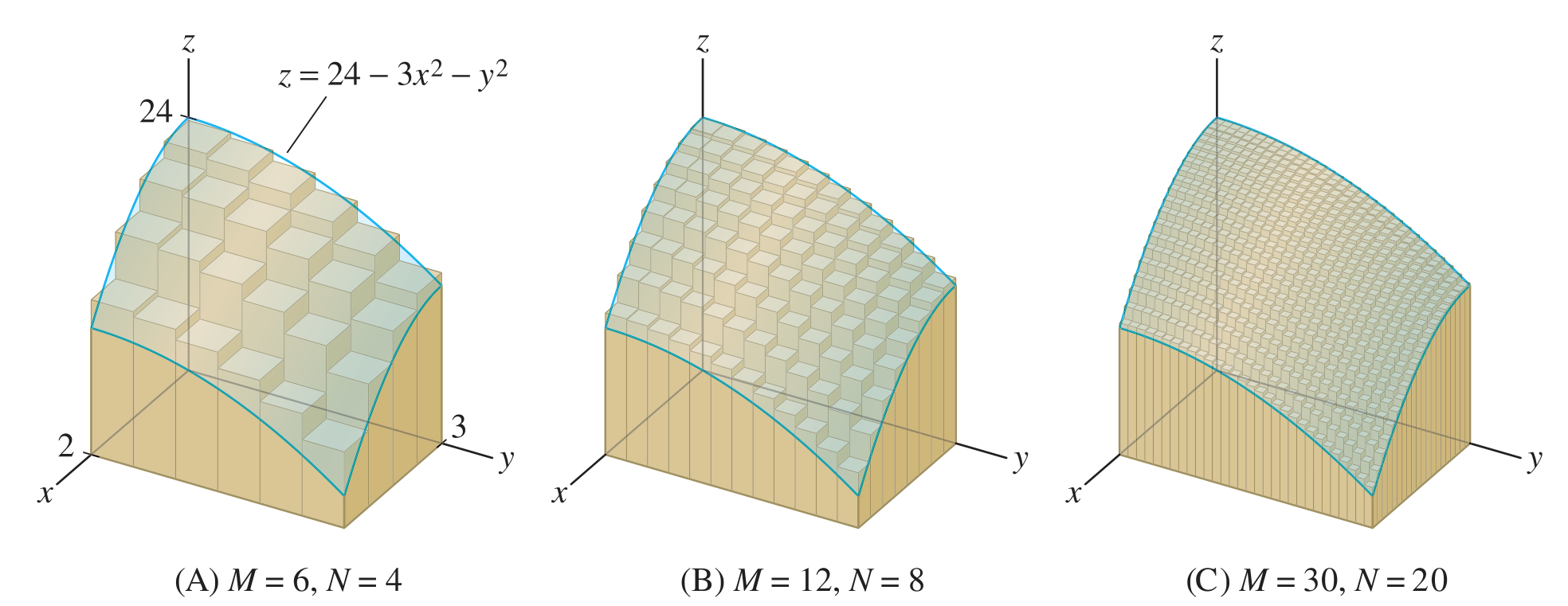
Consider the iterated integral , and the picture:
The inner integral produces a function . Given a value of , this function returns the integral over the line segment given by with and set to the given value.
Imagine we set , in this case . Then the inner integral provides the area under the curve over this line segment.
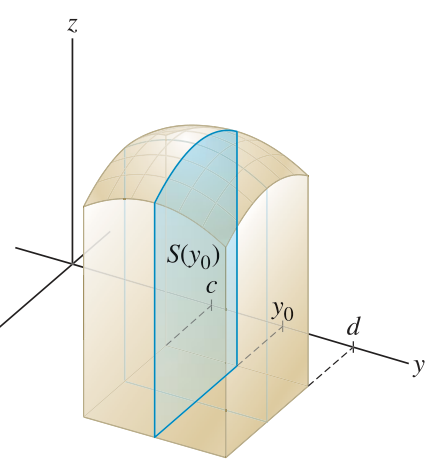 Computing the outer integral then gives the volume of the region between the bounds , , and . It does so by computing the area of the vertical slices as a function of , and then integrating this area as varies over its own domain .
Example
Iterated integral and volume
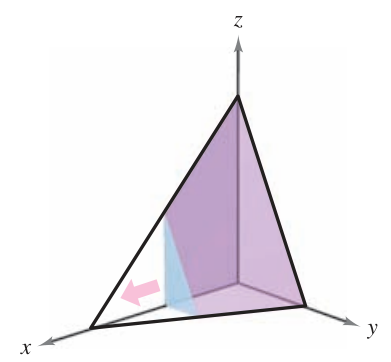
Consider the function , and let describe a plane. Problem: Find the volume of the region under in the first octant ().
Solution: The region is bounded in the -plane by the axes and the line , since there. So, compute the integral:
The meaning of the two integration steps can be explained by writing the inner integral as the area of a cross section:
The outer integral then sums these areas multiplied by infinitesimal thicknesses : .
Exercise 08B-03
Volume of a solid
Find the volume of the region under for and .
Order of integration
When the inner bounds of integration are functions, in order to change the order of integration we must consider the region over which the integral is taken, and define new functions for the new inner bounds.
Example
Bounds for a triangular region
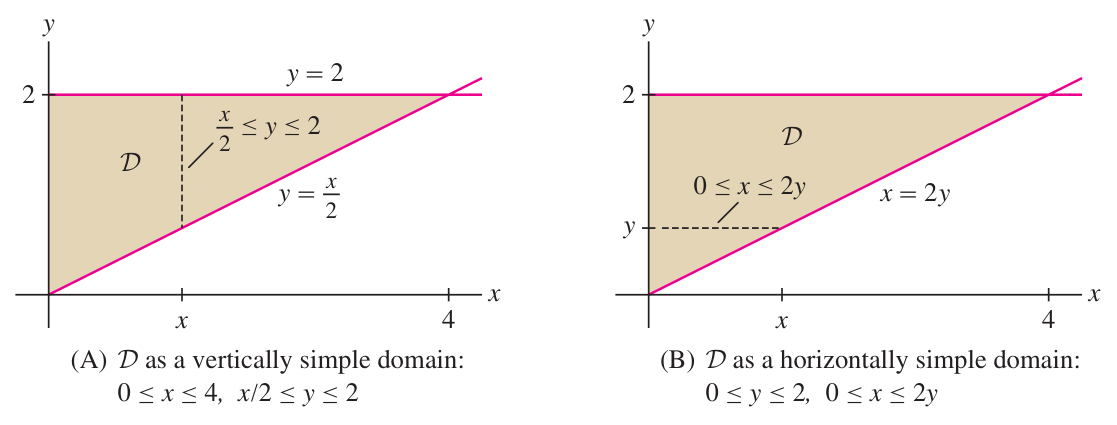
Problem: Write two different integration bounds for the region in the figure:
Solution: On the left, we can use . On the right, use .
Example
Changed order of integration, new boundary functions
Problem: Find new bounds to change the order of integration in the following double integral:
Solution: The region can be interpreted as the portion under the top of a parabola , facing down, maximum at in the -plane. To integrate first we take the range and then . Thus:
Exercise 08B-04
Change order of integration
Change the order of integration in the following double integral:
(Hint: first sketch the region in question.)
Integration over measures of area and volume
Another perspective on integration extends the concept of the “unit of length” to units of another measure. In calculus, one considers the “unit of area” such as the infinitesimal square or the “unit of volume” such as the infinitesimal cube .
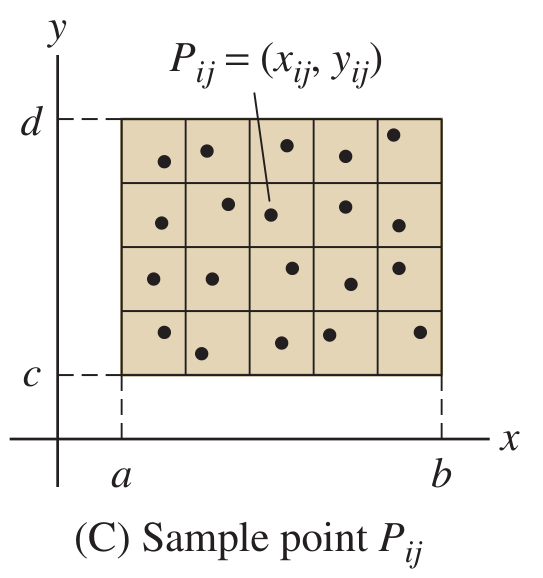
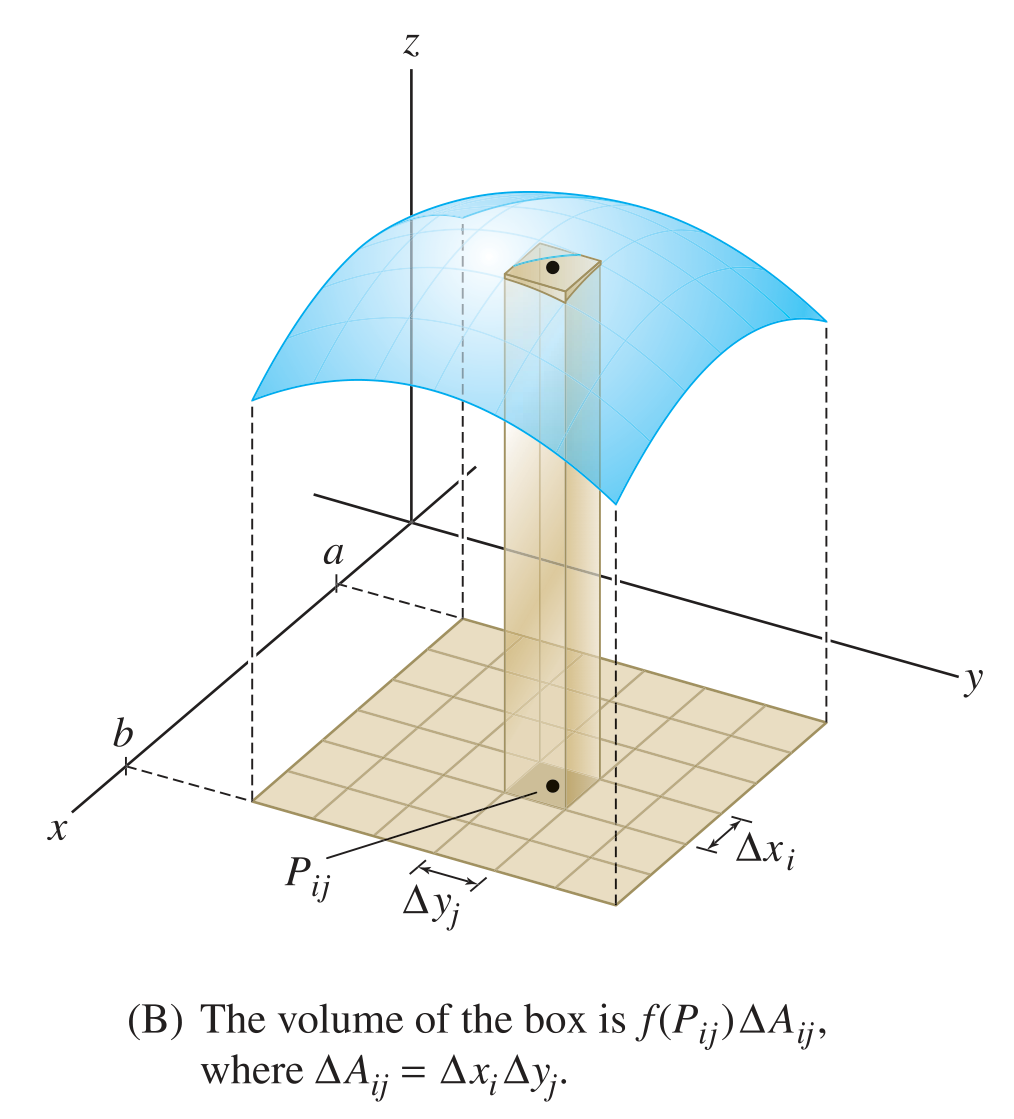
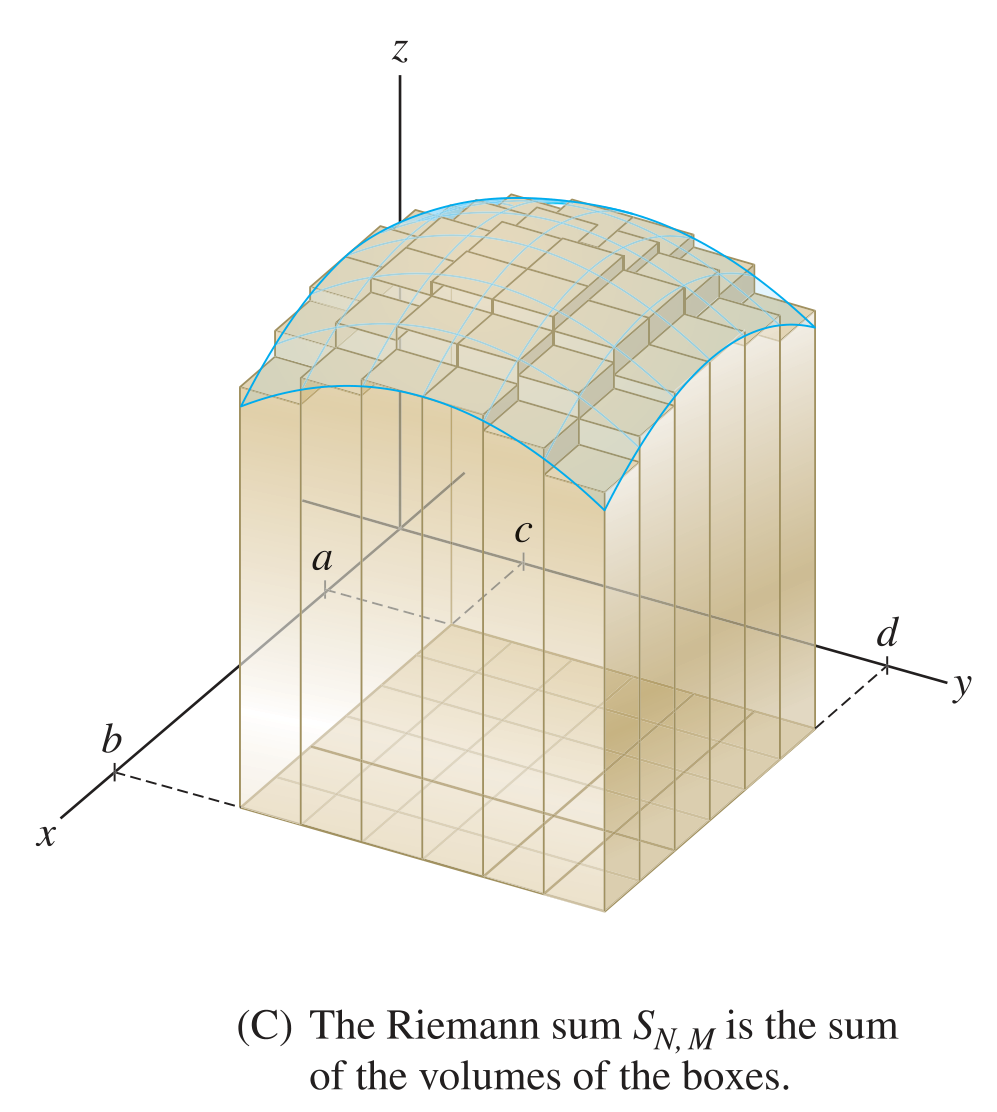
From this point of view, the double integral is the integral of the function over the rectangular box , summing the infinitesimal quantities of area times height, . This sum can be written as the limit of a Riemann sum:
where is the box , and is a point that lives somewhere in the square inside a grid over .
In line with this perspective on integration, sometimes the unit of area is written suggestively as with for “area”, and similarly can be written with for “volume”.
Example
Integration over measure of area
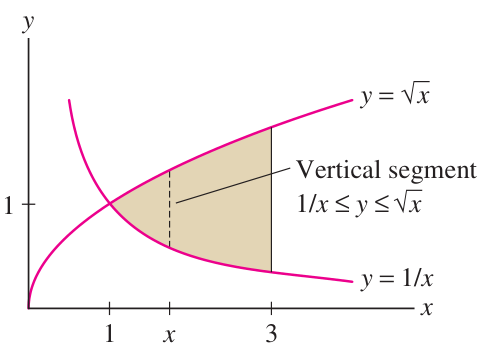
Problem: Compute the integral where is the region in the figure:
Solution: We rewrite the integral as an iterated integral and then compute. The region can be written as and . So we have:
Area of a region
By integrating the function over a region, we obtain the area of the region:
Example
Area under curve as double integral
Problem: Find the area under the curve for using a double integral.
Solution: Compute:
Note that this agrees with the usual method: .
Double integration in polar coordinates
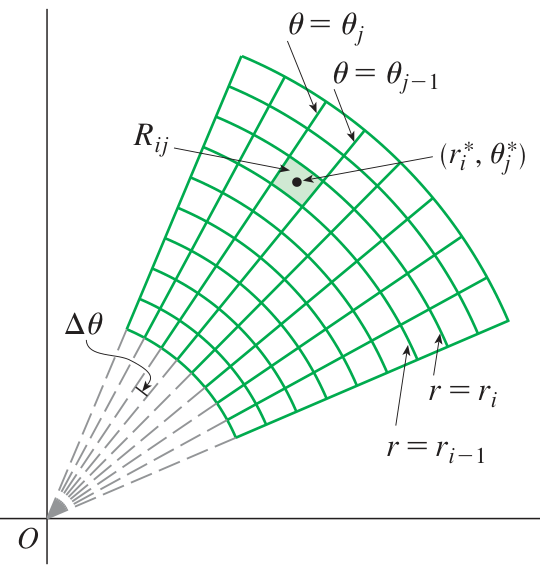
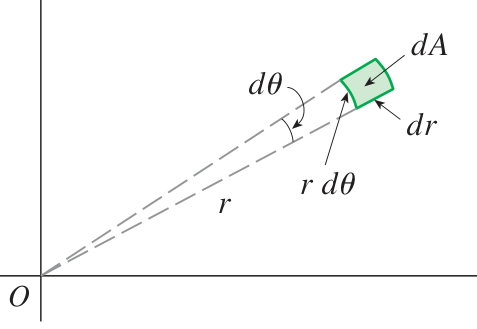
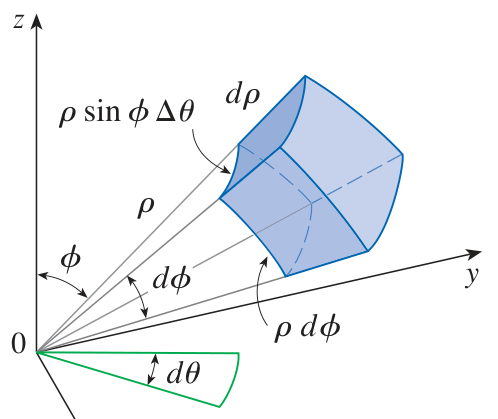
Iterated integrals are defined in other coordinate systems in exactly the same manner. However, they do not give the expected geometric quantity unless extra factors are added to create an infinitesimal unit of area. For polar coordinates, the unit of area is . For spherical coordinates, the unit of volume is .
Example
Double integral in polar
Problem: Compute for the region with that lies between the circles of radii 1 and 2.
Solution: We convert the integral into polar coordinates using . Obtain:
Area measure requires correction factors
What happens if we neglect the factor ‘’ in and simply compute ? We can still perform this iterated integral. But the resulting quantity corresponds to the integral of the function over the box , as if and were Cartesian coordinates.
Exercise 08B-05
Deriving polar area formula
Use the formula for infinitesimal area in polar double integrals to derive the formula for the area enclosed under the loop of a polar graph .
Applications of multiple integrals
Density and total quantity
When the function of several variables is a density or , then the integral gives the total quantity:
If measures the ordinary density, then the integral gives total mass. If measures a charge density, then the integral gives total charge. If measures the probability density, then the integral gives total probability.
Average value
The average value of a distributed quantity is the total amount of that quantity divided by the total measure of the region over which it is spread.
When is defined on a region , then the average value of over that region is given by:
where . Similarly, if is defined on a region , then the average value of over that region is given by:
where .
Center of mass
The center of mass of a planar region or a solid body is the average position of an element of material in the region or body. If the density of the body varies, it is the average position weighted by the density.
Position in a planar region is given by the vector . Let be the area of a planar region . Since integration is linear and respects vector components, we can compute the average position componentwise:
(and analogously for the of a solid body, using three components). If there is a varying density, then we need the average weighted by density:
where is now the mass, which will not be proportional to area (or volume) if the density is not uniform.
Moments
Given a quantity that depends on points in space, the higher moments of this quantity are given by the integral of the powers of the quantity over the region. These moments are often computed for the case where returns one of the coordinates, or a radius. For example, when then the first moment is the -coordinate of the center of mass.
An important moment in physics is the moment of inertia, which is the second moment of the distance to the axis of rotation:
where gives the distance from to the line that forms the axis of rotation.
Problems due 14 Oct 2023, 8:00pm
Problem 08-01
Volumes of solids
For each of the following regions, write and compute a double integral to find its volume.
- (a) Region bounded by , , , , , .
- (b) Region bounded by . (You will need to add two double integrals.)
- (c) Region bounded by , , , , .
- (d) Region under and above . (Hint: use a substitution and the Wallis Formula: .)
Problem 08-02
Order of integration
For each of the following, set up two iterated integrals, one for each order of integration. One of them is easier to evaluate. Explain why it is, then evaluate it.
- (a) where is the region bounded by and .
- (b) where is the region bounded by , , .
- (c) where is the region bounded by , , , .
- (d) where is the region bounded by , , .
Problem 08-03
Polar double integrals
Integrate over using polar coordinates:
- (a) where is the region with .
- (b) where is the region with and .
- (c) where is the region with and .
Sketch the region, change the integral to polar coordinates, and evaluate:
- (d) .
- (e) .
Problem 08-04
Center of mass, moment of inertia
Consider the region of the -plane that is bounded above by and bounded below by the -axis. Suppose the mass density is . Find:
- (a) the center of mass of this region,
- (b) the moment of inertia of this region, supposing it is rotated about the -axis.
Problem 08-05
Additional writing for solo-study
Write and submit solutions to Exercises 08B-01, -03, -04, -05.