Volume using cylindrical shells
Videos
Review Videos
Review
- Volume using cross-sectional area
- Disk/washer method - 01
- Disk/washer method - 02
- Disk/washer method - 03
Shells
Link to original
01 Theory
Theory 1
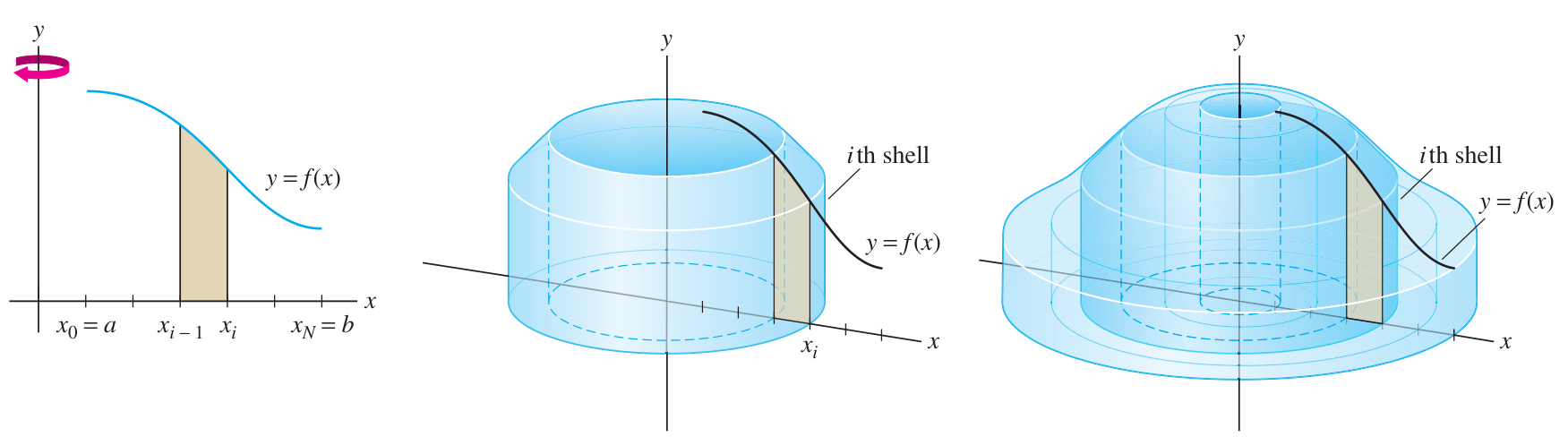
Take a graph in the first quadrant of the -plane. Rotate this about the -axis. The resulting 3D body is symmetric around the axis. We can find the volume of this body by using an integral to add up the volumes of infinitesimal shells, where each shell is a thin cylinder.
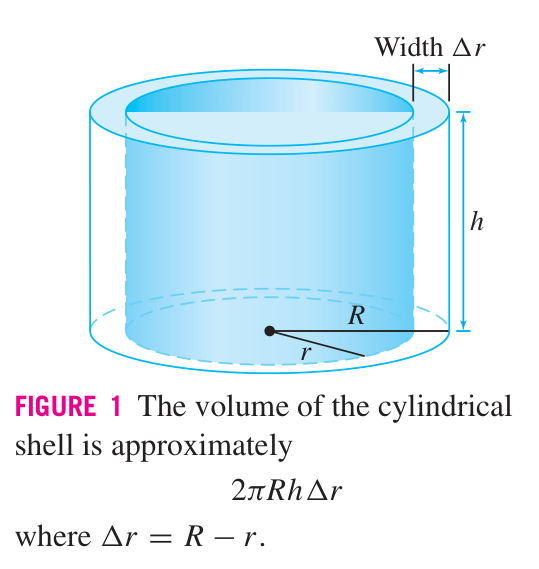
The volume of each cylindrical shell is :
In the limit as and the number of shells becomes infinite, their total volume is given by an integral.
Volume by shells - general formula
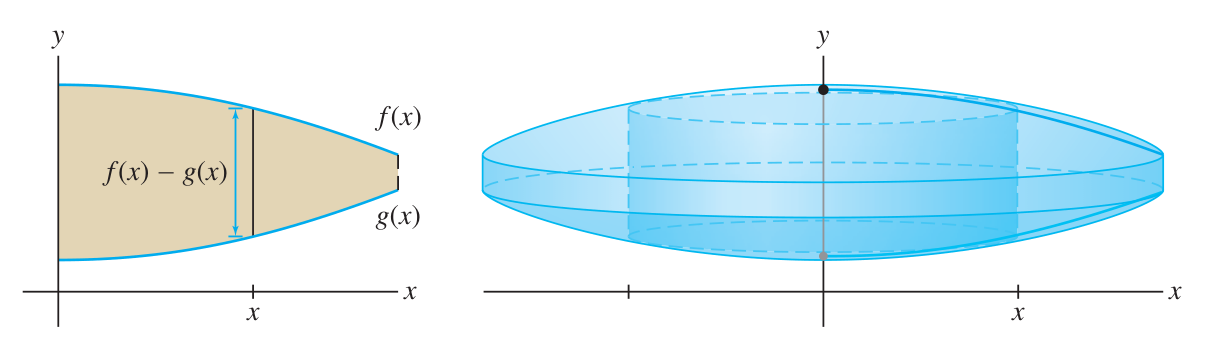
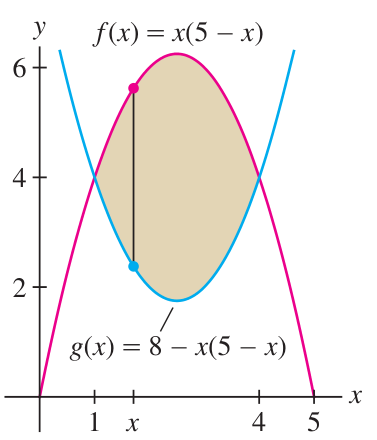
In any concrete volume calculation, we simply interpret each factor, ‘’ and ‘’ and ‘’, and determine and in terms of the variable of integration that is set for .
Link to originalShells vs. washers
Can you see why shells are sometimes easier to use than washers?
02 Illustration
Example - Revolution of a triangle
Revolution of a triangle
A rotation-symmetric 3D body has cross section given by the region between , , , and is rotated around the -axis. Find the volume of this 3D body.
Solution
(1) Cross-section region:
Bounded above-right by . Bounded below-right by . These intersect at .
Bounded left by .
(2) Set up integral:
Rotated around -axis, therefore use for integration variable (shells!). Formula:
Domain is .
because shell radius is the -distance from to the shell position.
Height:
is limit of which equals here, so .
(3) Evaluate integral:
Link to original
Practice exercise
Revolution of a sinusoid
Consider the region given by revolving the first hump of about the -axis. Set up an integral that gives the volume of this region using the method of shells.
Link to originalSolution
(1) Set up the integral for shells:
Integration variable: , the distance of a shell to the -axis.
Then and , the height of a shell.
Bounds: one hump is given by . Thus:
(2) Perform the integral using IBP:
Choose and since is A and is T.
Then and .
Use IBP formula:
Compute first term:
Compute integral term:
So the answer is .
Integration by substitution (review only)
Videos
Review Videos
[Note: this section is non-examinable. It is included for comparison to IBP.]
Link to original
- Integration by Substitution 1:
- Integration by Substitution 2:
- Integration by Substitution 3:
- Integration by Substitution 4:
- Integration by Substitution 5:
- Integration by Substitution: Definite integrals, various examples
03 Theory
Theory 1
The method of -substitution is applicable when the integrand is a product, with one factor a composite whose inner function’s derivative is the other factor.
Substitution
Suppose the integral has this format, for some functions and :
Then the rule says we may convert the integral into terms of considered as a variable, like this:
The technique of -substitution comes from the chain rule for derivatives:
Here we let . Thus for some .
Now, if we integrate both sides of this equation, we find:
And of course .
Link to originalExtra - Full explanation of -substitution
(1) Chain rule for derivatives:
Let be a function and its derivative. Let be another function.
Using primes:
Using differentials:
(2) Integrate both sides:
(3) Introduce ‘variable’ from the -format of the integral:
Treating as a variable, the definition of gives:
Set the ‘variable’ to the ‘function’ output:
Combine these:
(4) Substitute for :
This is “-substitution” in final form.
Integration by parts
Videos
Review Videos
Videos:
Link to original
- Integration by Parts 1: and
- Integration by Parts 2: and
- Integration by Parts 3: Definite integrals
- Example: , two methods:
- Integration by Parts 6:
04 Theory
Theory 1
The method of integration by parts (abbreviated IBP) is applicable when the integrand is a product for which one factor is easily integrated while the other becomes simpler when differentiated.
Integration by parts
Suppose the integral has this format, for some functions and :
Then the rule says we may convert the integral like this:
This technique comes from the product rule for derivatives:
Now, if we integrate both sides of this equation, we find:
and the IBP rule follows by algebra.
Extra - Full explanation of integration by parts
(1) Product rule for derivatives:
(2) Integrate both sides:
Definite IBP
Definite version of FTC:
Link to originalChoosing factors well
IBP is symmetrical. How do we know which factor to choose for and which for ?
Here is a trick: the acronym “LIATE” spells out the order of choices – to the left for and to the right for :
05 Illustration
Example - A and T factors
A and T factors
Compute the integral:
Solution
(1) Choose and :
Set because simplifies when differentiated.
(By the trick: is Algebraic, i.e. more “”, and is Trig, more “”.)
Remaining factor must be .
(2) Compute and :
Key chart:
(3) Evaluate IBP formula:
Link to originalWhy IBP?
The rationale of IBP is that is easier to compute than .
Exercise - Hidden A
Hidden A
Compute the integral:
Link to originalSolution
(1) Choose :
Because Log is farthest left in LIATE.
Therefore we must choose .
(2) Compute and :
We have and . Obtain chart:
(3) Evaluate IBP formula:
Perform new integration:
Final answer is: