Partial fractions
Videos
Review Videos
Videos, Math Dr. Bob:
Link to original
- Partial Fractions 01 - Distinct Linear Factors
- Partial Fractions 02 - Repeated Linear Factors
- Partial Fractions 03 - Distinct Mixed Factors
- Partial Fractions 04 - Repeated Quadratic Factors
- Partial Fractions 05 - Composition with
01 Theory
Theory 1
A rational function is a ratio of polynomials, for example:
Partial fraction decomposition
The partial fraction decomposition of a rational function is a way of writing it as a sum of simple terms, like this:
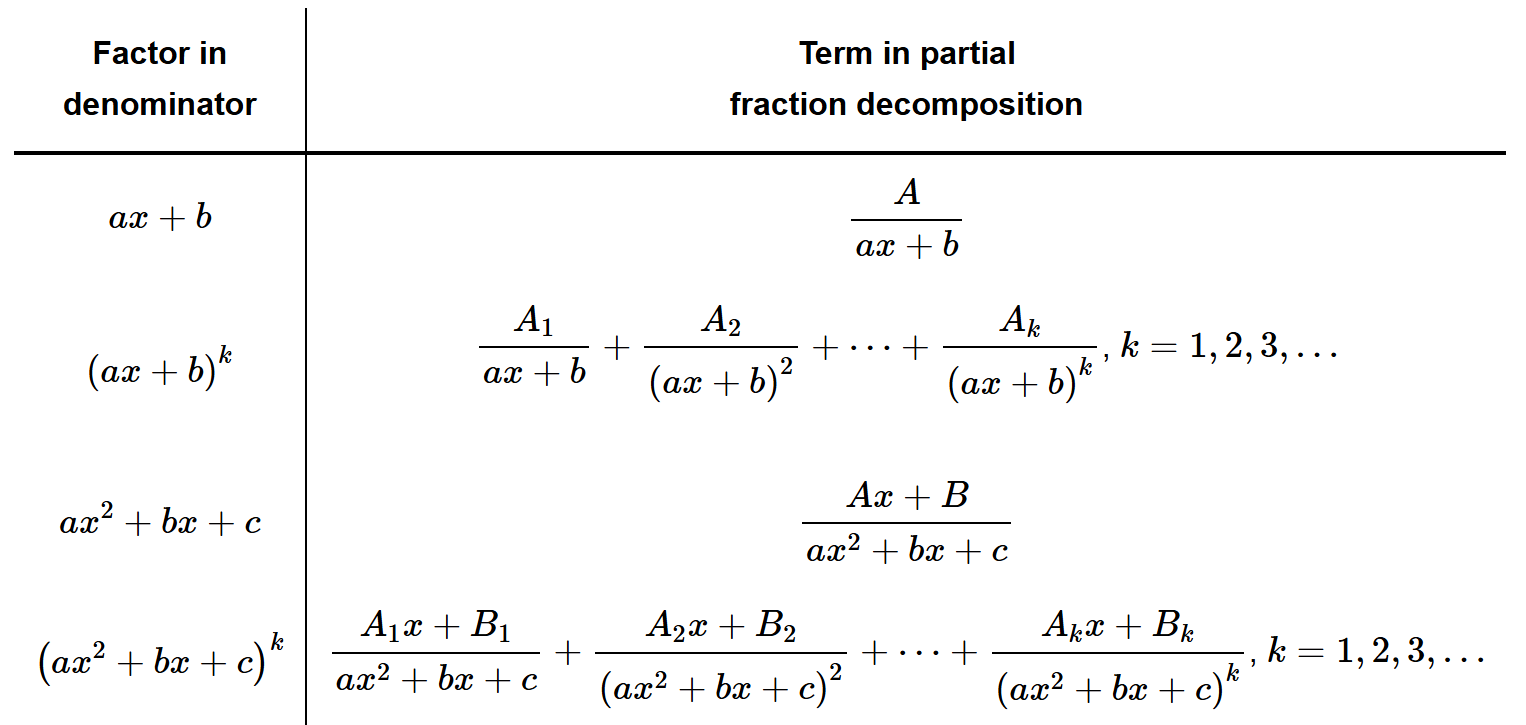
Allowed denominators:
- Linear, e.g. , or linear power, e.g.
- Quadratic, e.g. , or quadratic power, e.g.
- Condition: quadratics must be irreducible. (No roots, i.e. .)
Allowed numerators: constant (over linear power) or linear (over quadratic power)
These are allowed as simple terms in partial fraction decompositions:
These are not allowed:
These are allowed, showing irreducible quadratic and higher powers:
In this example the numerator is linear and the denominator is quadratic and irreducible.
To create a partial fraction decomposition, follow these steps:
- Check denominator degree is higher
- Else do long division
- Factor denominator completely (even using irrational roots)
- Write the generic sum of partial fraction terms with their constants
Repeated factors – special treatment – incrementing powers
Link to original
- Solve for constants
02 Illustration
Partial fractions with repeated factor
Partial fractions with repeated factor
Find the partial fraction decomposition:
Solution
(1) Check that denominator degree is lower.
(2) Factor denominator:
Rational Roots Theorem: check for roots at and and .
Discover that is a root. Therefore divide by :
Factor again:
Final factored form:
(3) Write the generic PFD:
(4) Solve for , , and :
Multiply across by the common denominator:
For , set , obtain:
For , set , obtain:
For , insert prior results and solve.
Plug in and :
Now plug in another convenient , say :
(4) Plug in , , for the final answer:
Link to original
03 Theory
Theory 2
Partial fractions can be integrated using just a few techniques. Consider these terms:
Linear power bottom
In order to integrate terms like this:
If then use log:
If then use power rule:
Quadratic bottom, constant top
Formula for simple irreducible quadratics:
Memorize this formula!
Quadratic bottom, linear top
In order to integrate terms like this:
Break into separate terms:
Then:
- First term with in top:
- Second term lacking in top:
Link to originalExtra - Completing the square when “no real roots”
To integrate terms with more general quadratics, like this:
we need , i.e. “no real roots” of the quadratic. If that holds, then we can complete the square and substitute as follows.
Look what happens when completing the square:
Notice that is equivalent to the condition . Create a new label . So this condition means and we can safely define .
Then a -substitution simplifies the equation like this:
The quadratic formula shows that the condition is equivalent to the condition “no real roots.” (In our case . If we had , we could divide out this and change the others.)
So we see that “no real roots” is equivalent to the condition that the denominator can be converted to the format with some constant .
At this point, to compute the integral, do trig sub with and :
04 Illustration
Example - Repeated quadratic, linear tops
Partial fractions - repeated quadratic, linear tops
Compute the integral:
Solution
(1) Partial fraction decomposition:
- Numerator degree is lower than denominator.
- Factor denominator completely. (No real roots.)
Write generic PFD:
- Notice: repeated factor: use incrementing powers up to 2.
- Notice: linear over quadratic.
Common denominators and solve:
Therefore:
(2) Integrate:
Integrate the first term using substitution :
Break up the second term:
Integrate the first term of RHS:
Integrate the second term of RHS using :
Link to original
Extra - “Rationalize a quotient” - convert into PFD
Extra - “Rationalize a quotient” - convert into PFD
Sometimes an integrand may be converted to a rational function using a substitution.
Consider this integral:
Set , so and :
Now this rational function has a partial fraction decomposition:
It is easy to integrate from there!
Practice exercises:
Link to original
- To compute , try the substitution .
- To compute , try the substitution .
- To compute , try the substitution .
Simpson’s Rule
Videos
Review Videos
Videos, Math Dr. Bob:
Videos, Organic Chemistry Tutor:
Link to original
05 Theory - review
Theory 1
The Trapezoid Rule is a technique to approximate the area under a curve as the sum of areas of thin trapezoids whose top corners lie on the curve.
The tops of the trapezoids are lines that approximate the curve. They are determined as lines that agree with the curve at two points.
Trapezoid rule - area formula
Given a function and a partition of the range labeled by (with and ), the Trapezoid Rule determines the area formula:
Notice the pattern in s and see how this formula comes about: The area of one trapezoid is . All vertical values (excepting the endpoints and ) are represented in two trapezoids, so their contribution is doubled.
Extra - Trapezoid rule - error bound
The error of the Trapezoid Rule approximation is bounded by this formula:
Here is any number satisfying for .
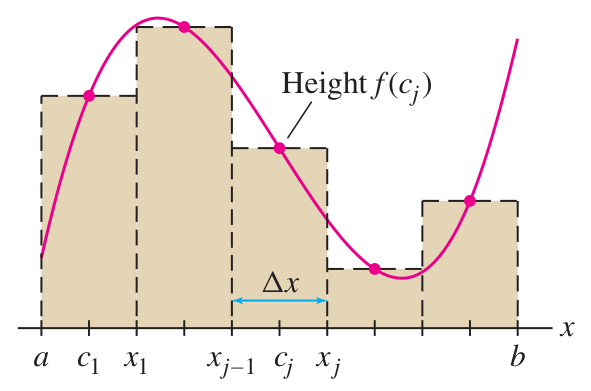
The Midpoint Rule is a technique to approximate the area under a curve as the sum of areas of thin rectangles whose top midpoints lies on the curve.
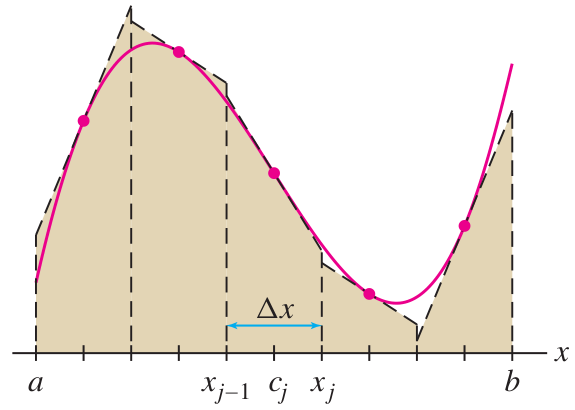
The very same formula also represents the areas of trapezoids whose top midpoints lie on the curve and whose top line is tangent to the curve:
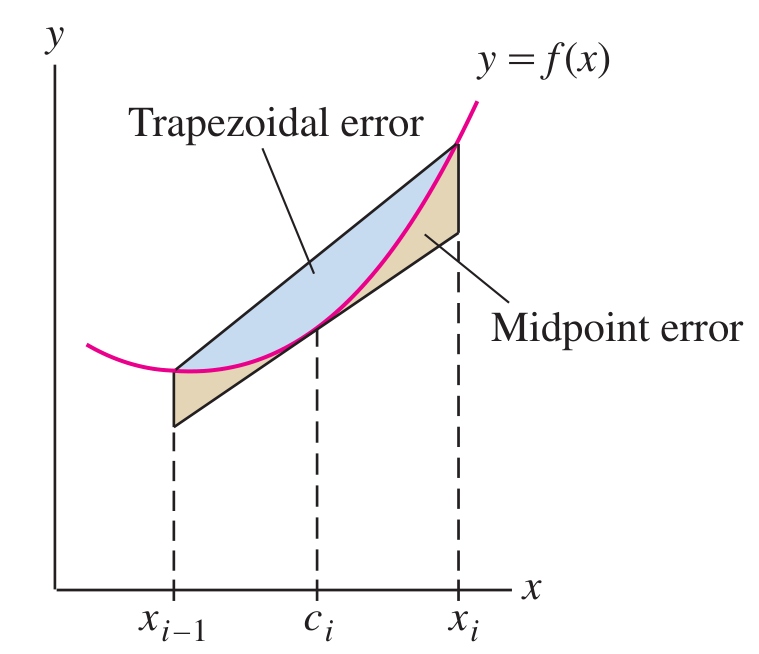
The reason they are equal is simple: when pivoting the top line on the ‘attached’ midpoint, the area of the trapezoid does not change.
Midpoint Rule - area formula
Given a function and a partition of the range labeled by (with and ), the Midpoint Rule determines the area formula:
Here each is the midpoint of the interval . It can be given by the formula .
Extra - Midpoint Rule - error bound
The error of the Midpoint Rule approximation is bounded by this formula:
Here is any number satisfying for .
Notice that has an error bound that is of the bound for . This does not mean that always has a smaller error than . It means that without calculating the error, simply plugging numbers into the error bound formulas, we obtain a smaller bound for than for . This is about our knowledge of the error, not the reality of the error.
Link to original
06 Theory
Theory 2
It turns out that the Midpoint Rule and the Trapezoid Rule tend to differ from the exact integral in opposite directions, and the Midpoint Rule tends to be twice as accurate. Therefore we may improve on both of them by constructing a weighted average of the formulas. This is called Simpson’s Rule.
Simpson’s Rule - defining formula
Simpson’s Rule is given by the weighted sum of the Trapezoid and Midpoint Rules:
Simpson’s Rule - computing formula
Given a function and a partition of the range labeled by (with and ), Simpson’s Rule determines the area formula:
Simpson’s Coefficient Pattern
Memorize the pattern for Simpson’s Rule:
Simpson’s Rule - error bound
The error of Simpson’s Rule approximation is bounded by this formula:
Here is any number satisfying for .
Link to originalSimpson’s Rule “Parabola Rule”
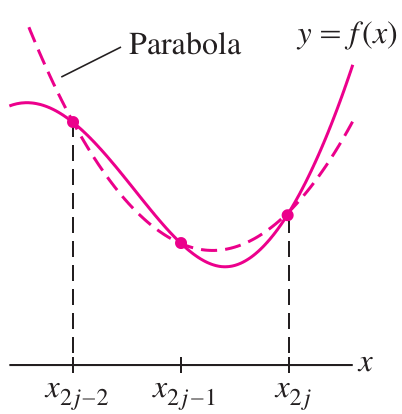
The formula of Simpson’s Rule can also be explained or defined geometrically: it is the formula giving the sum of areas under small parabolas that meet the curve in three points.
There is a unique parabola passing through any three points with differing -values:
These may be pieced together to form an approximation to the curve:
The area under the parabola through , , and is given by this formula:
This formula may be verified using basic calculus (area under a parabola) and a lot of algebra. (Ambitious students should derive it.)
The area under the parabola through , , and is given by a similar formula:
The Simpson’s Rule formula is the sum of all these formulas! So the s in Simpson’s come from duplication of endpoint terms as the “rectangular” regions are stacked end-to-end.
07 Illustration
Example - Simpson’s Rule on the Gaussian Distribution
Simpson’s Rule on the Gaussian distribution
The function is very important for probability and statistics, but it cannot be integrated analytically.
Apply Simpson’s Rule to approximate the integral:
with and . What error bound is guaranteed for this approximation?
Solution
(1) We need a table of values of and :
These can be plugged into the Simpson Rule formula to obtain our desired approximation:
To find the error bound we need to find the smallest number we can manage for .
Take four derivatives and simplify:
On the interval , this function is maximized at . Use that for the optimal :
Finally we plug this into the error bound formula:
Link to original