Power series as functions
Videos
Review Videos
Videos, Math Dr. Bob
Link to original
- Power series functions: Derivative/Antiderivative - Basics
- Power series functions: Derivative/Antiderivative - Interval of Convergence
- Power series functions: Derivative/Antiderivative - More examples
- Power series functions: Geometric Power Series
01 Theory
Theory 1
Given a numerical value for within the interval of convergence of a power series, the series sum may be considered as the output of a function .
Many techniques from algebra and calculus can be applied to such power series functions.
Addition and Subtraction:
Summation notation:
Scaling:
Summation notation:
Extra - Multiplication and composition
Multiplication:
For example, suppose that the geometric power series converges, so . Then we have for its square:
Composition:
Assume:
Then:
Differentiation:
Antidifferentiation:
For example, for the geometric series we have:
Do the series created with sums, products, derivatives etc., all converge? On what interval?
For the algebraic operations, the resulting power series will converge wherever both of the original series converge.
For calculus operations, the radius is preserved, but the endpoints are not necessarily:
Power series calculus - Radius preserved
If the power series has radius of convergence , then the power series and also have the same radius of convergence .
Power series calculus - Endpoints not preserved
It is possible that a power series converges at an endpoint of its interval of convergence, yet and do not converge at .
Link to originalExtra - Proof of radius for derivative and integral series
Suppose has radius of convergence :
Consider now the derivative and its successive-term ratios:
Consider now the antiderivative and its successive-term ratios:
In both these cases the ratio test provides that the series converges when .
02 Illustration
Example - Geometric series: algebra meets calculus
Geometric series: algebra meets calculus
Consider the geometric series as a power series functions:
Take the derivative of both sides of the function:
This means satisfies the identity:
Now compute the derivative of the series:
On the other hand, compute the square of the series:
So we find that the same relationship holds, namely , for the closed formula and the series formula for this function.
Link to original
Example - Manipulating geometric series: algebra
Manipulating geometric series: algebra
Find power series that represent the following functions:
(a) (b) (c) (d)
Solution
(a)
Rewrite in format :
Choose . Plug into geometric series:
Therefore:
(b)
Rewrite in format :
Choose . Plug into geometric series:
Therefore:
(c)
Rewrite in format :
Choose . Here . Plug into geometric series:
Therefore:
(d)
Rewrite in format :
Choose . Here . Plug into geometric series:
Therefore:
Link to original
Example - Manipulating geometric series: calculus
Manipulating geometric series: calculus
Find a power series that represents .
Solution
Differentiate to obtain similarity to geometric sum formula:
Integrate series to find original function:
Use known point to solve for :
Link to original
Example - Recognizing and manipulating geometric series: Part I
Recognizing and manipulating geometric series: Part I
(a) Evaluate . (Hint: consider the series of .)
(b) Find a series approximation for .
Solution
(a)
(1) Follow hint, study series of :
Notice:
Integrate the series:
Solve for using which (plugging above) implies and thus . So:
(2) Relate to the given series:
Notice that if we set . Also, . Therefore:
So the answer is .
(b) Find a series approximation for :
Observe that .
Plug into the series:
Link to original
Example - Recognizing and manipulating geometric series: Part II
Recognizing and manipulating geometric series: Part II
(a) Find a series representing using differentiation.
(b) Find a series representing .
Solution
(a)
Notice that .
What is the series for ?
Let :
Now integrate this by terms:
Conclude:
Plug in to solve for :
Final answer:
(b)
Rewrite integrand in format of geometric series sum:
Therefore:
Integrate the series by terms to obtain the answer:
Link to original
Taylor and Maclaurin series
Videos
Review Videos
Videos, Math Dr. Bob
Link to original
03 Theory
Theory 1
Suppose that we have a power series function:
Consider the successive derivatives of :
When these functions are evaluated at , all terms with a positive -power become zero:
This last formula is the basis for Taylor and Maclaurin series:
Power series: Derivative-Coefficient Identity
This identity holds for a power series function which has a nonzero radius of convergence.
We can apply the identity in both directions:
- Know ? Calculate for any .
- Know ? Calculate for large . (Faster than differentiating.)
Many functions can be ‘expressed’ or ‘represented’ near (i.e. for small enough ) as convergent power series. (This is true for almost all the functions encountered in pre-calculus and calculus.)
Such a power series representation is called a Taylor series. When , the Taylor series is also called the Maclaurin series.
One power series representation we have already studied:
Whenever a function has a power series (Taylor or Maclaurin), the Derivative-Coefficient Identity may be applied to calculate the coefficients of that series.
Conversely, sometimes a series can be interpreted as an evaluated power series coming from for some . If the closed form function format can be obtained for this power series, the total sum of the original series may be discovered by putting in the argument of the function.
Link to original
04 Illustration
Example - Maclaurin series of
Maclaurin series of e to the x
What is the Maclaurin series of ?
Solution
Using repeatedly, we see that for all .
So for all . Therefore for all by the Derivative-Coefficient Identity:
Link to original
Example - Maclaurin series of
Maclaurin series of cos x
Find the Maclaurin series representation of .
Solution
Use the Derivative-Coefficient Identity to solve for the coefficients:
0 1 2 3 4 5 By studying this pattern, we find the series:
Link to original
Maclaurin series from other Maclaurin series
Maclaurin series from other Maclaurin series
(a) Find the Maclaurin series of using the Maclaurin series of .
(b) Find the Maclaurin series of using the Maclaurin series of .
(c) Using (b), find the value of .
Solution
(a)
Remember that . Let us differentiate the cosine series by terms:
Take negative to get:
(b)
Set :
Multiply all terms by :
(c)
For any series:
we have:
We can use this to compute . From the series formula:
we see that:
Power, NOT term number
The coefficient with corresponds to the term having , not necessarily the term of the series.
Therefore:
Link to original
Computing a Taylor series
Computing a Taylor series
Find the first five terms of the Taylor series of centered at .
Solution
A Taylor series is just a Maclaurin series centered at a nonzero number.
General format of a Taylor series:
The coefficients satisfy .
Find the coefficients by computing the derivatives and evaluating at :
The first terms of the series:
Link to original
05 Theory
Theory 2
Link to originalStudy these!
- Memorize all of these series!
- Recognize all of these series!
- Recognize all of these summation formulas!
Applications of Taylor series
Videos
Review Videos
Videos, Math Dr. Bob
Link to original
- Approximating with Maclaurin polynomials: to find
- Approximating with Taylor polynomials: at to find
06 Theory reminder
Theory 1
Linear approximation is the technique of approximating a specific value of a function, say , at a point that is close to another point where we know the exact value . We write for , and , and . Then we write and use the fact that:
Computing a linear approximation
For example, to approximate the value of , set , set and , and set so .
Then compute: So .
Finally:
Now recall the linearization of a function, which is itself another function:
Given a function , the linearization at the basepoint is the functional form of the tangent line, the line passing through with slope :
The graph of this linearization is the tangent line to the curve at the point .
The linearization may be used as a replacement for for values of near . The closer is to , the more accurate the approximation is for .
Link to originalComputing a linearization
We set , and we let .
We compute , and so .
Plug everything in to find :
Now approximate :
07 Theory
Theory 2
Taylor polynomials
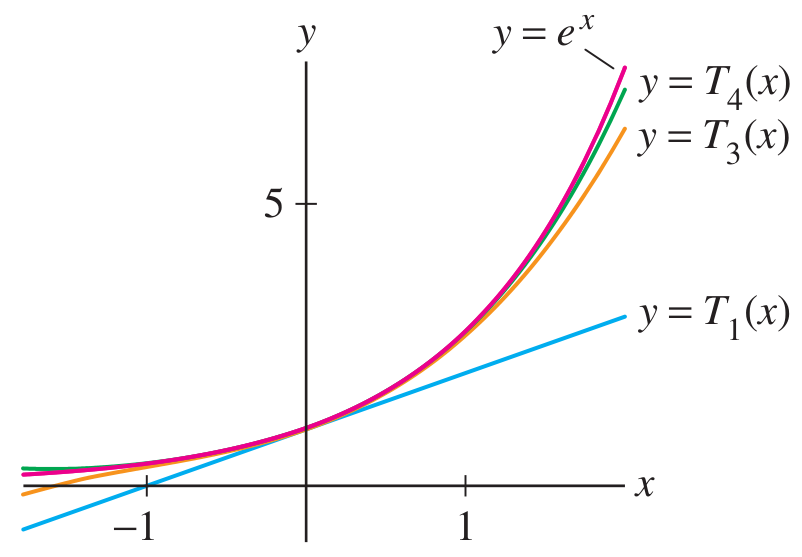
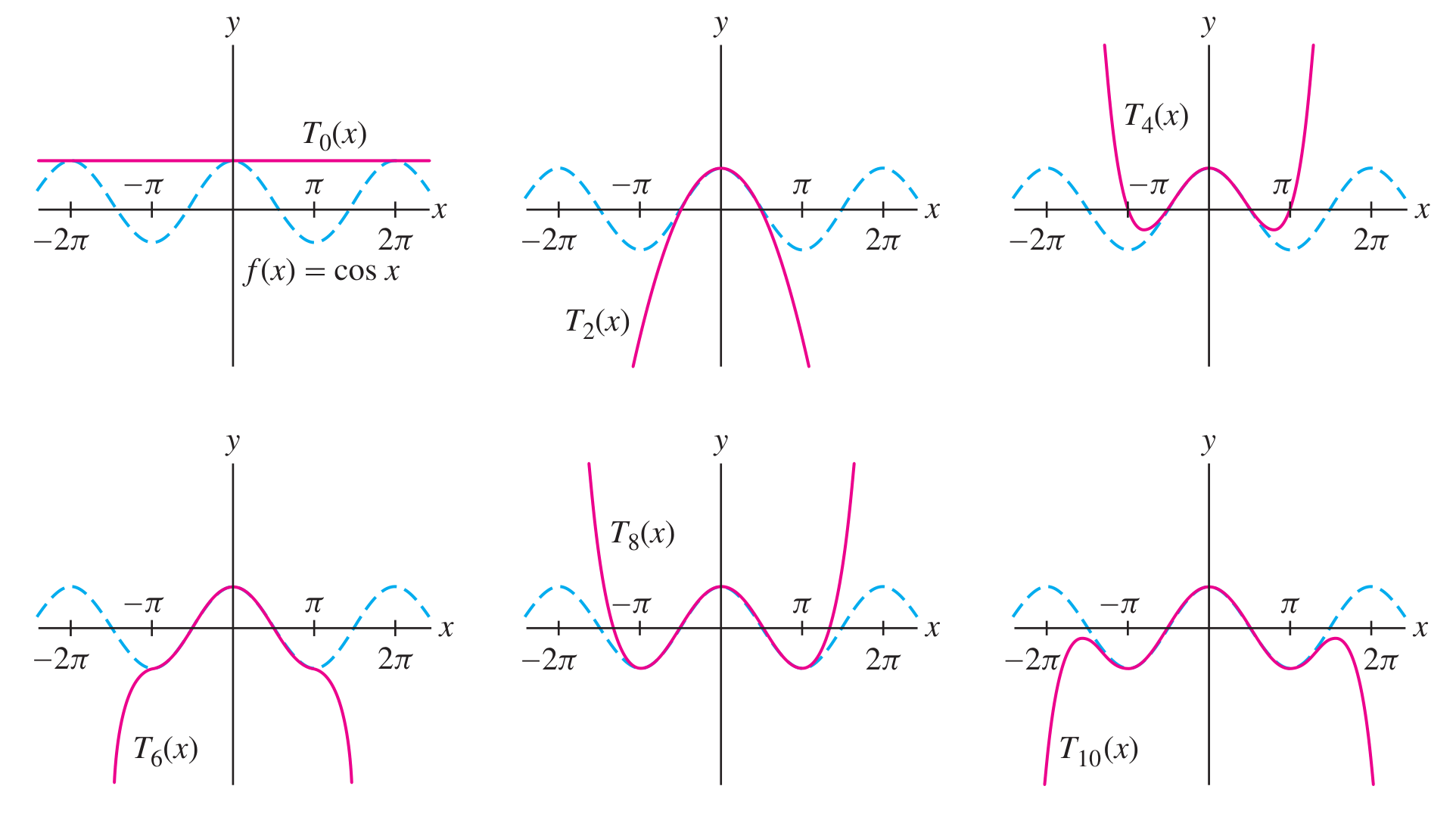
The Taylor polynomials of a function are the partial sums of the Taylor series of :
These polynomials are generalizations of linearization. Specifically, , and .
The Taylor series is a better approximation of than for any .
Link to originalFacts about Taylor series
The series has the same derivatives as at the point . This fact can be verified by visual inspection of the series: apply the power rule and chain rule, then plug in and all factors left with will become zero.
The difference vanishes to order at :
The factor drives the whole function to zero with order as .
If we only considered orders up to , we might say that and are the same near .
08 Illustration
Taylor polynomial approximations
Taylor polynomial approximations
Let and let be the Taylor polynomials expanded around .
By considering the alternating series error bound, find the first for which must have error less than .
Solution
Write the Maclaurin series of because we are expanding around :
This series is alternating when we insert , so the AST error bound formula applies (“Next Term Bound”):
Find smallest such that , and then we know:
Plug in the series for :
Solve for the first time by listing the values:
The first time is below happens when .
This is NOT the same as in . That is the highest power of allowed.
The sum of prior terms is .
Since because there is no term, the final answer is .
Link to original
Taylor polynomials to approximate a definite integral
Taylor polynomials to approximate a definite integral
Approximate using a Taylor polynomial with an error no greater than .
Solution
Plug into the series of :
Find an antiderivative by terms:
Plug in bounds for definite integral:
Notice alternating series pattern. Apply error bound formula, “Next Term Bound”:
So we can guarantee an error less than by summing the first terms through :
Link to original