Complex exponential
Videos
Review Videos
Videos, Khan Academy
Link to original
01 Theory - Complex plane and polar data
Theory 1
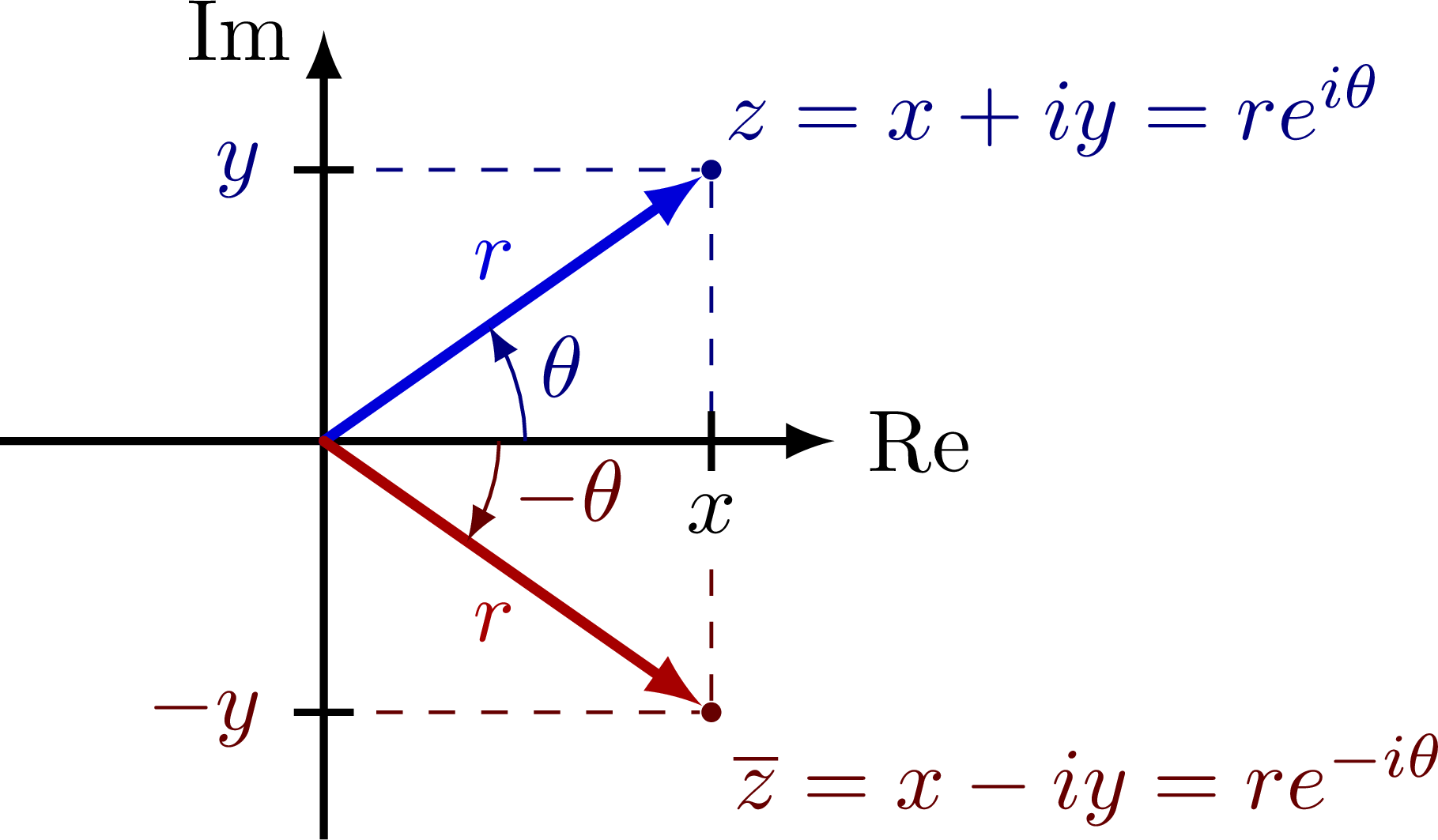
A complex number
can be represented in the plane as the point with Cartesian coordinates . The coefficient of “ ” determines the vertical coordinate, and the coefficient of “ ” determines the horizontal coordinate.
Let us be given a complex number
. The “real part” and “imaginary part” of
can be extracted with designated functions: The polar data (radius and angle) have special names and notations for complex numbers:
Using this notation, we see that product with the conjugate gives square of modulus:
Link to original
02 Theory - cis, Euler, products, powers
Theory 1
Multiplication of complex numbers is much easier to understand when the numbers are written using polar form.
There is a shorthand ‘
’ notation. Convert to polar coordinates, so and : The “
” stands for . For example:
Euler Formula
General Euler Formula:
On the unit circle
: The form
expresses the same data as the form. The principal advantage of the form is that it reveals the rule for multiplication, which comes from exponent laws: Complex multiplication - Exponential form
In words:
- Multiply radii
- Add angles
Notice:
Notice:
Therefore
‘acts upon’ other numbers by rotating them counterclockwise!
De Moivre’s Theorem - Complex powers
In exponential notation:
In
notation: Expanded
notation: So the power of
acts like this:
- Stretch:
to - Rotate: by
increments of
Link to originalExtra - Derivation of Euler Formula
Recall the power series for
: Plug in
: Simplify terms:
Separate by
-factor. Select out the : Separate into a series without
and a series with : Identify
and . Write trig series: Therefore
.
03 Illustration
Example - Complex product, quotient, power using Euler
Complex product, quotient, power using Euler
Define:
Product
: Quotient
: Power
: Notice:
Simplify:
Link to original
Example - Complex power from Cartesian
Complex power from Cartesian
Compute
. Solution
First convert to exponential form:
Compute the power:
Link to original
Complex roots
Videos
Review Videos
Videos, Trefor Bazett
- Finding cube roots: Find cube roots of
Videos, Brain Gainz
Link to original
- Finding nth roots: Fourth roots of
and cube roots of
04 Theory - Roots formula
Theory 1
The exponential notation leads to a formula for a complex
root of any complex number:
distinct roots Every complex number actually has
distinct roots! That’s two square roots, three cube roots, four
roots, etc. All complex roots
The complex roots of
are given by this formula: In Cartesian notation:
In words:
- Start with the basic root:
- Rotate by increments of
to get all other roots
- After
distinct roots, this process repeats itself Link to originalExtra - Complex roots proof
We must verify that
:
05 Illustration
Example - Finding all
roots of Finding all 4th roots of 16
Compute all the
roots of . Solution
Write
. Evaluate roots formula:
Simplify:
Link to original
Example - Finding
roots of Finding 2nd roots of 2i
Find both
roots of . Solution
Write
. Evaluate roots formula:
Compute the options:
: Convert to rectangular:
Link to original
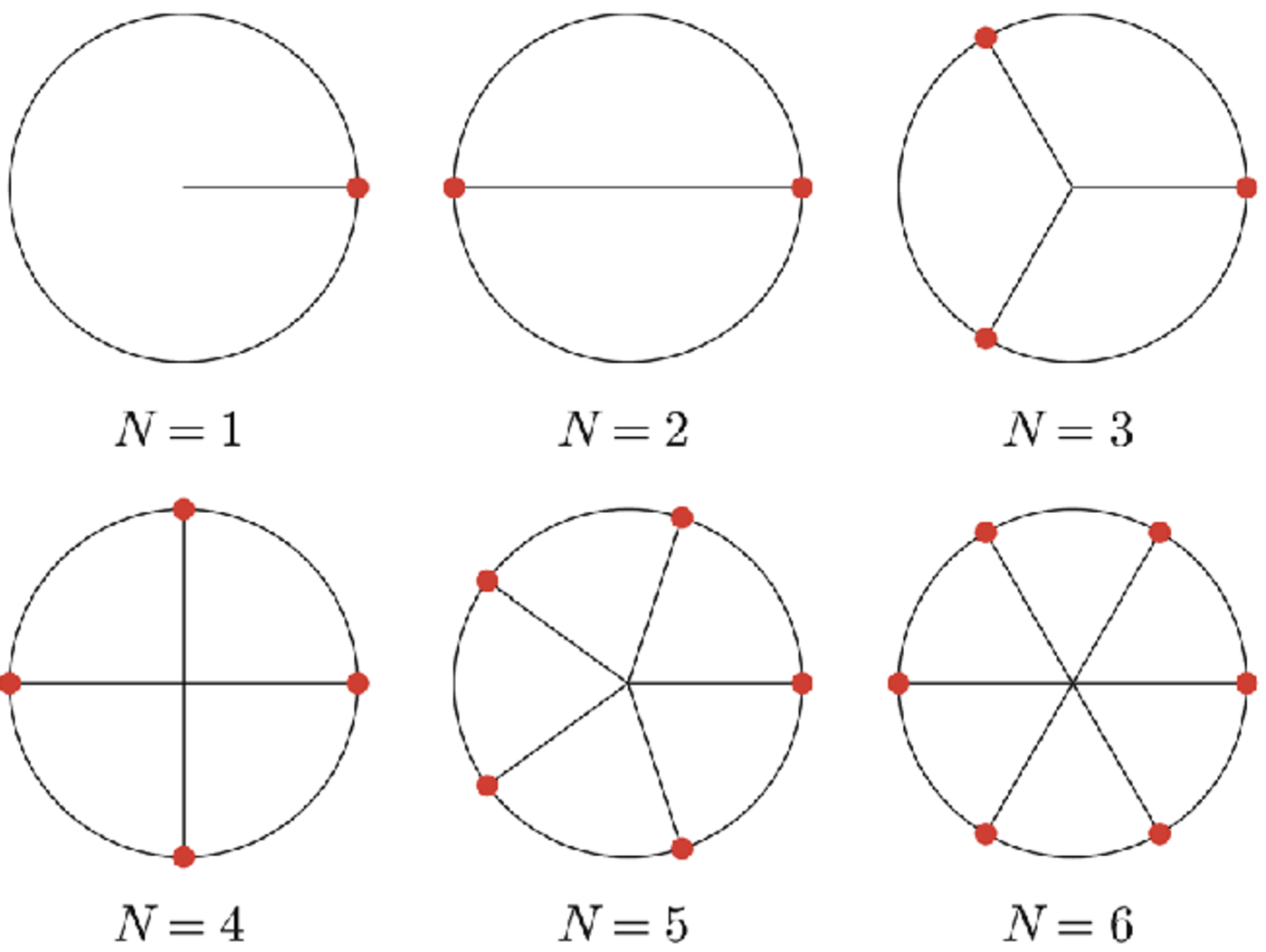
Example - Some roots of unity
Some roots of unity
Find the
and and and and and roots of the number . Solution
(1)
Write
. Evaluate roots formula. There is no possible :
(2)
Write
. Evaluate roots formula in terms of : Compute the two options,
:
(3)
Evaluate roots formula in terms of
: Compute the options:
:
(4)
Evaluate roots formula:
Compute the options:
:
(5)
Evaluate roots formula:
Compute the options:
: Don’t simplify, it’s not feasible.
(6)
Evaluate roots formula:
Compute the options:
: Simplify:
Link to original