01
(a)
From the first equation,
Plug that in for
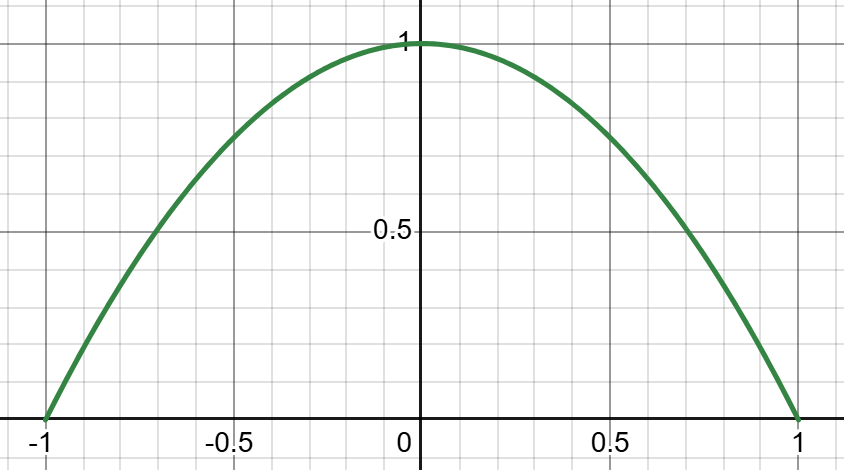
The sketched curve should be the portion of the line with
(b)
For this one, best not to solve for
Therefore the points on the curve satisfy the equation
02
Find a formula for the slope of the tangent line:
Solve for the
03
Derivative functions:
Slope:
Second derivative:
At
04
(a)
Observe that
Therefore, all points on the curve satisfy
Since
(b)
Observe that
However, this time
So the image of this parametric curve is
05
(a)
First choose a function
When choosing
Start by trying
But then
Therefore we define
So we use:
(b)
Same method but different condition:
Therefore we define
So we use:
06
First derivative:
Second derivative:
This is positive if-and-only-if
07
Derivatives:
Arclength: