Parametric curves
01
Convert parametric curve to function graph
Write the following curves as the graphs of a function
. (Find for each case.) (a)
, and (b)
, and Sketch each curve.
Link to originalSolution
01
(a) From the first equation,
. Plug that in for
in : The sketched curve should be the portion of the line with
.
(b)
For this one, best not to solve for
. Instead, notice the trig identity: Therefore the points on the curve satisfy the equation
. Solve this for the function: Link to original
03
Convert function graph to parametric curve
Find parametric curves
whose images are the following graphs: (a)
and (b)
and Link to originalSolution
05
(a)
First choose a function
, then set to ensure the equation is satisfied. When choosing
, we want to cover the whole domain of which is . We also need to satisfy the initial condition. Start by trying
: But then
. Since we should have . We can arrange for this by setting and solving for : Therefore we define
. Then: So we use:
(b)
Same method but different condition:
Therefore we define
. Then: So we use:
Link to original
03
Parametric concavity
Find the interval(s) of
on which the parametric curve is concave up. Link to originalSolution
06
First derivative:
Second derivative:
This is positive if-and-only-if
. (Numerator always positive, denominator same sign as .) So: Link to original
06
Cycloid - Arclength and surface area of revolution
Consider the cycloid given parametrically by
. (a) Find the length of one arch of the cycloid.
(b) Suppose one arch of the cycloid is revolved around the
-axis. Find the area of this surface of revolution. Link to originalSolution
09
(a)
One arch is formed from the range
. Compute
: Therefore
. Now recall a power-to-frequency formula, and use it in reverse:
Therefore:
(b)
Link to original
Polar curves
01
Convert points: Cartesian to Polar
Convert the Cartesian (rectangular) coordinates for these points into polar coordinates:
(a)
(b) (c) (d) Link to originalSolution
01
(a)
Q1, SAFE,
.
(b)
Q1, SAFE,
.
(c)
Q2, UNSAFE,
and we add to this angle.
(d)
Q2, UNSAFE,
Link to original(use 30-60-90 triangle) and we add to this angle.
01
Polar curve - Vertical or horizontal tangent lines
Find all points on the given curve where the tangent line is horizontal or vertical.
Hint: First determine parametric Cartesian coordinate functions using
as the parameter. Link to originalSolution
03
Observe that this parametric curve is a circle centered at
with radius . So we expect vertical tangents at and horizontal tangents at . Treat
as the parameter. We always have . This equals here because . Since we can further simplify to . Then
. Also
.
To find vertical tangents, solve for
: Check that
is not also zero at these points, else they would be stationary points: Now find the Cartesian coordinates for these points:
To find the horizontal tangents, solve for
: Check that
is not also zero at these points, else they would be stationary points: Now find the Cartesian coordinates for these points:
Link to original
04
Convert equations: Cartesian to Polar
Convert the Cartesian equation to a polar equation. Be sure to simplify.
(a)
(b) (c) Link to originalSolution
05
(a)
(b) (c) (a)
Insert
and :
(b)
(c)
Link to original
04
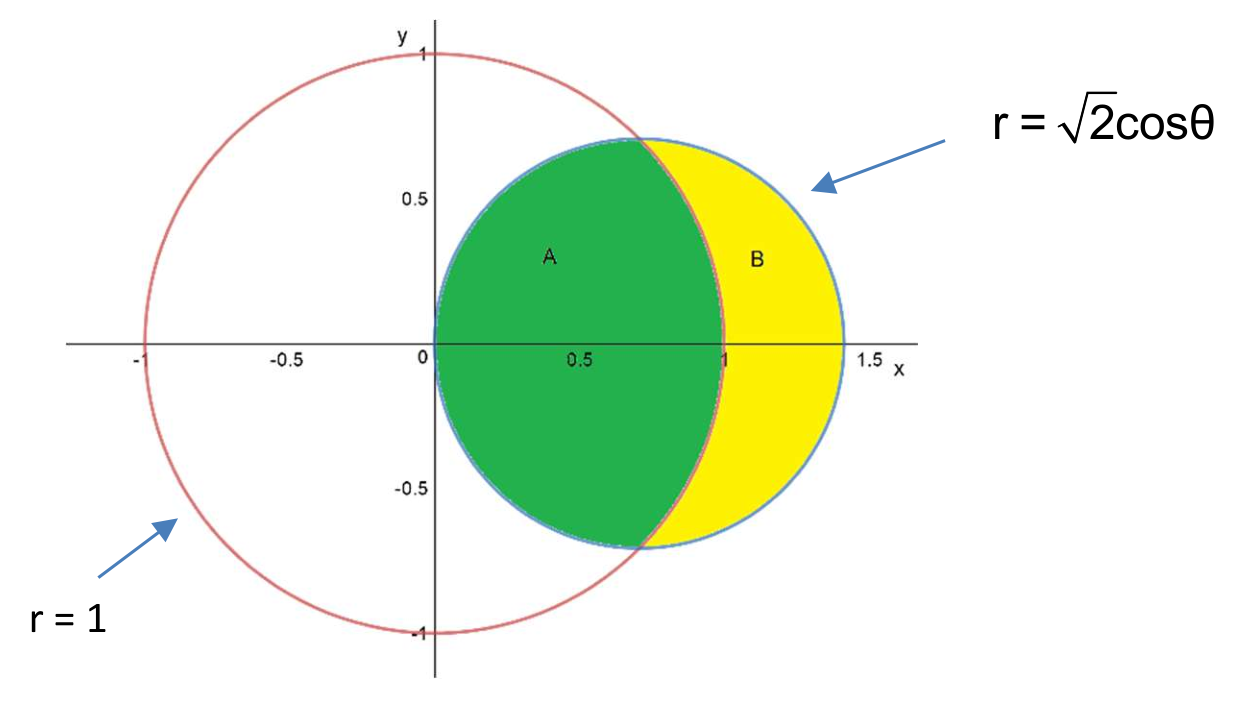
Polar coordinates - lunar areas
(a) Find the area of the green region.
(b) Find the area of the yellow region.
(You can find these in either order.)
Link to originalSolution
04
(a) Find the angle of the line from the origin to the point of intersection of the two curves (in Quadrant I):
Compute the area below this line, inside the larger circle, and above the
-axis: (This circular sector is also just
of the whole disk area, which is .) Compute the area above the line and inside the smaller circle:
Combined area in green above the
-axis is . Double this for the total green area:
(b) Notice that green and yellow combine to give the area of the smaller circle. The area of the smaller circle is
. Therefore, the yellow region has area:
Note: It is also reasonable to find the yellow region first, using this formula:
Link to original
06
Area of an inner loop
A limaçon is given as the graph of the polar curve
. Find the area of the inner loop of this limaçon.
Link to originalSolution
07
Solve for consecutive (in
) solutions to to get the starting and ending for a single loop: The interval
corresponds to the inner loop. To see this, draw a graph of the limaçon: Link to original
Complex numbers
01
Complex forms - exponential to Cartesian
Write each number in the form
. (a)
(b) Link to originalSolution
01
(a) Use Euler’s Formula:
(b)
Link to original
04
Complex products and quotients using polar
For each pair of complex numbers
and , compute: (a)
(b)
(Use polar forms with
.) Link to originalSolution
05
(a)
Product:
Dividend:
Reciprocal:
(b)
Product:
Dividend:
Reciprocal:
Link to original
05
Complex powers using polar
Using De Moivre’s Theorem, write each number in the form
. (a)
(b) (First convert to polar/exponential, then compute the power, then convert back.)
Link to originalSolution
06
(a)
Convert to polar:
De Moivre’s Theorem:
(b)
Convert to polar:
De Moivre’s Theorem:
Link to original
02
Complex roots using polar
Find each of the indicated roots.
(a) The four
roots of . (b) The three cube (
) roots of . Try to write your answer in
form if that is not hard, otherwise leave it in polar form. Link to originalSolution
07
(a)
For
roots, always start by writing in exponential: Now use the roots formula:
Write out these roots by evaluating
at :
(b)
For
roots, always start by writing in exponential: Now use the roots formula:
Write out these roots by evaluating
at : (The polar answers are acceptable too.)
Link to original

