Hydrostatic force
Videos
Review Videos
Videos, Organic Chemistry Tutor
Link to original
01 Theory
Theory 1
The pressure in a liquid is a function of the depth alone. This is a fundamental fact about liquids.
Pressure function
The fluid pressure in a liquid is a simple multiple of depth :
Constants:
In SI units:
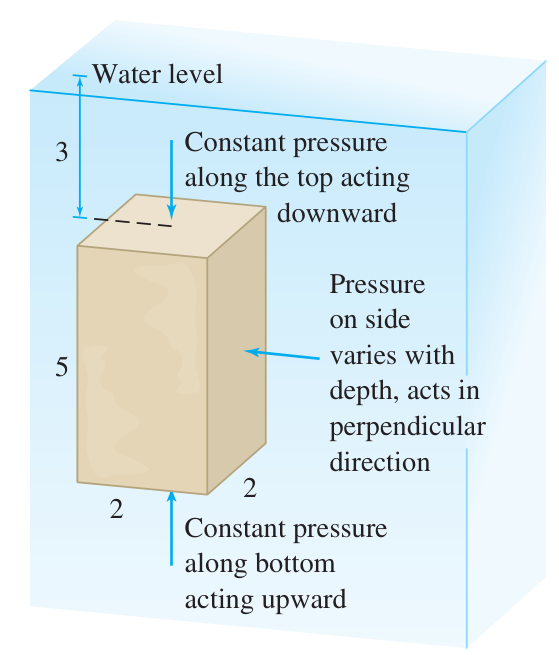
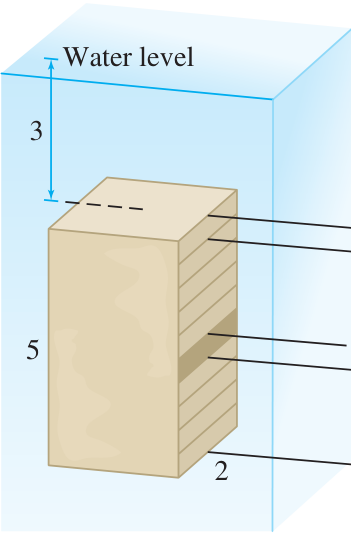
The pressure of a fluid acts upon any surface in the fluid by exerting a force perpendicular to the surface. Force is pressure times area. If the pressure varies across the surface, the total force must be calculated using an integral to add up differing contributions of force on each portion of the surface.
Fluid force on submerged plate
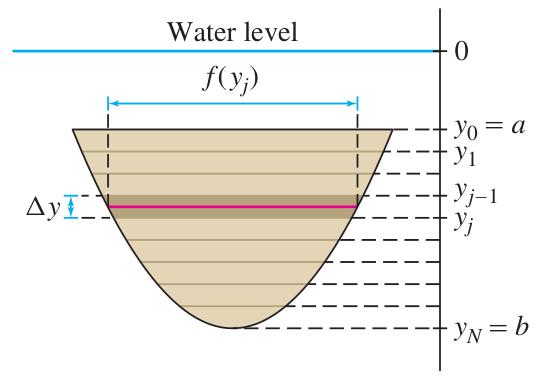
Total fluid force on plate:
Use for top of plate (shallow edge) and for bottom of plate (deep edge).
Use when at the water line, and increases with depth.
(Other are possible. )
Vertical plate
This formula assumes the plate is oriented straight vertically, not slanting.
(Add the factor for a plate tilted by angle .)
Link to original
02 Illustration
Example - Fluid force on a triangular plate
Fluid force on a triangular plate
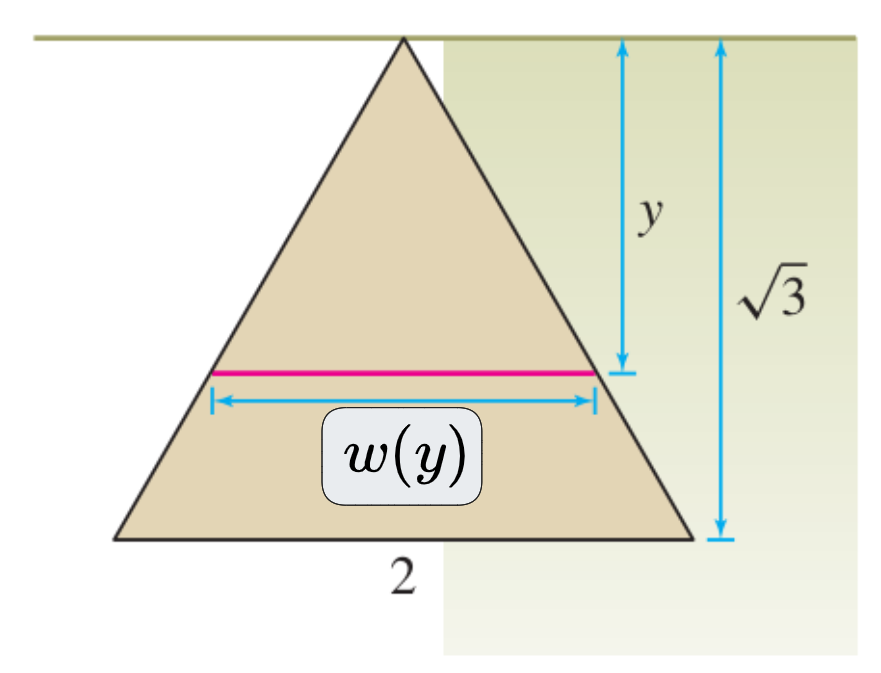
Find the total force on the submerged vertical plate with the following shape: Equilateral triangle, sides , top vertex at the surface, liquid is oil with density .
Solution
(1) Write the width function:
Establish coordinate system: at water line (also the vertex), and increases going down.
Method 1: Geometry of similar triangles
Top triangle with base at is similar to total triangle with base .
Therefore, corresponding parts have the same ratios.
Therefore:
Method 2: Quick linear interpolation function
Generalized “quick linear interpolation function”
Generalization:
where:
- is edge 1 and is edge 2 (increasing order of )
- is when comes earlier (smaller ), and if it comes later
- is created to force the quantity to equal for the given value at
(2) Compute integral using width function:
Bounds:
- (shallow)
- (deep)
Integral formula:
Link to original
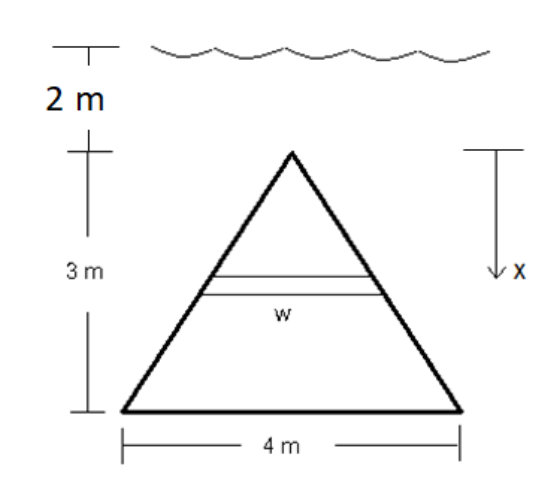
Example - Fluid force on deeply submerged triangular plate
Triangular plate deeply submerged
Set up an integral to calculate the fluid force of water on the following plate, using and as appropriate:
Solution
The coordinate system has been established as at the vertex, increasing downwards.
Set at the vertex and at the base of this triangle.
Width function using quick linear interpolation:
Now find such that at : at that edge, , so we must have too. Therefore .
Water depth is since we must have at the water surface where . So the solution is:
Link to original
Fluid force on circular plate
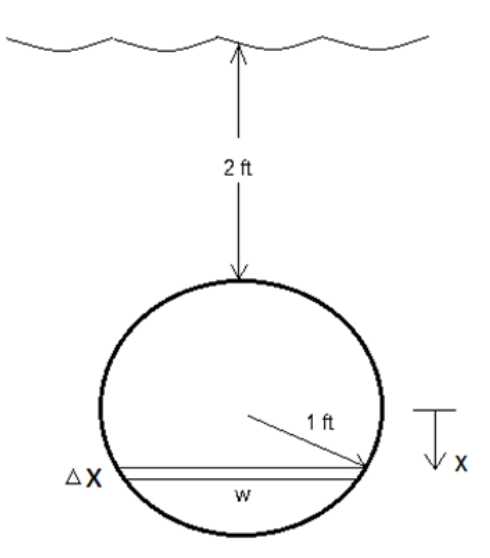
Fluid force on circular disk plate
Set up an integral to find the force on the following circular plate suspended deep under water:
Solution
By setting at the center of the circle, we have the equation of the circle:
Solve this to obtain:
So the integral is:
Link to original
03 Theory
Theory 2
What if the submerged surface is not oriented straight vertically?
The amount of surface for a horizontal strip at a given depth will be increased by a factor of where is the angle of incline of the surface (with corresponding to horizontal and to vertical). Thus:
where is the thickness of a strip.
So the total force formula becomes:
Link to originalFluid force for tilted surface
Total fluid force on tilted plate:
As before, measures depth with at the surface.
04 Illustration
Example - Weight of water on a dam
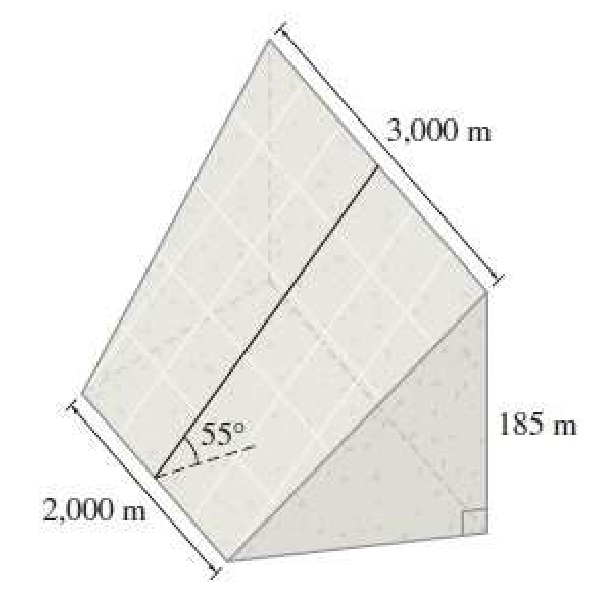
Weight of water on angled dam
Find the total hydrostatic force on an angled dam with the following geometric description: Tilted trapezoid. Base , Top , and vertical height . The base is tilted at an angle of .
Solution
(1) Write the width function:
Establish coordinate system: at water line (also the top edge), and increases going down.
“Quick linear interpolation function”:
(2) Incorporate angle of incline in strip thickness:
So the area of a strip is:
(3) Compute total force using integral formula.
Plug data into formula:
Link to original
Work
Videos
Review Videos
Videos, BlackPenRedPen:
Link to original
- Work performed: pumping water from trough
- Work performed: pumping water from rectangular tank
- Work performed: pumping water from conical tank
- Work performed: pumping water from spherical tank
01 Theory
Theory 1
Work is a measure of energy expended to achieve some effect. According to physics:
To compute the work performed against gravity while lifting some matter, decompose the matter into horizontal layers at height and thickness . Each layer is lifted some distance. The weight of the layer gives the force applied.
The work performed on each single layer is summed by an integral to determine the total work performed to lift all the layers:
Link to originalWork performed
- for water
02 Illustration
Example - Pumping water from spherical tank
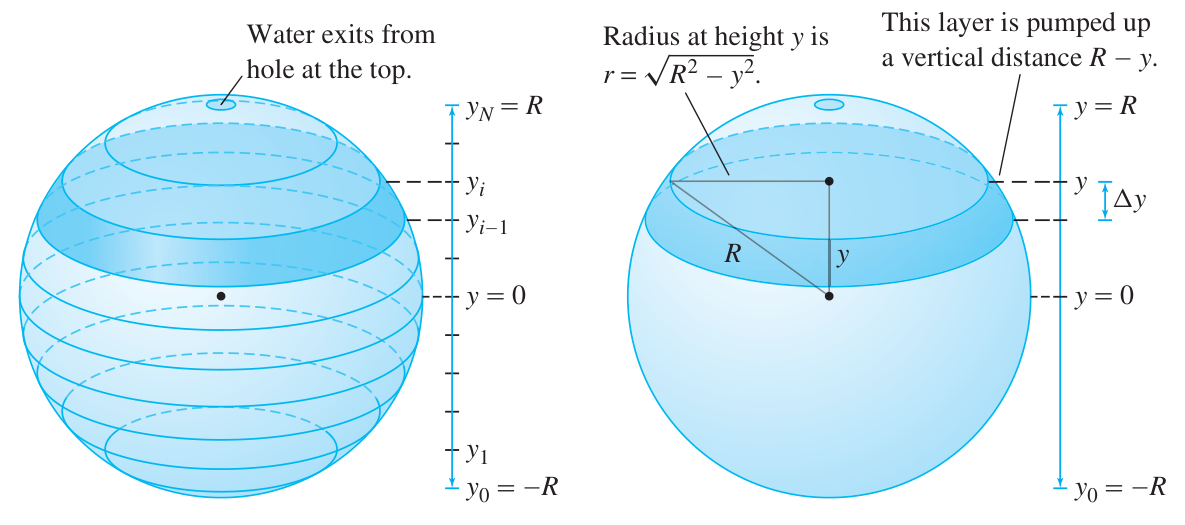
Pumping water from spherical tank
Calculate the work done pumping water out of a spherical tank of radius .
Solution
(1) Slice the tank of water into horizontal layers:
Coordinate is at the center of the sphere, increasing upwards.
(2) Calculate weight of single slice:
(3) Work to lift out single slice:
Distance to raise a slice:
Then:
(4) Total work by integrating over all slices:
Note A: The integration runs over all slices, which start at (bottom of tank), and end at (top of tank).
Extra question: what if the spigot sits above the tank?
Extra question: what if the tank starts at just of water depth?
Link to original
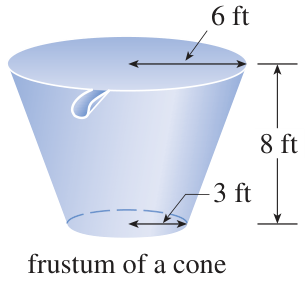
Example - Water pumped from a frustum
Water pumped from a frustum
Find the work required to pump water out of the frustum in the figure. Assume the weight of water is .
Solution
(1) Find weight of a horizontal slice.
Coordinate at top, increasing downwards.
Use for radius of cross-section circle.
Linear decrease in from to :
Area is :
:
(2) Find work to pump out a horizontal layer.
Layer at is raised a distance of .
Work to raise layer at :
(3) Integrate over all layers.
Integrate from top to bottom of frustum:
Link to original
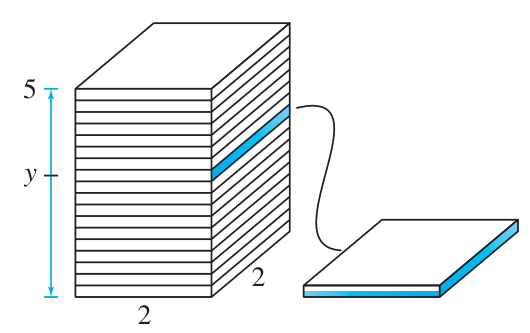
Example - Raising a building
Raising a building
Find the work done to raise a cement columnar building of height and square base per side. Cement has a density of .
Solution
(1) Weight of each layer:
(2) Work to lift layer into place:
(3) Find total work as integral over the layers:
Link to original
Example - Raising a chain
Raising a chain
An chain is suspended from the top of a building. Suppose the chain has weight density . What is the total work required to reel in the chain?
Solution
(1) Compute weight of a ‘link’ (vertical slice of the chain):
(2) Work to raise link to top:
Each link (slice) is raised from height to height 80:
Then:
(3) Integrate over the chain for total work:
Link to original
Example - Raising a leaky bucket
Raising a leaky bucket
Suppose a bucket is hoisted by a cable up an tower. The bucket is lifted at a constant rate of and is leaking water weight at a constant rate of . The initial weight of water is . What is the total work performed against gravity in lifting the water? (Ignore the bucket itself and the cable.)
Solution
(1) Compute total force from water :
Choose coordinate at base, at top.
Rate of water weight loss per unit height:
Total water weight at height :
(2) Work to raise bucket by :
(3) Total work by integrating :
Link to originalChange of method and integral formula!
For this example, we use the formula rather than the formula used in the earlier examples.
- This integral sums over the work to lift macroscopic material through each microscopic as if in sequence, and thus represents distance lifted.
- Earlier examples summed over the work to lift microscopic material through the macroscope (all the way up).