Simple divergence test
Videos
Review Videos
Videos, Math Dr. Bob
Link to original
- Geometric series and SDT, again: Geometric series, Simple Divergence Test (aka “Limit Test”)
- Integral test: Basics
- Integral test: -series
- Extra: Integral test: Further examples
- Extra: Integral test: Estimations
01 Theory
Theory 1
Simple Divergence Test (SDT)
Applicability: Any series.
Test Statement:
AKA the “Not Even Close” test
Link to originalThe converse is not valid. For example, diverges even though .
02 Illustration
Example - Simple Divergence Test: examples
Simple divergence test: examples
(a) Consider:
This diverges by the SDT because and not .
(b) Consider:
This diverges by the SDT because .
We can say the terms “converge to the pattern ,” but that is not a limit value.
Link to original
Positive series
Videos
Review Videos
Link to original
- Direct Comparison Test: Theory and basic examples
- Direct Comparison Test: Series
- Limit Comparison Test: Theory and basic examples
- Limit Comparison Test: Further examples
03 Theory
Theory 1
Positive series
A series is called positive when its individual terms are positive, i.e. for all .
The partial sum sequence is monotone increasing for a positive series.
By the monotonicity test for convergence of sequences, therefore converges whenever it is bounded above. If is not bounded above, then diverges to .
Another test, called the integral test, studies the terms of a series as if they represent rectangles with upper corner pinned to the graph of a continuous function.
To apply the test, we must convert the integer index variable in into a continuous variable . This is easy when we have a formula for (provided it doesn’t contain factorials or other elements dependent on integrality).
Integral Test (IT)
Applicability: must be:
- Continuous
- Positive
- Monotone decreasing
Test Statement:
Extra - Integral test: explanation
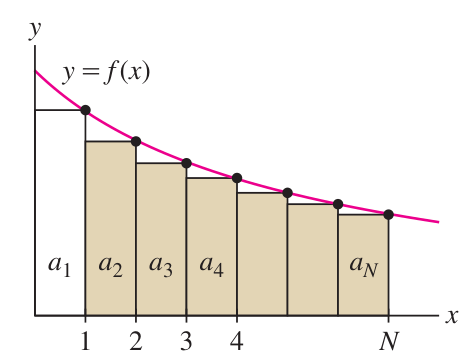
To show that integral convergence implies series convergence, consider the diagram:
This shows that for any . Therefore, if converges, then is bounded (independent of ) and so is bounded by that inequality. But ; so by adding to the bound, we see that itself is bounded, which implies that converges.
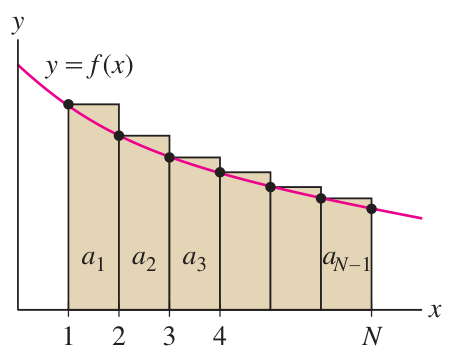
To show that integral divergence implies series divergence, consider a similar diagram:
This shows that for any . Therefore, if diverges, then goes to as , and so goes to as well. So diverges.
Notice: the picture shows entirely above (or below) the rectangles. This depends upon being monotone decreasing, as well as . (This explains the applicability conditions.)
Next we use the integral test to evaluate the family of -series, and later we can use -series in comparison tests without repeating the work of the integral test.
-series
A -series is a series of this form:
Convergence properties:
Link to originalExtra - Proof of -series convergence
(1) To verify the convergence properties of -series, apply the integral test:
Applicability: verify it’s continuous, positive, decreasing.
Convert to to obtain the function .
Indeed is continuous and positive and decreasing as increases.
(2) Apply the integral test.
Integrate, assuming :
When we have
When we have
When , integrate a second time:
Conclude: the integral converges when and diverges when .
We could instead immediately refer to the convergence results for -integrals instead of reproving them here.
04 Illustration
Example - -series examples
p-series examples
By finding and applying the -series convergence properties:
We see that converges: so
But diverges: so
Link to original
Example - Integral test - pushing the envelope of convergence
Integral test - pushing the envelope of convergence
Does converge?
Does converge?
Notice that grows very slowly with , so is just a little smaller than for large , and similarly is just a little smaller still.
Solution
(1) The two series lead to the two functions and .
Check applicability.
Clearly and are both continuous, positive, decreasing functions on .
(2) Apply the integral test to .
Integrate :
Conclude: diverges.
(3) Apply the integral test to .
Integrate :
Conclude: converges.
Link to original
05 Theory
Theory 2
Link to originalDirect Comparison Test (DCT)
Applicability: Both series are positive: and .
Test Statement: Suppose for large enough . (Meaning: for with some given .) Then:
- Smaller pushes up bigger:
- Bigger controls smaller:
06 Illustration
Example - Direct comparison test: rational functions
Direct comparison test: rational functions
(a)
Choose: and
Check:
Observe: is a convergent geometric series
Therefore: converges by the DCT.
(b)
Choose: and .
Check:
Observe: is a convergent -series
Therefore: converges by the DCT.
(c)
Choose: and
Check: (notice that )
Observe: is a convergent -series
Therefore: converges by the DCT.
(d)
Choose: and
Check:
Observe: is a divergent -series
Therefore: diverges by the DCT.
Link to original
07 Theory
Theory 3
Some series can be compared using the DCT after applying certain manipulations and tricks.
For example, consider the series . We suspect convergence because for large . But unfortunately, always, so we cannot apply the DCT.
We could make some ad hoc arguments that do use the DCT, eventually:
Trick Method 1:
- Observe that for we have . (Check it!)
- But converges, indeed its value is , which is .
- So the series converges.
Trick Method 2:
- Observe that we can change the letter to by starting the new at .
- Then we have:
- This last series has terms smaller than so the DCT with (a convergent -series) shows that the original series converges too.
These convoluted arguments suggest that a more general version of Comparison is possible.
Indeed, it is sufficient to compare the relative large-n behavior of the two series. We use the termwise ratios to estimate comparative behavior for increasing .
Limit Comparison Test (LCT)
Applicability: Both series are positive: and .
Test Statement: Suppose that . Then: If , i.e. finite non-zero, then:
Extra - LCT edge cases
If or , we can still draw an inference, but only in one direction:
- If :
- If :
Link to originalExtra - Limit Comparison Test explanation
Suppose and . Then for sufficiently large, we know .
Doing some algebra, we get for large.
If converges, then also converges (constant multiple), and then the DCT implies that converges.
Conversely: we also know that , so for all sufficiently large. Thus if converges, also converges, and by the DCT again converges too.
The cases with or are handled similarly.
08 Illustration
Example - Limit Comparison Test examples
Limit comparison test examples
(a)
Choose: and .
Compare in the limit:
Observe: is a convergent geometric series
Therefore: converges by the LCT.
(b)
Choose: ,
Compare in the limit:
Observe: is a divergent -series
Therefore: diverges by the LCT.
(c)
Choose: and
Compare in the limit:
Observe: is a converging -series
Therefore: converges by the LCT.
Link to original
Alternating series
Videos
Review Videos
Videos, Math Dr. Bob:
Link to original
- Alternating Series Test: Theory and basic examples
- Alternating Series Test: Remainder estimates
- Alternating Series Test: Further remainder estimates
09 Theory
Theory 1
Consider these series:
The absolute values of terms are the same between these series, only the signs of terms change.
The first is a positive series because there are no negative terms.
The second series is the negation of a positive series – the study of such series is equivalent to that of positive series, just add a negative sign everywhere. These signs can be factored out of the series. (For example .)
The third series is an alternating series because the signs alternate in a strict pattern, every other sign being negative.
The fourth series is not alternating, nor is it positive, nor negative: it has a mysterious or unknown pattern of signs.
A series with any negative signs present, call it , converges absolutely when the positive series of absolute values of terms, namely , converges.
THEOREM: Absolute implies ordinary
If a series converges absolutely, then it also converges as it stands.
A series might converge due to the presence of negative terms and yet not converge absolutely:
A series is said to be converge conditionally when the series converges as it stands, but the series produced by inserting absolute values, namely , diverges.
The alternating harmonic series above, , is therefore conditionally convergent. Let us see why it converges. We can group the terms to create new sequences of pairs, each pair being a positive term. This can be done in two ways. The first creates an increasing sequence, the second a decreasing sequence:
Suppose gives the sequence of partial sums of the original series. Then gives the first sequence of pairs, namely , , , . And gives the second sequence of pairs, namely , , , .
The second sequence shows that is bounded above by , so is monotone increasing and bounded above, so it converges. Similarly is monotone decreasing and bounded below, so it converges too, and of course they must converge to the same thing.
The fact that the terms were decreasing in magnitude was an essential ingredient of the argument for convergence. This fact ensured that the parenthetical pairs were positive numbers.
Alternating Series Test (AST) - “Leibniz Test”
Applicability: Alternating series only: with
Test Statement: If:
- as (i.e. it passes the SDT: if this fails, conclude diverges)
- are decreasing, so
Then:
“Next Term Bound” rule for error of the partial sums:
Link to originalExtra - Alternating Series Test: Theory
Just as for the alternating harmonic series, we can form positive paired-up series because the terms are decreasing:
The first sequence is monotone increasing from , and the second is decreasing from . The first is therefore also bounded above by . So it converges. Similarly, the second converges. Their difference at any point is which is equal to , and this goes to zero. So the two sequences must converge to the same thing.
By considering these paired-up sequences and the effect of adding each new term one after the other, we obtain the following order relations:
Thus, for any even and any odd :
Now set and subtract from both sides:
Now set and subtract from both sides:
This covers both even cases () and odd cases (). In either case, we have:
10 Illustration
Example - Alternating Series Test: Basic illustration
Alternating series test: basic illustration
(a) converges by the AST.
Notice that diverges as a -series with .
Therefore the first series converges conditionally.
(b) converges by the AST.
Notice the funny notation: .
This series converges absolutely because , which is a -series with .
Link to original
Example - Approximating
Approximating pi
The Taylor series for is given by:
Using the AST “next term bound,” how many terms are needed to approximate to within ?
Solution
(1) The main idea is to use and thus . Therefore:
and thus:
(2) Write for the error of the approximation, meaning .
By the AST error formula, we have .
We desire such that . Therefore, calculate such that , and then we will know:
(3) The general term is . Plug in in place of to find . Now solve:
We conclude that at least terms are necessary to be confident (by the error formula) that the approximation of is accurate to within .
Link to original