Parametric curves
Videos
Review Videos
Videos, Organic Chemistry Tutor
Link to original
01 Theory
Theory 1
Parametric curves are curves traced by the path of a ‘moving’ point. An independent parameter, such as for ‘time’, controls both and values through Cartesian coordinate functions and . The coordinates of the moving point are .
Parametric curve
A parametric curve is a function from parameter space to the plane given in terms of coordinate functions:
Other notations
Be aware that sometimes the coordinate functions are written with and (or yet other letters) like this:
Or simply equating coordinate letters with functions:
Sometimes a different parameter is used, like or .
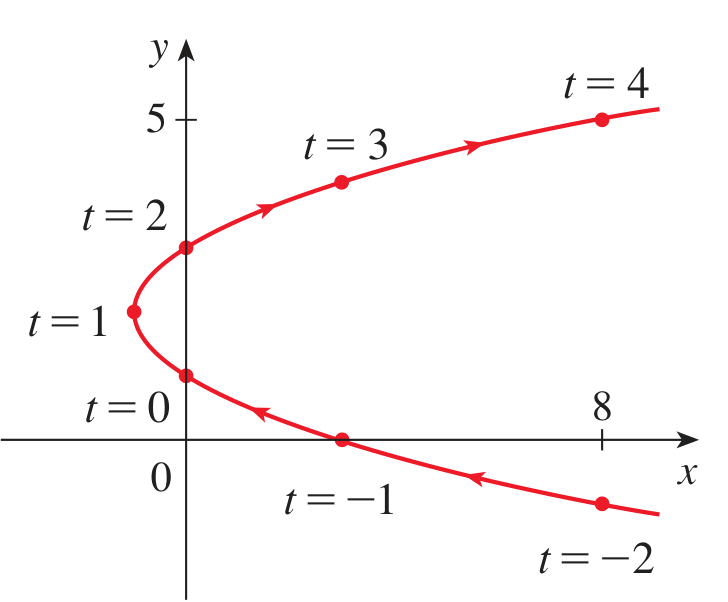
For example, suppose:
The curve traced out is a parabola that opens horizontally:
Given a parametric curve, we can create an equation satisfied by and variables by solving for in either coordinate function (inverting either or ) and plugging the result into the other function.
In the example:
This is the equation of a parabola centered at that opens to the right.
Image of a parametric curve
The image of a parametric curve is the set of output points that are traversed by the moving point.
A parametric curve has hidden information that isn’t contained in the image:
- The time values when the moving point is found in various locations.
- The speed at which the curve is traversed.
- The direction in which the curve is traversed.
We can reparametrize a parametric curve to use a different parameter or different coordinate functions while leaving the image unchanged.
In the previous example, shift by :
Since the parameter and the parameter both cover the same values for , the same curve is traversed. But the moving point in the second, shifted version reaches any given location one unit earlier in time. (When in the second version, the input to and is the same as when in the first one.)
Link to original
02 Illustration
Example - Parametric circles
Parametric circles
The standard equation of a circle of radius centered at the point :
This equation says that the distance from a point on the circle to the center point equals . This fact defines the circle.
Parametric coordinates for the circle:
For example, the unit circle is parametrized by and .
Link to original
Example - Parametric lines
Parametric lines
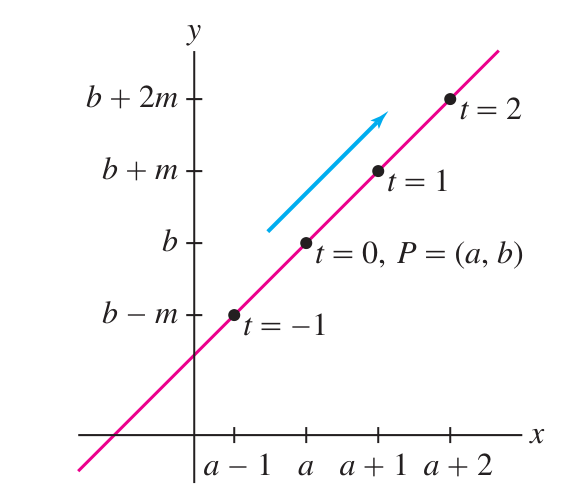
(1) Parametric coordinate functions for a line:
Compare this to the graph of linear function:
Vertical lines cannot be described as the graph of a function. We must use .
(2) Parametric lines can describe all lines equally well, including horizontal and vertical lines.
A vertical line is achieved by setting and .
A horizontal line is achieved by setting and .
A non-vertical line may be achieved by setting and , and .
(3) Assuming that , the parametric coordinate functions describe a line satisfying:
and therefore the slope is and the -intercept is .
(4) The point-slope construction of a line has a parametric analogue:
Link to original
Example - Parametric ellipses
Parametric ellipses
The general equation of an ellipse centered at with half-axes and is:
This equation represents a stretched unit circle:
- by in the -axis
- by in the -axis
Parametric coordinate functions for the general ellipse:
Link to original
Example - Parametric cycloids
Parametric cycloids
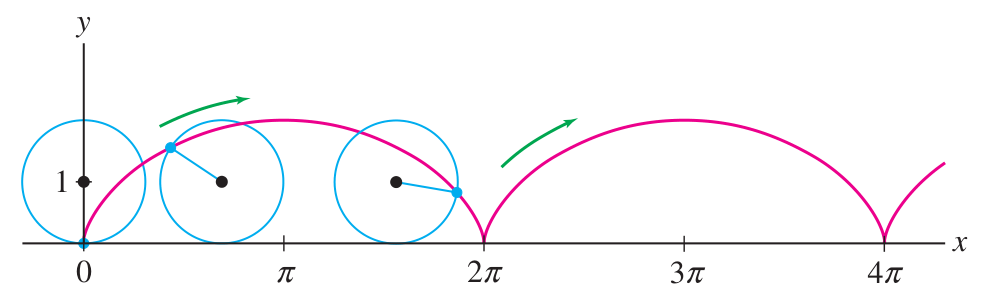
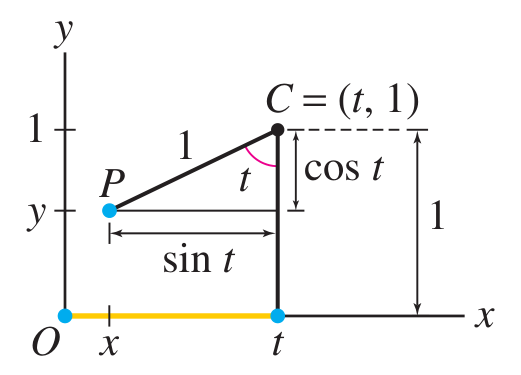
The cycloid is the curve traced by a pen attached to the rim of a wheel as it rolls.
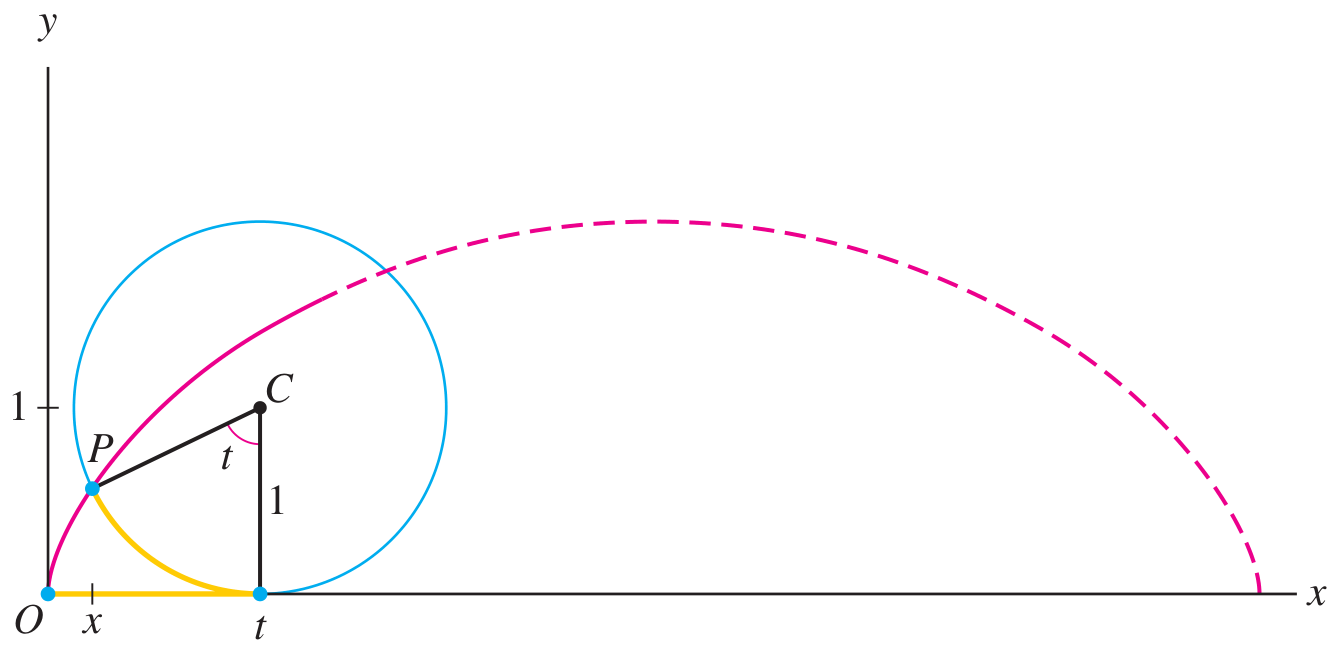
It is easy to describe the cycloid parametrically. Consider the geometry of the situation:
The center of the wheel is moving rightwards at a constant speed of , so its position is . The angle is revolving at the same constant rate of (in radians) because the radius is .
The triangle shown has base , so the coordinate is . The coordinate is .
So the coordinates of the point are given parametrically by:
If the circle has another radius, say , then the parametric formulas change to:
Link to original
Calculus with parametric curves
03 Theory - Slope, concavity
Theory 1
We can use and data to compute the slope of a parametric curve in terms of .
Slope formula
Given a parametric curve , its slope satisfies:
Concavity formula
Given a parametric curve , its concavity satisfies the formula:
Extra - Derivation of slope and concavity formulas
For both derivations, it is necessary to view as a function of through the inverse parameter function. For example if is the parametrization, then is the inverse parameter function.
We will need the derivative in terms of . For this we use the formula for derivative of inverse functions:
Given all this, both formulas are simple applications of the chain rule.
For the slope:
For the concavity:
(In the second step we inserted the formula for from the slope.)
Pure vertical, Pure horizontal movement
In view of the formula , we see:
- Pure vertical: when and yet
- Pure horizontal: when and yet
When for the same , we have a stationary point, which might subsequently progress into pure vertical, pure horizontal, or neither.
Link to original
04 Illustration
Example - Tangent to a cycloid
Tangent to a cycloid
Find the tangent line (described parametrically) to the cycloid when .
Solution
(1) Compute and .
Find and :
(2) Plug in :
(3) Apply formula: :
Calculate at :
So:
This is the slope for our line.
(4) Need the point for our line. Find at .
Plug into parametric formulas:
(5) Point-slope formulation of tangent line:
Inserting data:
Link to original
Example - Vertical and horizontal tangents of the circle
Vertical and horizontal tangents of the circle
Consider the circle parametrized by and . Find the points where the tangent lines are vertical or horizontal.
Solution
(1) For the points with vertical tangent line, we find where the moving point has (purely vertical motion):
The moving point is at when , and at when .
(2) For the points with horizontal tangent line, we find where the moving point has (purely horizontal motion):
The moving point is at when , and at when .
Link to original
Example - Finding the point with specified slope
Finding the point with specified slope
Consider the parametric curve given by . Find the point where the slope of the tangent line to this curve equals 5.
Solution
(1) Compute the derivatives:
Therefore the slope of the tangent line, in terms of :
(2) Set up equation:
(3) Find the point:
Link to original