Due date: Tuesday 10/21, 11:59pm
Joint distributions
01
01
Finish a PMF table - Strange families
Suppose that 15 percent of the families in a strange community have no children, 20 percent have 1 child, 35 percent have 2 children, and 30 percent have 3 children. Assume the odds of a child being a boy or a girl are equal.
If a family is chosen at random from this community, then
, the number of boys, and , the number of girls, in this family will have the joint PMF partially shown in this table:
0 1 2 3 0 0.15 0.10 ? 0.0375 0.3750 1 0.10 0.175 ? 0.00 0.3875 2 ? ? 0.00 0.00 0.2000 3 0.0375 0.00 0.00 0.00 0.0375 0.3750 0.3875 0.2000 0.0375 [not used] (a) Complete the table by finding the missing entries.
(b) What is the probability that “
or is 1”? Link to originalSolution
11
(a)
Fill the cells using the respective column sum or row sum.
We have , so
: We have , so
: We have , so
: We have , so
(b)
(1) Add up the probabilities in which either
or .
(2) Alternatively, you could use the inclusion-exclusion principle using the marginal sums.
Link to original
02
08
Sales rep making calls
A sales representative is responsible for selling a particular item. On a given day, he has time to make a sales pitch to up to 3 customers. His goal is to sell the item to 2 customers; if he is successful with the first two, he will not try to sell to the
customer. The probability of any one customer purchasing the item is 0.6, independent of the others. Let
be the number of customers to which he tries to sell the item and be the number of customers that purchase the item. Construct the joint PMF of and . Link to originalSolution
12
Link to original
2 3
03
10
Soft-drink machine
A soft-drink machine has a random amount
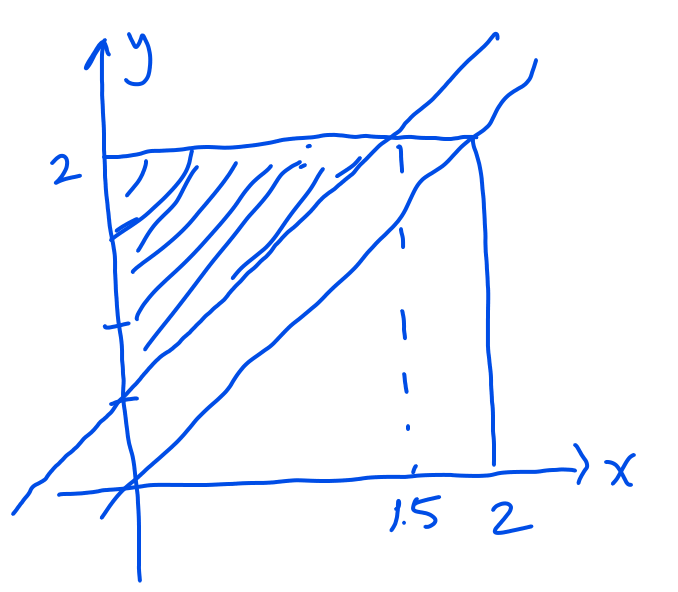
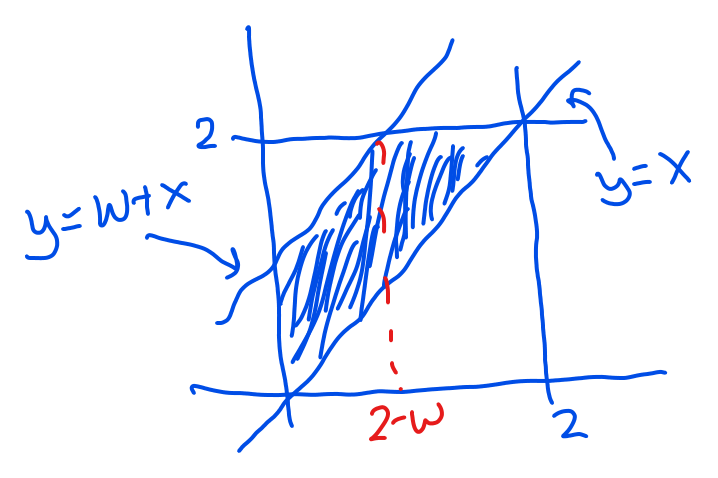
in supply at the beginning of a given day and dispenses a random amount during the day (with measurements in gallons). It is not resupplied during the day, and therefore . It has been observed that and have a joint density given by: (a) Find the probability that the amount of soft-drink dispensed on a given day is greater than 1.5 gallons. (First compute the marginal PDF of
.) (b) Find the probability that the amount of soda remaining in the machine at the end of the day is greater than
gallon. That is, find . (c) Find the CDF of
, the amount of soda remaining in the machine at the end of the day. Link to originalSolution
07
(a)
Marginal PDF of
is: Then:
(b)
(c)
Link to original
04
11
Alice and Bob meeting at a cafe
Alice and Bob plan to meet at a cafe to do homework together. Alice arrives at the cafe at a random time (uniform) between 12:00pm and 1:00pm; Bob independently arrives at a random time (uniform) between 12:00pm and 2:00pm on the same day. Let
be the time, past 12:00pm, that Alice arrives (in hours) and be the time, past 12:00pm, that Bob arrives (in hours). So and represent 12:00pm. Recall the joint PDF of
and from the previous HW. (a) Consider
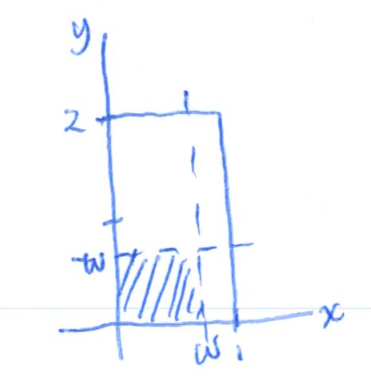
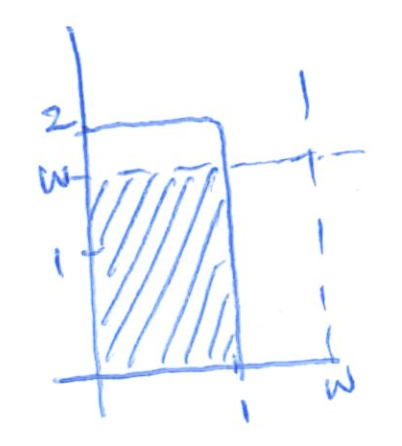
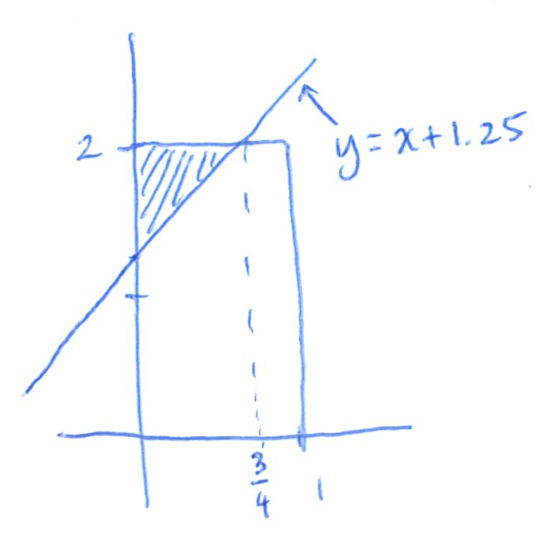
, the time that will pass (beyond 12:00pm) before Alice and Bob will begin working together. Find the CDF of W. (b) Find the probability Alice will have to wait more than 75 minutes for Bob.
Link to originalSolution
09
(a)
Case 1:
:
Case 2:
:
(b)
Link to original
Independent random variables
05
01
Random point in a triangle
Consider a joint distribution that is uniform over the triangle with vertices
, and . Suppose a point is chosen at random according to this distribution. (a) Find the joint PDF
. (b) Find the marginal PDFs for
and . (c) Are
and independent? Link to originalSolution
13
(a)
Find the area of the triangle, and find a formula for the PDF.
The area of the triangle is
. Therefore the PDF is
(b)
(1) Integrate with respect to
to find the marginal PDF for .
(2) Integrate with respect to
to find the marginal PDF for .
(c)
(1) Compute the product
and compare to .
(2) Consider the case wherein
Therefore,
Link to originaland are not independent.
06
02
Factorizing the density
Consider two joint density functions for
and : (Assume the densities are zero outside the given domain.)
Supposing
is the joint density, are and independent? Why or why not? Supposing is the joint density, are and independent? Why or why not? Correction Update: the
coefficient in is incorrect, it should be a constant which is irrational. If you wish, you may instead substitute as the formula over the same domain for . Link to originalSolution
14
(1) Compute the marginal distribution of
by integrating with respect to .
(2) Compute the marginal distribution of
by integrating with respect to .
(3) Determine independence by multiplying the marginal pdfs.
Since the product of the marginal PDFs equals the joint PDF, we conclude that
and are independent.
(4) Compute the marginal distribution of
by integrating with respect to .
(5) Compute the marginal distribution of
by integrating with respect to .
(6) Determine independence by multiplying the marginal pdfs.
Therefore,
Link to originaland are not independent.
Review
07
07
Square root
Suppose that
. Let
. Find the PDF of . Link to originalSolution
08
(1) PDF of
:
(2) CDF of
:
(3) PDF of
: Link to original
08
08
Blood sugar testing
A test for diabetes is a measurement
of a person’s blood sugar level following an overnight fast. If a person has diabetes, is a Gaussian random variable. Now suppose that the doctor has decided to use the following scores: positive for diabetes if
140, negative if , and the test is inconclusive if . Find the probability the test result will be inconclusive for a person who has diabetes.
Link to originalSolution
Optional challenge problem
- Complete this problem instead of one of the Review problems of your choice.
- You must indicate on your paper which of the Review problems should be replaced by this one. Indicate at the chosen problem (can otherwise leave blank) to direct the grader to the last page where you work this challenge problem.
09
04
Joint CDF on box events: All four corners
Consider the following formula:
Prove this formula. Hint: Do these steps along the way:
- Draw these events in the
-plane:
- Draw the event
. Write the probability of this event in terms of . Link to originalSolution
15
(1) Write the event
in terms of .
(2) Write the terms
, , and in terms of .
(3) Simplify expression for
. Link to original