01 Theory
Theory 1
THEOREM: Continuous PDF of a sum
Let be any joint continuous PDF.
Suppose . Then:
When and are independent, so , this becomes convolution:
Link to originalExtra - Derivation of PDF
The joint CDF of :
Find by differentiating:
To calculate this derivative, change variables by setting and . The Jacobian is 1, so becomes , and we have:
02 Illustration
Example - Sum of parabolic random variables
Sum of parabolic random variables
Suppose is an RV with PDF given by:
Let be an independent copy of . So , but is independent of .
Find the PDF of .
Solution
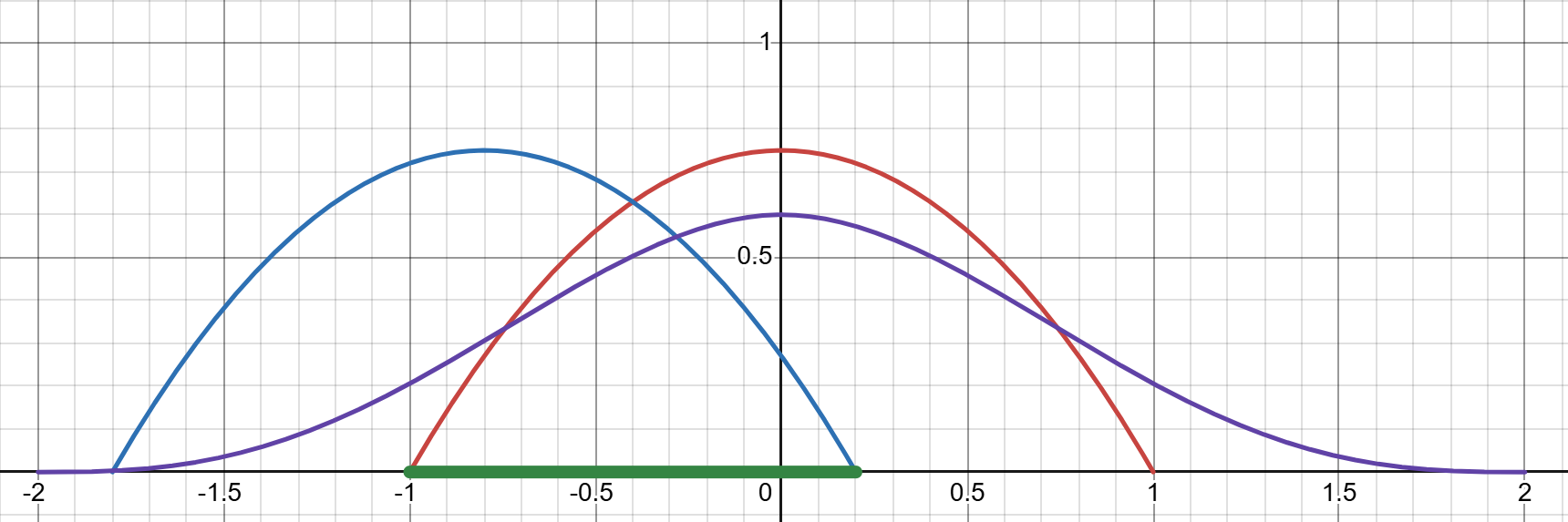
The graph of matches the graph of except (i) flipped in a vertical mirror, (ii) shifted by to the left.
When , the integrand is nonzero only for :
When , the integrand is nonzero only for :
Final result is:
Link to original
03 Theory - extra
Theory 3
Videos by 3Blue1Brown:
Convolution
The convolution of two continuous functions and is defined by:
For more example calculations, look at 9.6.1 and 9.6.2 at this page.
Applications of convolution
- Convolutional neural networks (machine learning theory: translation invariant NN, low pre-processing)
- Image processing: edge detection, blurring
- Signal processing: smoothing and interpolation estimation
- Electronics: linear translation-invariant (LTI) system response: convolution with impulse function
Link to originalExtra - Convolution
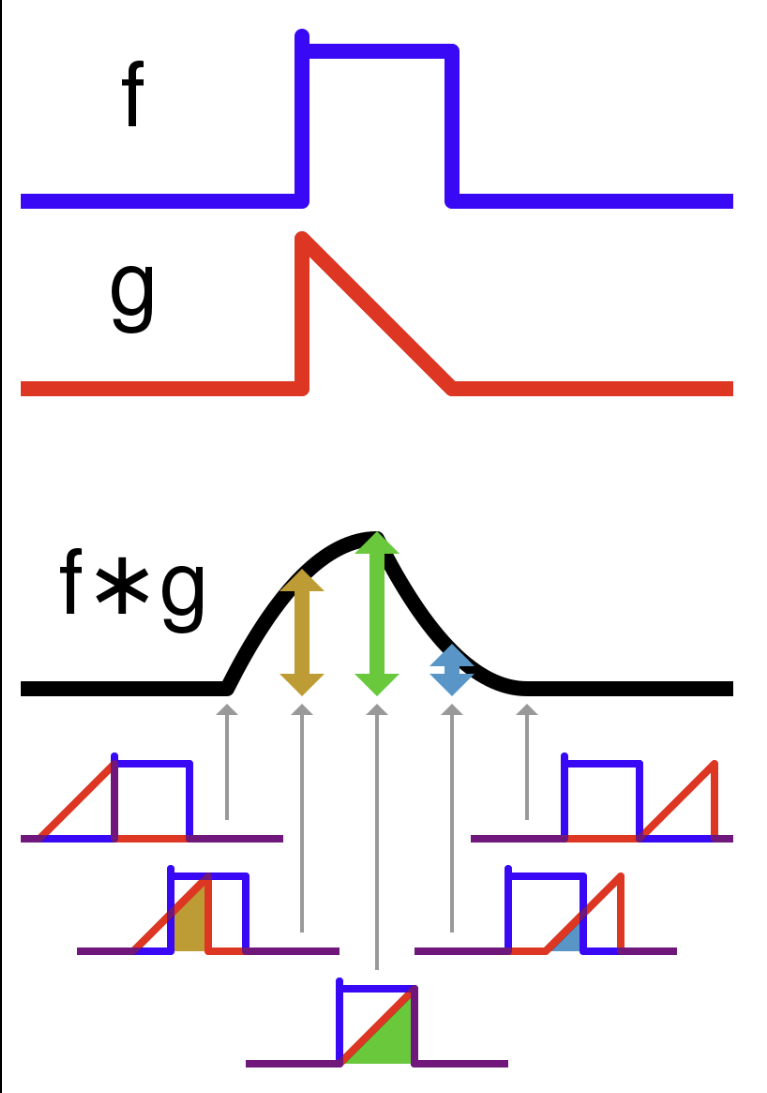
Geometric meaning of convolution Convolution does not have a neat and precise geometric meaning, but it does have an imprecise intuitive sense.
The product of two quantities tends to be large when both quantities are large; when one of them is small or zero, the product will be small or zero. This behavior is different from the behavior of a sum, where one summand being large is sufficient for the sum to be large. A large summand overrides a small co-summand, whereas a large factor is scaled down by a small cofactor.
The upshot is that a convolution will be large when two functions have similar overall shape. (Caveat: one function must be flipped in a vertical mirror before the overlay is considered.) The argument value where the convolution is largest will correspond to the horizontal offset needed to get the closest overlay of the functions.
Algebraic properties of convolution
The last of these is not the typical Leibniz rule for derivatives of products!
All of these properties can be checked by simple calculations with iterated integrals.
Convolution in more variables Given , their convolution at is defined by integrating the shifted products over the whole domain: