Due date: Sunday 3/15, 11:59pm
Positive series
01
04
Link to originalIntegral Test (IT)
Determine whether the series is convergent by using the Integral Test.
Show your work. You must check that the test is applicable.
(a) (b) (c)
Solution
Solutions - 0180-04
(a) Verify applicability of the integral test:
- is continuous for all . (Only discontinuity is at , but the series starts at .)
- since for all .
- is monotone decreasing, since as increases, the denominator increases, and the term decreases.
Apply the integral test:
This is finite and the improper integral converges, so the series converges by the Integral Test.
(b) Verify applicability of the integral test with :
- is definitely continuous for all .
- since and for all .
- Decreasing?
- has zeros at .
- When , .
- Series starts at , so the terms are monotone decreasing.
Apply the integral test:
This is finite and the improper integral converges, so the series converges by the Integral Test.
(c) Verify applicability of the integral test for :
- is continuous for all . (The only discontinuity is at , but the series starts at .)
- since for all .
- is monotone decreasing, since as increases, the denominator increases, and the term decreases.
Apply the integral test:
So the improper integral diverges, and the series diverges by the Integral Test.
Link to original
02
06
Link to originalLimit Comparison Test (LCT)
Use the Limit Comparison Test to determine whether the series converges:
Show your work. You must check that the test is applicable.
Solution
Solutions - 0180-06
For very large , we expect the exponentials to dominate, and the series looks like . This will yield a converging geometric series. Anyway, let us choose as the comparison series.
Now divide above and below by the leading power:
By L’Hopital’s Rule, we find that:
Therefore:
Since , the LCT says that both series converge, or both diverge.
Now and this is geometric with . Therefore it converges, and the original series must converge too.
Link to original
03
05
Link to originalIT, DCT, LCT
Determine whether the series converges by checking applicability and then applying the designated convergence test.
(a) Integral Test:
(b) Direct Comparison Test:
(c) Limit Comparison Test:
Solution
Solutions - 0180-05
(a)
Set . Applicability of the IT:
- is is continuous other than at , and the series starts at .
- since for all , and for all .
- . This is zero at . For , , so the function is decreasing.
Apply the integral test:
This is finite, so the original series converges by the IT.
(b) For very large , the large powers dwarf the small powers, and the terms look like which equals . So we take this for a comparison series and apply the DCT:
But converges (). So by the DCT, the original series converges.
(c) For very large , the large powers dwarf the small powers, and the terms look like which equals . So we take this for a comparison series and apply the LCT:
Observe that . Therefore the LCT says that both series converge or both diverge.
We know that converges (). So by the LCT, the original series converges.
Link to original
Alternating series
04
02
Link to originalAbsolute and conditional convergence
Determine whether the series are absolutely convergent, conditionally convergent, or divergent by applying series tests.
Show your work. You must check that the test is applicable.
(a) (b)
Solution
Solutions - 0190-07
(a) We first check for absolute convergence:
This fails the SDT, so the series diverges!
(b) Notice that . Check for absolute convergence:
Then:
Since converges (), the DCT says that converges. So the original series converges absolutely and we are done.
Link to original
Sequences and series - additional practice
05
06
Link to originalLimits and convergence
For each sequence, either write the limit value (if it converges), or write ‘diverges’.
(a) (b) (c) (d)
(e) (f) (g) (h)
Solution
Solutions - 0140-06
(a) diverges (b) (c) diverges (d)
(e)
(f) diverges:
(g)
(h)
Use L’Hopital’s Rule:
Link to original
06
07
Link to originalLimits and convergence
For each sequence, either write the limit value (if it converges), or write ‘diverges’.
(a) (b) (c) (d)
(e) (f) (g)
Solution
Solutions - 0140-07
(a)
(b) diverges:
(Note that .)
(c) :
L’Hopital’s Rule:
(d) by (c), the sign doesn’t affect convergence to
(e) :
Multiply above and below by :
(f) :
This is a well-known formula for . If that formula is not used as the definition of , then it would not be circular reasoning to argue as follows:
(g) diverges:
So:
Link to original
07
03
Link to originalGeometric series
Compute the following summation values using the sum formula for geometric series.
(a) (b)
Solution
Solutions - 0150-03
(a)
First term:
Common ratio is .
Geometric series summation formula, always first term on top:
(b)
First term:
Common ratio:
Geometric series summation formula:
Link to original
08
02
Link to originalGeometric series
Compute the following summation values using the sum formula for geometric series.
(a) (b)
Solution
Solutions - 0150-02
(a)
The first term is . The common ratio is . Therefore the sum:
(b)
Split numerator and obtain two geometric series:
Geometric series total sum formula:
Link to original
09
04
Link to originalRepeating digits
Using the geometric series formula, find the fractional forms of these decimal numbers:
(a) (b)
Solution
Solutions - 0150-04
(a)
First term: .
Common ratio:
Geometric series summation formula:
(b)
This is geometric starting with .
First term: .
Common ratio: .
Geometric series summation formula:
Add back the first term:
Link to original
10
07
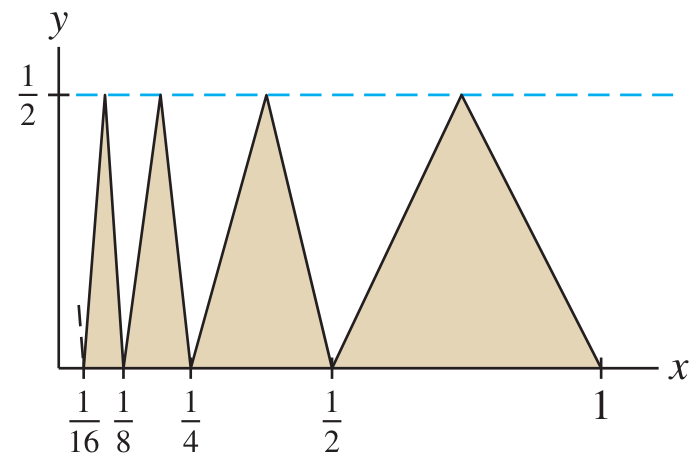
Link to originalTotal area of infinitely many triangles
Find the area of all the triangles as in the figure:
(The first triangle from the right starts at , and going left they never end.)
Solution
Solutions - 0150-07
Compute the first few areas, with being the area of the largest triangle:
This is a geometric series with :
Geometric series total sum formula:
Link to original
