Stepwise problems - Sun. Nov 23, 11:59pm
Polar curves
01
01
Convert points: Cartesian to Polar
Convert the Cartesian (rectangular) coordinates for these points into polar coordinates:
(a)
(b) (c) (d) Link to originalSolution
01
(a)
Q1, SAFE,
.
(b)
Q1, SAFE,
.
(c)
Q2, UNSAFE,
and we add to this angle.
(d)
Q2, UNSAFE,
Link to original(use 30-60-90 triangle) and we add to this angle.
02
02
Convert equations: Polar to Cartesian
Convert the polar equation to a Cartesian equation. Be sure to simplify.
(a)
(b) (c) Link to originalSolution
02
(a)
(b)
Use
and therefore: So:
This is a circle centered at
with radius .
(c)
Using
and : Note: This assumes that
Link to original.
Calculus with polar curves
03
01
Polar curve - Vertical or horizontal tangent lines
Find all points on the given curve where the tangent line is horizontal or vertical.
Hint: First determine parametric Cartesian coordinate functions using
as the parameter. Link to originalSolution
03
Observe that this parametric curve is a circle centered at
with radius . So we expect vertical tangents at and horizontal tangents at . Treat
as the parameter. We always have . This equals here because . Since we can further simplify to . Then
. Also
.
To find vertical tangents, solve for
: Check that
is not also zero at these points, else they would be stationary points: Now find the Cartesian coordinates for these points:
To find the horizontal tangents, solve for
: Check that
is not also zero at these points, else they would be stationary points: Now find the Cartesian coordinates for these points:
Link to original
Regular problems - Sun. Nov 30, 11:59pm
Polar curves
05
03
Convert points: Polar to Cartesian
Convert the polar coordinates for these points into Cartesian (rectangular) coordinates:
(a)
(b) (c) (d) Link to originalSolution
04
(a)
(b)
Method 1:
First compute
and . Then and . Method 2:
Observe
. Then , and obtain the answer.
(c)
(d)
Link to original
06
04
Convert equations: Cartesian to Polar
Convert the Cartesian equation to a polar equation. Be sure to simplify.
(a)
(b) (c) Link to originalSolution
05
(a)
(b) (c) (a)
Insert
and :
(b)
(c)
Link to original
07
05
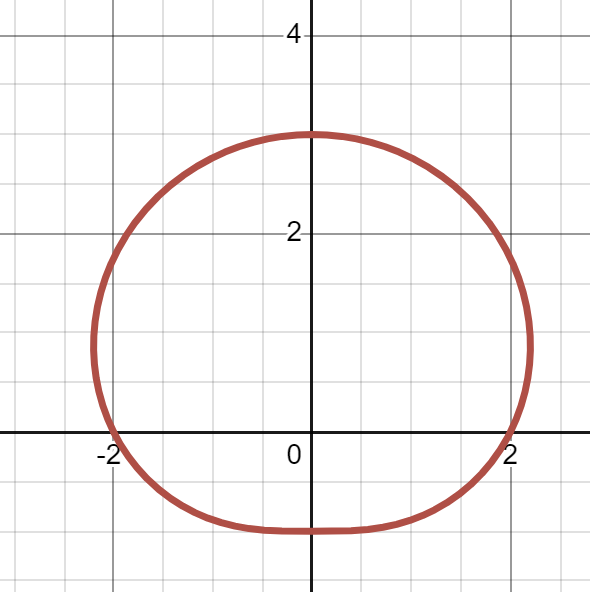
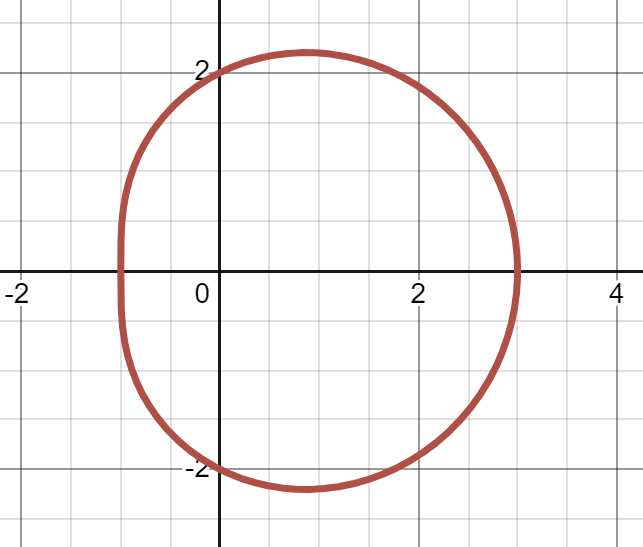
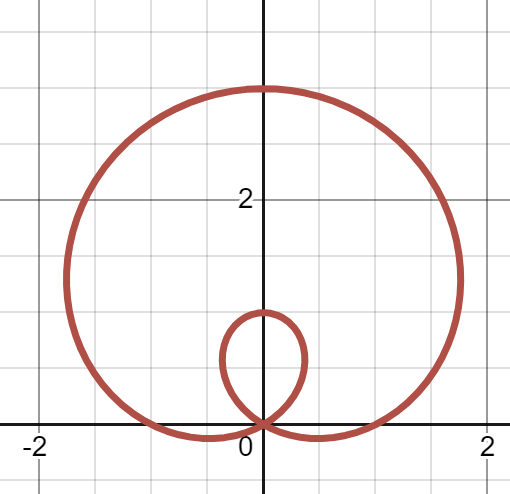
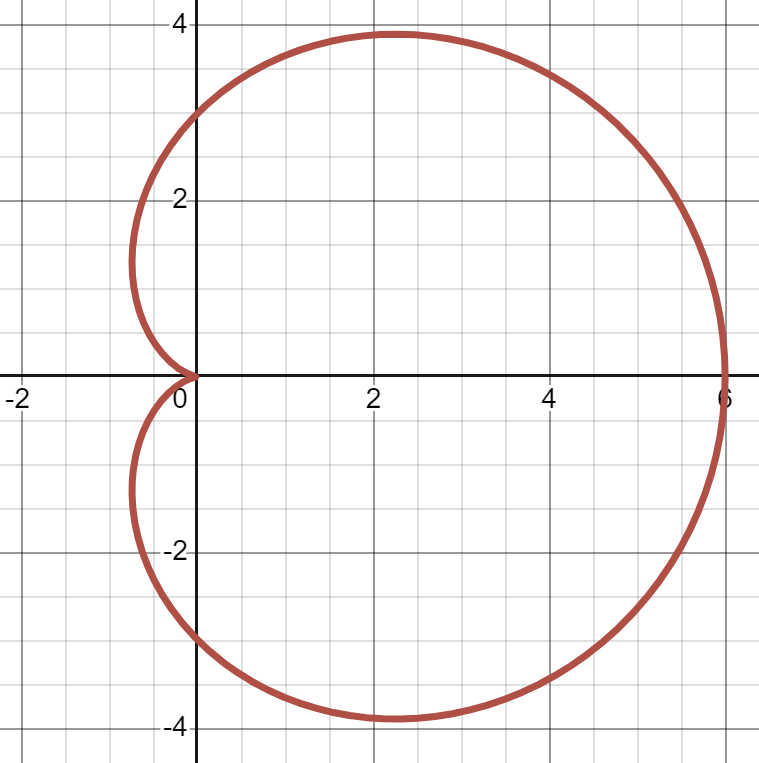
Sketching limaçons
Sketch the graphs of the following polar functions:
(a)
(b) (c)
(d) Link to originalSolution
06
(a)
(b)
(c)
(d)
Link to original
08
06
Sketching roses
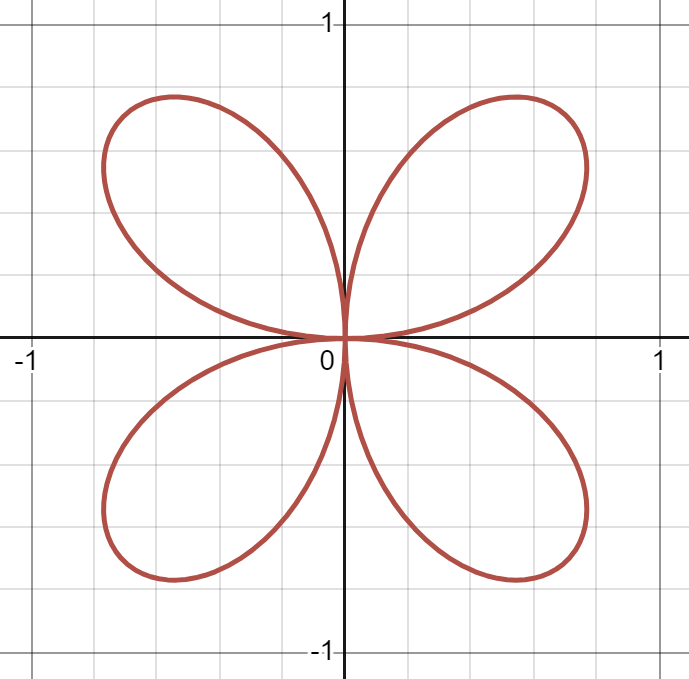
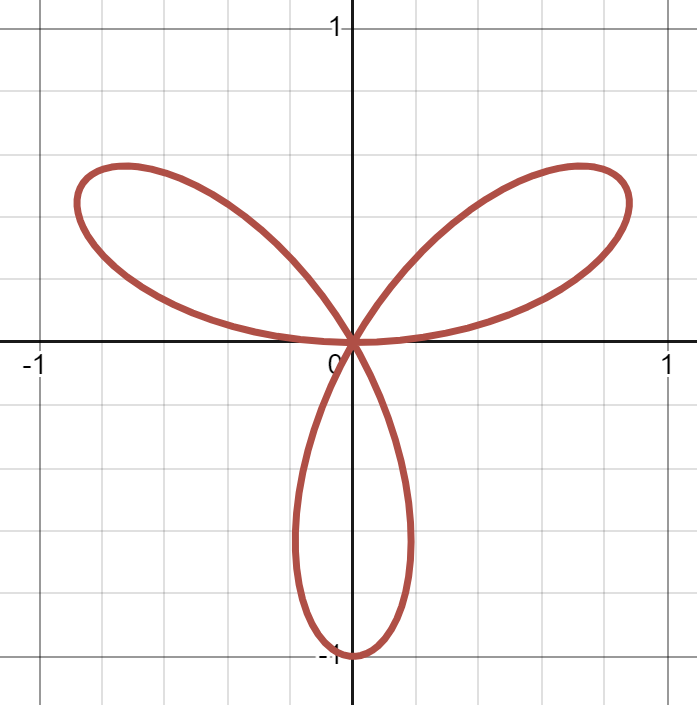
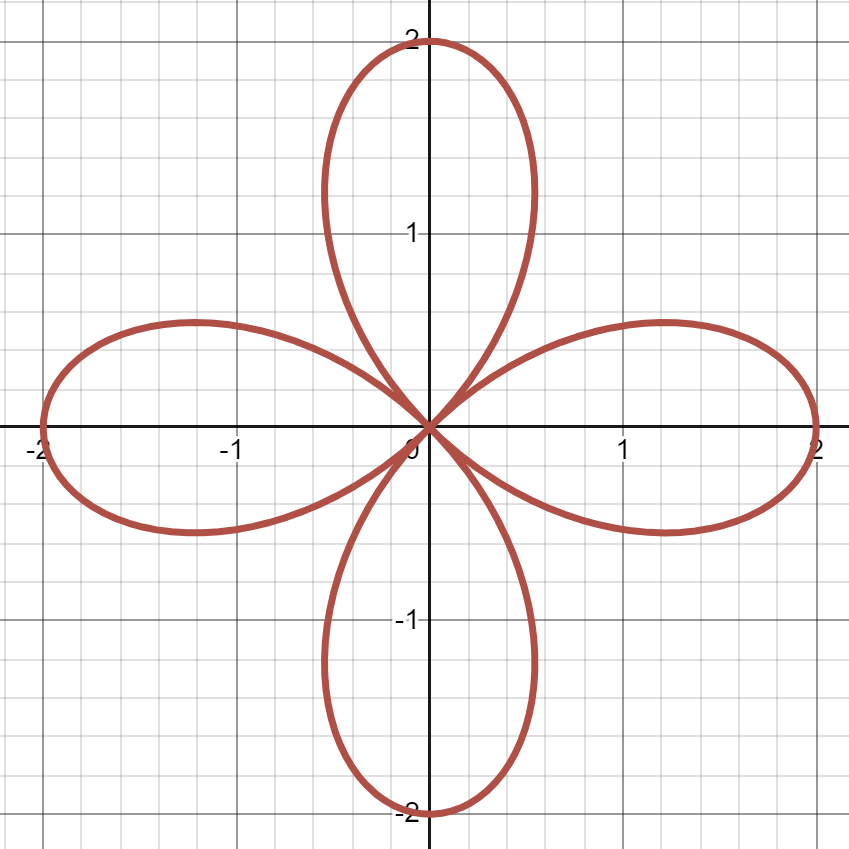
Sketch the graphs of the following polar functions. Use numbers to label the order in which the leaves/loops are traversed.
(a)
(b) (c) Link to originalSolution
07
(a)
Numbers should be placed on the loops, 1, 2, 3, 4, starting in Q1 and going clockwise.
(b)
Numbers should be placed on the loops, 1, 2, 3, starting in Q1 and going clockwise.
(c)
Numbers should be placed on the loops, 1, 2, 3, 4, starting on the
Link to original-axis and going clockwise.
Calculus with parametric curves
09
05
Minimum speed of a particle
Suppose a travelling particle has position modelled by the parametric curve:
What is the slowest speed of the particle?
Link to originalSolution
08
Derivatives:
Speed function:
Now we minimize this function as in Calc I.
Method 1:
Differentiate:
This equals zero if-and-only-if the numerator equals zero (assuming the denominator is not zero there):
Since
is negative for and positive for , we may deduce that is the time of the minimal value of . So: Method 2:
Instead of differentiating
Link to original, we can look at its square , since the minimum of this will occur at the same time as the minimum of (because is a monotone increasing function). But becomes , and the rest of the solution proceeds as in Method 1.
10
06
Cycloid - Arclength and surface area of revolution
Consider the cycloid given parametrically by
. (a) Find the length of one arch of the cycloid.
(b) Suppose one arch of the cycloid is revolved around the
-axis. Find the area of this surface of revolution. Link to originalSolution
09
(a)
One arch is formed from the range
. Compute
: Therefore
. Now recall a power-to-frequency formula, and use it in reverse:
Therefore:
(b)
Link to original