Trig power products
Videos
Review Videos
Videos, Math Dr. Bob:
Videos, Organic Chemistry Tutor:
Link to original
01 Theory
Theory 1
Review: trig identities
Trig power product:
A power product has this form:
for some integers and (even negative!).
To compute these integrals, use a sequence of these techniques:
- Swap an even bunch.
- -sub for power-one.
- Power-to-frequency conversion.
Memorize these three techniques!
Examples of trig power products:
Swap an even bunch
If either or is an odd power, use
(maybe repeatedly) to convert an even bunch to the opposite trig type.
An even bunch is all but one from the odd power.
For example:
-sub for power-one
If or , perform -substitution to do the integral.
The other trig power becomes a power; the power-one becomes .
For example, using and thus we can do:
By combining these tricks you can do any power product with at least one odd power! Make sure to leave a power-one from the odd power when swapping an even bunch.
Notice
Even powers: . So the method works for and similar.
Power-to-frequency conversion
Using these ‘power-to-frequency’ identities (maybe repeatedly):
change an even power (either type) into an odd power of cosine.
For example, consider the power product:
You can substitute appropriate powers of and :
By doing some annoying algebra, this expression can be expanded as a sum of smaller powers of :
Each of these terms can be integrated by repeating the same techniques.
Link to original
02 Illustration
Example - Power product - odd power
Power product - odd power
Compute the integral:
Solution
(1) Swap over the even bunch:
Max even bunch leaving power-one is .
Apply to in the integrand:
(2) Perform -substitution on the power-one integrand:
Set . Hence . Recognize this in the integrand and convert:
(3) Integrate using power rule:
Insert definition :
Link to original
03 Theory
Theory 2
Trig power product: or
A power product has this form:
A power product has this form:
To integrate these, swap an even bunch using:
OR:
Or do -substitution using:
OR:
Note
There is no simple “power-to-frequency conversion” for tan / sec !
We can modify the power-one technique to solve some of these. We need to swap over an even bunch from the odd power so that exactly the factor is left behind.
Considering all the possibilities, one sees that this method works when:
- is an odd power (with some secants present!)
- is an even power
Quite a few cases escape this method:
- Any with no power of
- Any for even and odd
These tricks don’t work for or or , among others.
Special integrals: tan and sec
We have:
Note
These integrals should be memorized individually.
Link to originalExtra - Deriving special integrals: tan and sec
The first formula can be found by -substitution, considering that .
The second formula can be derived by multiplying by a special “”, computing instead by expanding the numerator and doing -sub on the denominator.
04 Illustration
Example - Power product - tan and sec
Power product - tan and sec
Compute the integral:
Solution
(1) Try :
Factor out of the integrand:
We then must swap over remaining into the type.
Cannot do this because has odd power. Need even to swap.
(2) Try again: :
Factor out of the integrand:
Swap remaining into type:
Substitute and :
(3) Integrate in and convert back to :
Link to original
Trig substitution
Videos
Review Videos
Videos, Math Dr. Bob:
Link to original
- Trig sub 1: Basics and and and
- Trig sub 2:
- Trig sub 3:
- Trig sub 4:
- Trig sub 5:
05 Theory
Theory 1
Certain algebraic expressions have a secret meaning that comes from the Pythagorean Theorem. This meaning has a very simple expression in terms of trig functions of a certain angle.
For example, consider the integral:
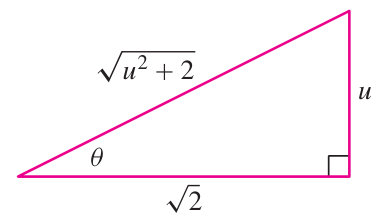
Now consider this triangle:
The triangle determines the relation , and it implies .
Now plug these into the integrand above:
Considering that , we obtain a very reasonable trig integral:
We must rewrite this in terms of using to finish the problem. We need to find assuming that . To do this, refer back to the triangle to see that . Plug this in for our final value of the integral:
Here is the moral of the story:
Pythagorean expressions
Re-express the Pythagorean expression using a triangle and a trig substitution.
In this way, we are able to eliminate square roots of quadratics.
There are always three steps for these trig sub problems:
- (1) Identify the trig sub: find the sides of a triangle and relevant angle .
- (2) Solve a trig integral (often a power product).
- (3) Refer back to the triangle to convert the answer back to .
To speed up your solution process for these problems, memorize these three transformations:
(1)
(2)
(3)
For a more complex quadratic with linear and constant terms, you will need to first complete the square for the quadratic and then do the trig substitution.
Link to original
06 Illustration
Example - Trig sub in quadratic: completing the square
Trig sub in quadratic - completing the square
Compute the integral:
Solution
(1) Complete the square to obtain Pythagorean form:
Add and subtract to get desired constant term:
(2) Perform shift substitution:
Set as inside the square:
Infer . Plug into integrand:
(3) Trig sub with :
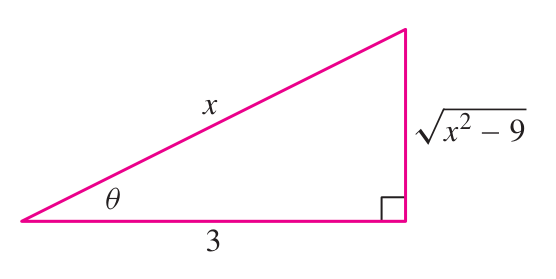
Use substitution . (From triangle or memorized tip.)
Infer . Plug in data:
(4) Integrate using ad hoc memorized formula:
(5) Convert trig back to :
First in terms of , referring to the triangle:
Then in terms of using . Plug everything in:
(6) Simplify using log rules:
The common denominator can be pulled outside as .
The new term can be “absorbed into the constant” (redefine ).
So we write our final answer thus:
Link to original