Moments and center of mass
Videos
Review Videos
Videos, Math Dr. Bob:
Link to original
- Moments and CoM 01: Points masses on a line
- Moments and CoM 02: Points masses in the plane
- Moments and CoM 03: Planar lamina of uniform density
- Moments and CoM 04: Integral formula for planar lamina
- Moments and CoM 05: Rod of non-uniform density
03 Theory
Theory 1
Moment
The moment of a region to an axis is the total (integral) of mass times distance to that axis:
Moment to -axis:
Moment to -axis:
Notice the swap in letters
- integrand has factor
- integrand has factor
Notice the total mass
If you remove or factors from the integrands, the integrals give total mass .
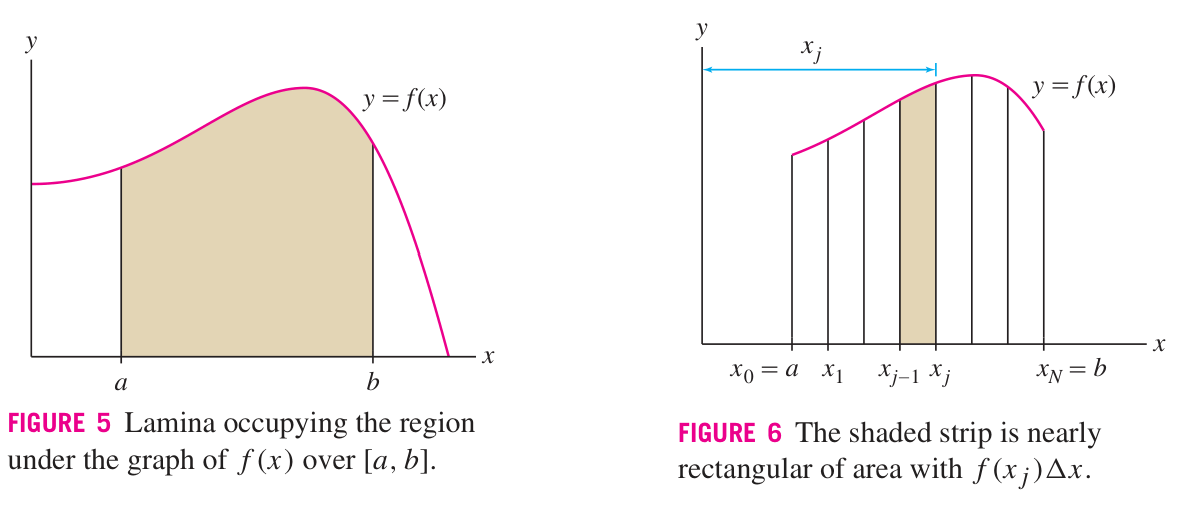
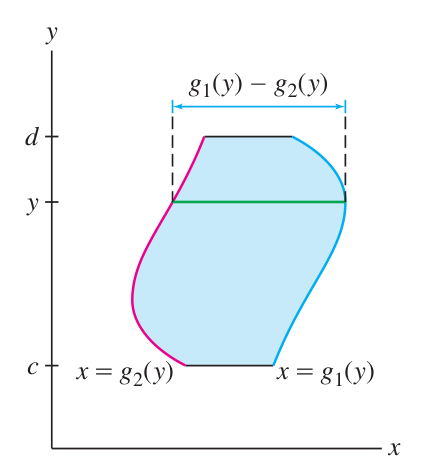
These formulas are obtained by slicing the region into rectangular strips that are parallel to the axis in question.
The area per strip is then:
- — region under
- — region between and
- — region ‘under’
- — region between and
The idea of moment is related to:
- Torque balance and angular inertia
- Center of mass
The center of mass (CoM) of a solid body is a single point with two important properties:
- “average position” of the body
- The average position determines an effective center of dynamics. For example, gravity acting on every bit of mass of a rigid body acts the same as a force on the CoM alone.
- “balance point” of the body
- The net torque (rotational force) about the CoM, generated by a force distributed over the body’s mass, equivalently a force on the CoM, is zero.
Centroid
When the body has uniform density, then the CoM is also called the centroid.
Center of mass from moments
Coordinates of the CoM:
Here is the total mass of the body.
Link to originalCenter of mass from moments - explanation
Notice how these formulas work. The total mass is always . The moment to (for example) is . Dividing these two values:
where .
In other words, through the formula , we find that is the average value of over the region with area .
04 Illustration
Example - CoM of a parabolic plate
CoM of a parabolic plate
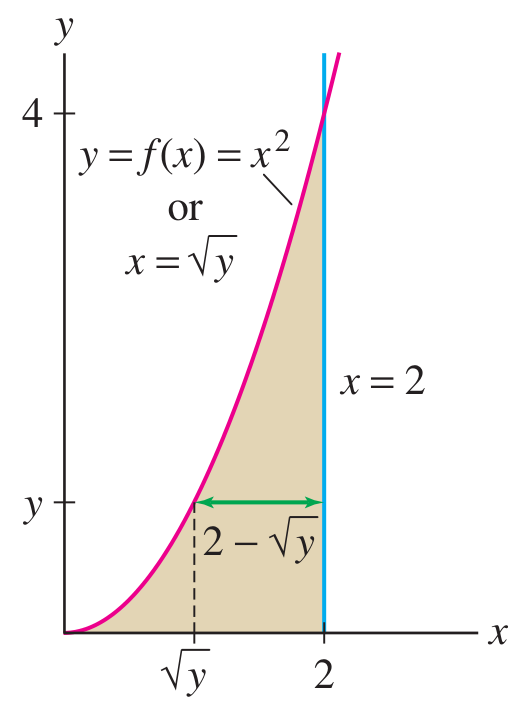
Find the CoM of the region depicted:
Solution
(1) Compute the total mass:
Area under the curve with density factor :
(2) Compute :
Formula:
Interpret and calculate:
(3) Compute :
Formula:
Width of horizontal strips between the curves:
Interpret :
Calculate integral:
(4) Compute CoM coordinates from moments:
CoM formulas:
Insert data:
Link to original
05 Theory
Theory 2
A downside of the technique above is that to find we needed to convert the region into functions in . This would be hard to do if the region was given as the area under a curve but cannot be found analytically. An alternative formula can help in this situation.
Midpoint of strips for opposite variables
When the region lies between and , we can find with an -integral:
When the region lies between and , we can find with a -integral:
Region under a curve
For the region “under the curve” , just set:
For the region “under the curve” , set:
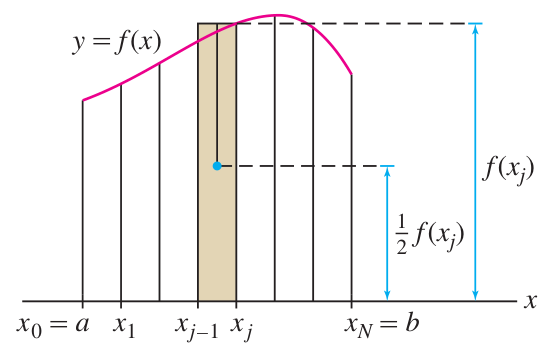
The idea for these formulas is to treat each vertical strip as a point concentrated at the CoM of the vertical strip itself.
The height to this midpoint is , and the area of the strip is , so the integral becomes .
Link to originalMidpoint of strips formula - full explanation
- If the strip is located at some , with values from up to , then:
- The area of the strip is . So the integral formula for can be recast:
- If the vertical strips are between and , then the midpoints of the strips are given by the ‘average’ function:
- The height of each strip is , so .
- Putting this together:
06 Illustration
Example - Computing CoM using only vertical strips
Computing CoM using only vertical strips
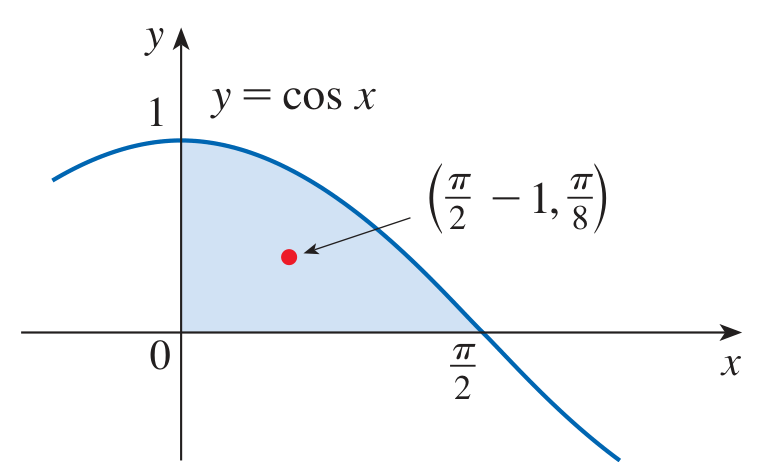
Find the CoM of the region:
Solution
(1) Compute the total mass :
Area under the curve times density :
(2) Compute , using vertical strips and the ‘midpoints’ method:
Plug and into formula:
Integration by ‘power to frequency conversion’:
(3) Compute using vertical strips and the regular method:
Plug into formula:
Integration by parts. Set , and so , :
(4) Compute CoM:
CoM formulas:
Plug in data:
Link to original
07 Theory
Theory 4
CoM of a triangle: “ trick”
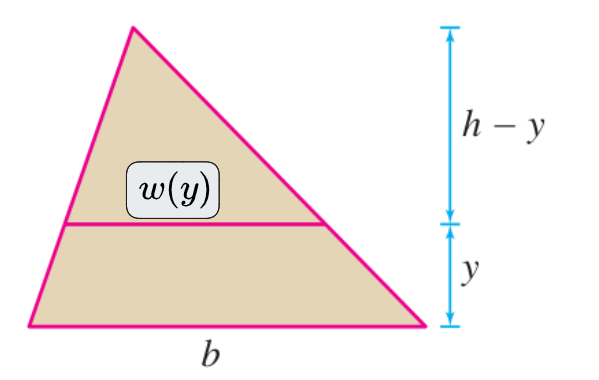
Given a triangle with edge and altitude (measured along a perpendicular to ), the CoM of the triangle lies on the line parallel to and shifted upwards by .
For example, if the triangle is positioned with base on the -axis, then its CoM will lie on the line .
Link to originalProof of “ trick”
Quick Linear Interpolation Function:
Thus:
Total mass:
Therefore:
07 Theory
Theory 3
Two useful techniques for calculating moments and (thereby) CoMs:
- Additivity principle
- Symmetry
Additivity says that you can add moments of parts of a region to get the total moment of the region (to a given axis).
A symmetry principle is that if a region is mirror symmetric across some line, then the CoM must lie on that line.
Link to original
08 Illustration
Example - Center of mass using moments and symmetry
Center of mass using moments and symmetry
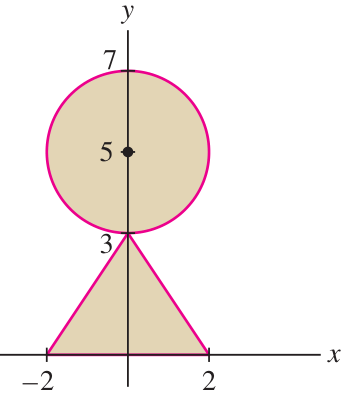
Find the center of mass of the two-part region:
Solution
(1) Symmetry: CoM on -axis
Because the region is symmetric in the -axis, the CoM must lie on that axis. Therefore .
(2) Additivity of moments:
Write for the total -moment (distance measured to the -axis from above).
Write and for the -moments of the triangle and circle.
Additivity of moments equation:
(3) Find moment of the circle using Symmetry:
By symmetry we know .
By symmetry we know .
Area of circle with is , so total mass is .
Centroid-from-moments equation:
Solve the equation for :
(4) Find moment of the triangle using Symmetry and the “ trick”:
By Symmetry, the CoM of the triangle must lie on the vertical line .
By the “ trick,” the CoM of the triangle must lie on the horizontal line at . In this case , so it lies on the line .
Therefore the triangle CoM is:
To get moments, multiply by mass :
(5) Apply additivity:
(6) Total mass of region:
Area of circle is . Area of triangle is . Thus .
(7) Compute center of mass from total and total :
We have and . Plug into formula:
Link to original
Example - Center of mass - two part region
Center of mass - two part region
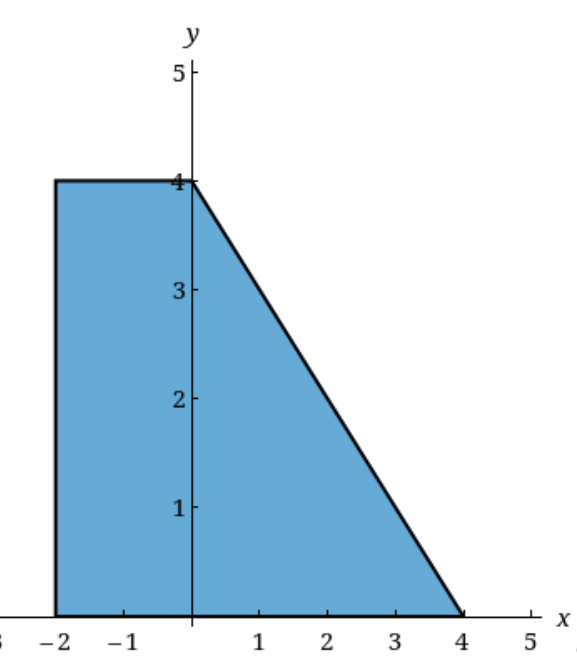
Find the center of mass of the region which combines a rectangle and triangle (as in the figure) by computing separate moments. What are those separate moments? Assume the mass density is .
Solution
(1) Apply symmetry to rectangle:
By symmetry, the center of mass of the rectangle is located at .
Thus and .
(2) Find moments of the rectangle:
Total mass of rectangle . Thus:
(3) Find moments of the triangle:
CoM of triangle using “ trick:”
From the base on the -axis, we have so the CoM lies on the line .
From the base on the -axis, we have so the CoM lies on the line .
Multiply by the triangle’s mass to get its moment:
Therefore:
(4) Add up total moments:
General formulas: and
Plug in data: and
(5) Find center of mass from moments:
Total mass of triangle .
Total combined mass .
Apply moment relation:
Link to original
Improper integrals
Videos
Review Videos
Videos, Math Dr. Bob:
Link to original
- Improper integrals: Infinite limits
- Improper integrals: Vertical asymptote
- Improper integrals:
- Improper integrals:
03 Theory
Theory 1
Improper integrals are those for which either a bound or the integrand itself become infinite somewhere on the interval of integration.
Examples:
(a) the upper bound is (b) the integrand goes to as (c) the integrand is at the point
The limit interpretation of (a) is this:
The limit interpretation of (b) is this:
The limit interpretation of (c) is this:
These limits are evaluated using the usual methods.
An improper integral is said to be convergent or divergent according to whether it may be assigned a finite value through the appropriate limit interpretation.
For example, converges while diverges.
Link to original
04 Illustration
Example - Improper integral - infinite bound
Improper integral - infinite bound
Show that the improper integral converges. What is its value?
Solution
(1) Improper integral definition:
(2) Replace infinity with a new symbol :
(3) Take limit as :
Link to original
Improper integral - infinite integrand
Improper integral - infinite integrand
Show that the improper integral converges. What is its value?
Solution
(1) Improper integral definition:
(2) Switch to and integrate:
(3) Take limit as :
Link to original
Example - Improper integral - infinity inside the interval
Example - Improper integral - infinity inside the interval
Does the integral converge or diverge?
Solution
WRONG APPROACH:
It is tempting to compute the integral incorrectly, like this:
But this is wrong! There is an infinite integrand at . We must break it into parts!
RIGHT APPROACH:
(1) Break apart at discontinuity:
(2) Improper integral definition, both terms separately:
(3) Integrate:
(4) Limits:
Neither limit is finite. For to exist we’d need both of these limits to be finite. So the original integral diverges.
Link to original
05 Theory
Theory 2
Two tools allow us to determine convergence of a large variety of integrals. They are the comparison test and the -integral cases.
Comparison test - integrals
The comparison test says:
- When an improper integral converges, every smaller integral converges.
- When an improper integral diverges, every bigger integral diverges.
Here, smaller and bigger are comparisons of the integrand at all values (accounting properly for signs), and the bounds are assumed to be the same.
For example, converges, and implies (when ), therefore the comparison test implies that converges.
-integral cases
Assume and . We have:
Proving the -integral cases
It is easy to prove the convergence / divergence of each -integral case using the limit interpretation and the power rule for integrals. (Or for , using .)
Additional improper integral types
The improper integral also has a limit interpretation:
The double improper integral has this limit interpretation:
Where is any finite number. This double integral does not exist if either limit does not exist for any value of .
Link to originalDouble improper is not simultaneous!
Watch out! This may happen:
This simultaneous limit might exist only because of internal cancellation in a case where the separate individual limits do not exist! We do not say ‘convergent’ in these cases!
06 Illustration
Example - Comparison to -integrals
Comparison to p-integrals
Determine whether the integral converges:
(a)
(b)
Solution
(a) (1) Observe large tendency:
Consider large values. Notice the integrand tends toward for large .
(2) Try comparison to :
Validate. Notice and when .
(3) Apply comparison test:
We know:
We conclude:
(b) (1) Observe large tendency:
Consider large values. Notice the integrand tends toward for large .
(2) Try comparison to :
Validate. Notice and when .
(3) Apply comparison test:
We know:
We conclude:
Link to original