Shells
01
Link to originalShells volume - offset graph, -axis
Consider the region in the first quadrant bounded by the lines , , , and the curve . Revolve this about the -axis.
Find the volume of the resulting solid.
Solution
Solutions - 0030-01
(1) Set up integral.
(2) Perform -substitution with and :
(3) Integrate with power rule:
Link to original
IBP
02
Link to originalIntegration by parts - A and T
Compute the integral:
Solution
Solutions - 0010-02
(1) Select and considering LIATE:
(2) Apply IBP formula :
(3) Select another and and do IBP again:
(4) Put all together in (A):
Note B: We can change notation to because the value of is arbitrary.
Link to original
03
Link to originalIntegration by parts - A and L
Compute the integral:
Solution
Solutions - 0010-03
(1) Select and considering LIATE:
(2) Apply IBP formula :
Link to original
05
Link to originalIntegration by parts - A and I
Compute the integral:
Solution
Solutions - 0010-05
(1) Select and considering LIATE:
(2) Apply IBP formula and compute integral:
(3) Perform -sub with and :
(4) Insert result in Exp. (A):
Note B: We can change to because the inner expression is never negative.
Link to original
Trig power products
01
Link to originalSomewhat odd power product
Compute the integral:
Solution
Solutions - 0040-01
(1) Notice odd power on . Swap the even bunch:
(2) Integrate with -sub setting and thus :
Link to original
02
Link to originalTangent and secant both even
Compute the integral:
Solution
Solutions - 0040-02
Notice . Therefore integrate with -sub setting and :
Link to original
05
Link to originalTangent and secant mixed parity
Compute the integral:
(a) Using .
(b) Using .
Solution
Solutions - 0040-05
(a) Select and thus :
(b)
(1) Select and thus :
(3) Swap even bunch using :
(4) Perform -sub with and integrate:
Link to original
Trig subs
01
Link to originalTrig sub
Compute the definite integral:
Solution
Solutions - 0050-01
(1) Substitute and thus . Adjust the bounds as follows:
Rewrite the integral:
(2) Use power-to-frequency conversion:
Note A: Use , then and this equals for .
Link to original
03
Link to originalTrig sub
Compute the integral:
Solution
Solutions - 0050-03
(1) Notice pattern, so we should make use of the identity .
Select and thus . Then:
Plug in and simplify:
(We must assume that for the relevant values of here.)
(2) Use power-to-frequency conversion:
(3) Convert back to terms of :
First draw a triangle expressing :
Therefore:
For , use the double-angle identity:
Therefore:
Link to original
05
Link to originalTrig sub
Compute the integral:
Solution
Solutions - 0050-05
(1) Notice pattern, so we should make use of the identity .
Select and thus . Then:
(2) Convert to and integrate:
(3) Convert back to terms of :
Draw a triangle expressing :
Therefore and . Then:
Link to original
Partial fractions
01
Link to originalDistinct linear factors
Compute the integral:
Solution
Solutions - 0060-01
(1) Write the partial fractions general form equation:
(2) Solve for constants.
Cross multiply:
Plug in , obtain so .
(3) Integrate each term:
Link to original
02
Link to originalLong division first
Compute the integral:
Solution
Solutions - 0060-02
(1) Numerator degree is not smaller! Long division first:
Now this already has the form of a partial fraction decomposition, so we proceed directly to integration.
(2) Integrate using power rule (with log):
Link to original
07
Link to originalPartial fractions - linear and quadratic
Compute the integral:
Solution
Solutions - 0060-07
(1) Denominator has degree 3, numerator has degree 2, therefore long division is not necessary.
(2) Write the partial fractions general form equation:
Notice that is an irreducible quadratic (cannot be factored). So we have:
(3) Solve for constants:
Cross multiply:
Plug in , obtain:
Expand RHS:
Comparing terms, obtain: and thus .
Comparing constant terms, .
(4) Integrate by terms:
Note A: For the last term, use the formula:
Link to original
08
Link to originalPartial fractions - repeated factor
Compute the integral:
Solution
Solutions - 0060-08
(1) Write the partial fractions general form equation:
Observe that appears in degree 3 in the integrand, so we have one term for each power up to 3 in the partial fraction decomposition.
(2) Solve for constants:
Cross multiply:
Plug in , obtain so .
Plug in , obtain .
Plug in , obtain:
Plug in , obtain:
(3) Integrate each term:
Optional simplification:
Link to original
Simpson’s Rule
02
Link to originalSimpson’s Rule for volume by shells
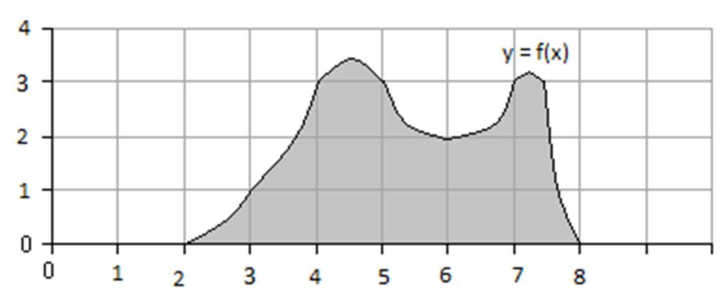
Use Simpson’s Rule with to compute the volume of the solid obtained by revolving the pictured region about the -axis. Can you do it without using a calculator?
Solution
Solutions - 0070-02
(1) Recall shells formula:
(2) Interpret:
Bounded above by . Bounded below by -axis.
Bounded left by . Bounded right by .
Obtain:
(3) Create table of values to apply Simpson’s Rule:
(4) Recall Simpson’s Rule formula:
Here since in this formula represents the integrand values.
Note that .
Plug in:
Therefore:
Therefore:
Link to original
03
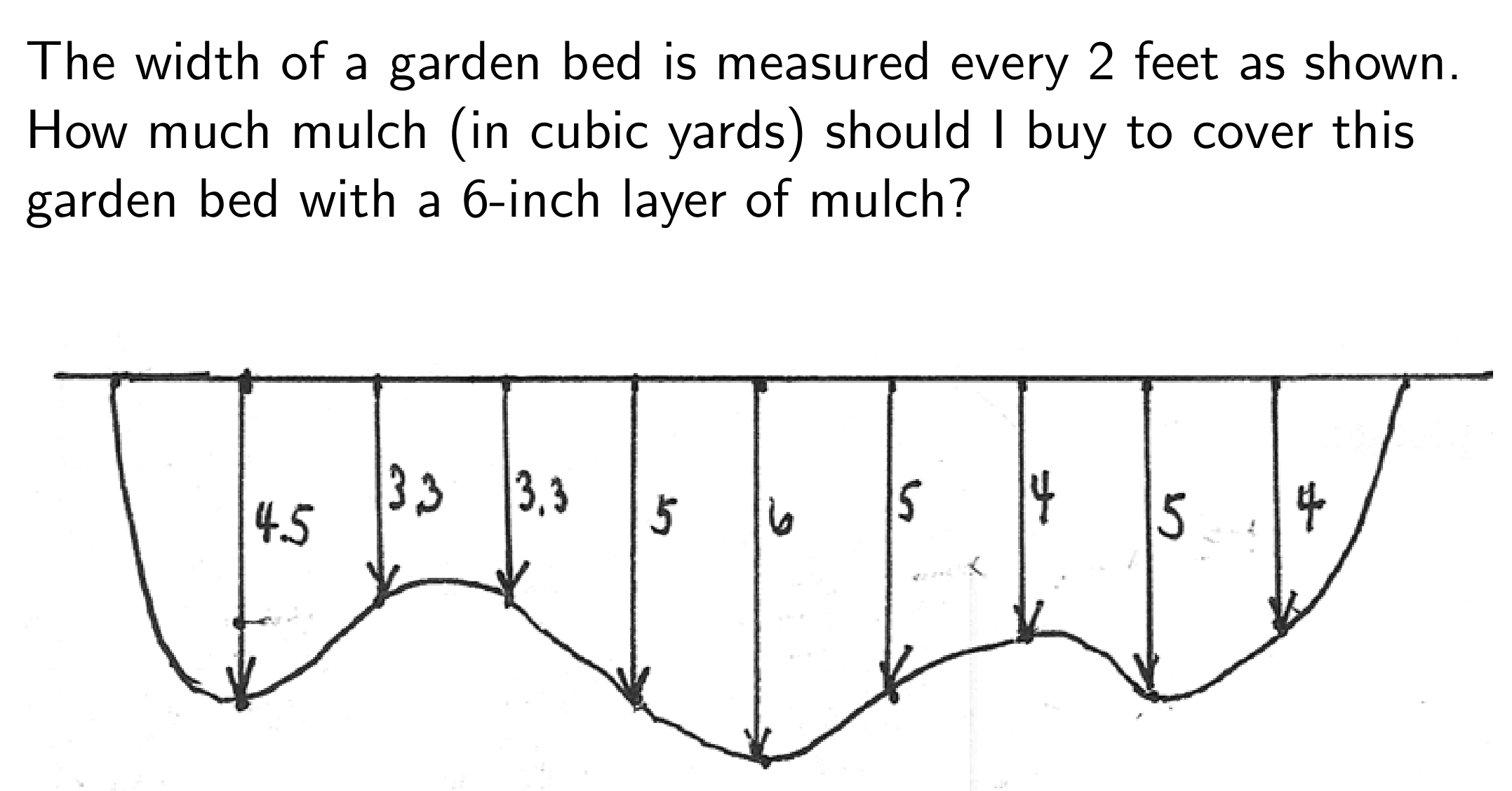
Link to originalArea of a garden bed
Solution
Solutions - 0070-03
Note: you can also start from and . This gives a different answer, .
(1) Set up integration:
Set at the left upper corner, with extending to the right, extending downwards. Then:
(2) Create table of values:
(3) Recall Simpson’s Rule formula:
Here and .
Thus:
(4) Compute cubic yards from known surface area:
Mulch is deep, so the volume is:
Link to original


