Arc length
Videos
Review Videos
Videos, Math Dr. Bob:
- Formula for Arc Length 01: Theory and catenary
- Formula for Arc Length 02: Curve given by integral
- Formula for Arc Length 03: Reverse engineering
- Arc Length of Parabola 01: Base case
- Arc Length of Parabola 02: Sinh formula
- Arc Length of Parabola 03: Log formula
Videos, Khan Academy:
Link to original
01 Theory
Theory 1
The total arc length of a curve is just the length of the curve.
The ‘arc length’ (not “total”) is a quantity measuring the length “as you go along,” usually given as a function of the points on the curve. It measures the length from some starting point ‘up to’ the given point.
We can use calculus to calculate the arc length of many curves. If the curve is the graph of a function, and we know the function and its derivative (whether from a formula or a data table), we can use integration to find the arc length.
Arc-length formula
The arc length of the graph of over is:
(This formula applies when exists and is continuous on .)
The arc length function of the graph of , starting from , is:
Link to originalArc-length formula - explanation
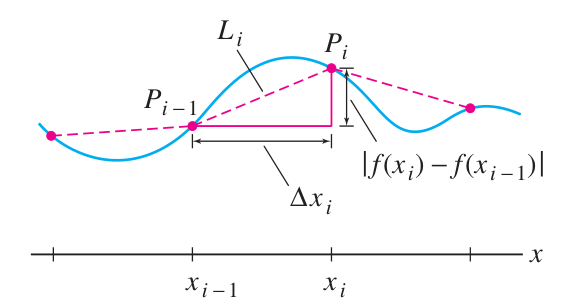
The arc-length integral is the limit of Riemann sums that add the lengths of straight line segments whose endpoints lie on the curve, and which together approximate the curve.
Each tiny line segment is the hypotenuse of a triangle with horizontal and vertical .
We can approximate the vertical using the derivative:
Considering infinitesimals in the limit, we have (horizontal side) and (vertical side). The Pythagorean Theorem gives:
which we can simplify using :
The integral of these infinitesimals gives the arc length:

02 Illustration
Example - Arc length calculation
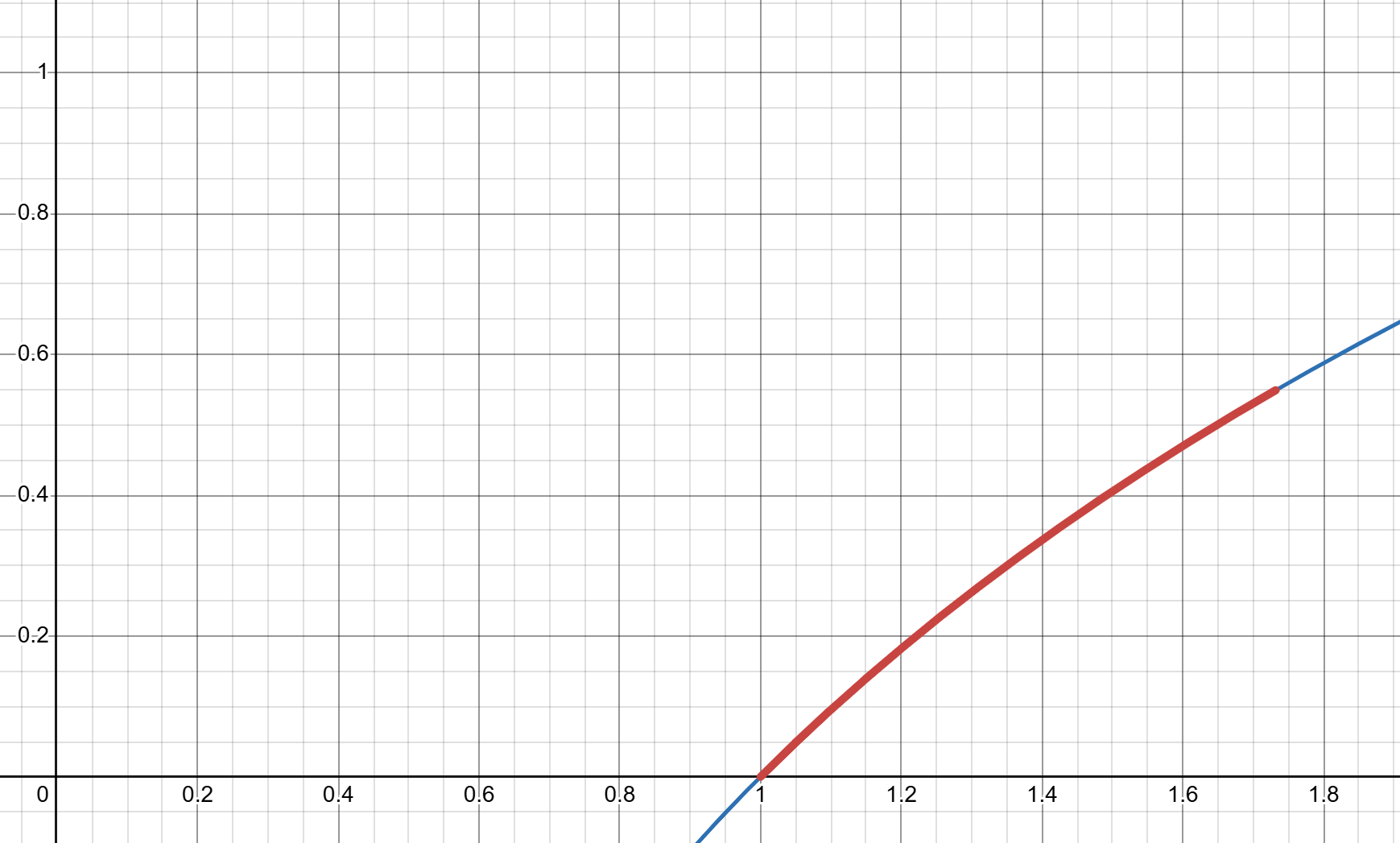
Arc length of ln x with trig sub
Find the length of the curve for :
Solution
(1) Set up arc length formula:
First note that . Then:
(2) Integrate using trig substitution:
Observe . Choose and therefore .
Link to original
Example - Arc length tricky algebra
02
Link to originalArc length - tricky algebra
Find the arc length of the curve for .
(Hint: expand under the root, then simplify, then factor; now it’s a square and the root disappears.)
Solutions---0080-02
Example - Hyperbolic Trig - Arc length of hanging chain
Surface areas of revolutions - thin bands
Videos
Review Videos
Videos, Math Dr. Bob
Link to original
- Area of a Surface of Revolution: Derivation, cylinder, cone, sphere
03 Theory
Theory 1
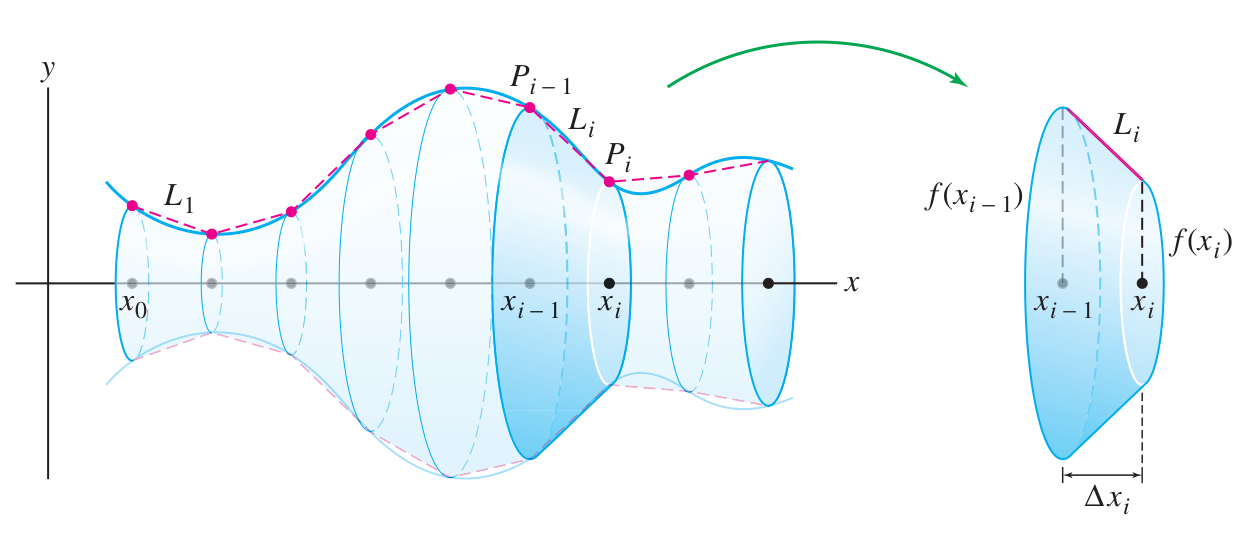
The infinitesimal of arc length along a curve, , can be used to find the surface area of a surface of revolution. The circumference of an infinitesimal band is and the width of such a band is .
The general formula for the surface area is:
In any given problem we need to find the appropriate expressions for and in terms of the variable of integration. For regions rotated around the -axis, the variable will be ; for regions rotated about the -axis it will be .
Assuming the region is rotated around the -axis, and the cross section in the -plane is the graph of and so , the formula above becomes:
Link to originalArea of revolution formula - thin bands
The surface area of the surface of revolution given by is given by the formula:
In this formula, we assume and is continuous. The surface is the revolution of on around the -axis.
04 Illustration
Example - Surface area of a sphere
Surface area of a sphere
Using the fact that a sphere is given by revolving a semicircle, verify the formula for the surface area of a sphere.
Solution
(1) Describe sphere as surface of revolution:
Upper semicircle:
As function of :
(2) Surface area formula:
Our bounds are and . Function is :
(3) Work out integrand:
Power rule and chain rule:
Therefore:
Integrand:
(4) Compute integral:
This is the expected surface area formula: .
Link to original