Probability models
01
Link to originalVenn diagrams - set rules and Kolmogorov additivity
Suppose we know three probabilities of events: , , and .
Calculate: , , , , and .
Solution
02
Link to originalInclusion-exclusion reasoning
Your friend says: “according to my calculations, the probability of is and the probability of is , but the probability of and both happening is only .”
You tell your friend they don’t understand probability. Why?
Solution
04
Link to originalAt least two heads from three flips
A coin is flipped three times.
What is the probability that at least two heads appear?
Solution
Conditional probability
02
Link to originalConditioning - two dice, at least one is 5
Two dice are rolled, and at least one is a 5.
What is the probability that their sum is 10?
Solution
04
Link to originalMultiplication - drawing two hearts
Two cards are drawn from a standard deck (without replacement).
(a) What is the probability that both are hearts?
(b) What is the probability that both are 4?
Solution
06
Link to originalConditioning relation
Suppose you know and and .
Calculate and and .
Solution
Bayes’ Theorem
02
Link to originalBayes’ Theorem - Inferring die from roll
A bag contains one 4-sided die, one 6-sided die, and one 12-sided die. You draw a random die from the bag, roll it, and get a 4.
What is the probability that you drew the 6-sided die?
Solution
03
Link to originalBayes’ Theorem - DNA evidence
A crime is committed in a town of 100,000 citizens. After all 100,000 citizens’ DNA is analyzed, your friend Jim is found to have a DNA match to evidence at the scene. A forensics expert says that the probability of an innocent person matching this evidence is 0.01% (i.e. the false positive rate). How likely is it that Jim is guilty?
Solution
Independence
03
Link to originalApplicant qualifications B
A hiring manager will randomly select two people from a group of 5 applicants. Of the 5 applicants, 2 are more qualified and 3 are less qualified (but the manager does not know this).
Let Event A be selecting 2 more qualified applicants and Event B be selecting 2 less qualified applicants. Determine whether A and B are independent events and justify your answer.
Solution
Tree diagrams
01
Link to originalBin of marbles
A bin contains 5 red marbles, 7 blue marbles, and 3 white marbles.
We draw a random marble. If it’s red, we put it back, if it’s not red, we keep it. We do this three times.
(a) What is the probability of getting red then white then blue?
(b) Suppose the last draw was blue. What is the probability that the first was red?
Solution
Counting
01
Link to originalCounting outcomes - permutations and combinations
In a lottery, five distinct numbers are picked at random from . How many possible outcomes are there:
(a) If we care about the order of numbers.
(b) If the order does not matter.
Solution
03
Link to originalDrawing balls of distinct color
A bin contains 3 green and 4 yellow balls. Two balls are drawn out.
What is the probability that they are different colors?
Solution
05
Link to originalBinomial - Repeated coin flips
A coin is flipped 7 times and the sequence of results recorded as an outcome.
(a) How many possible outcomes have exactly 3 heads?
(b) How many possible outcomes have at least 3 heads?
Solution
08
Link to originalCounting license plates
A license plate must consist of 3 letters followed by 4 digits. Assuming we choose from 26 letters, A-Z, and 10 digits, 0-9, how many different license plates could be created if:
(a) Letters and numbers cannot be repeated.
(b) Letters and numbers can be repeated except that there must be exactly two 9’s.
Solution
Repeated trials
01
Link to originalIndependent trials - At least 45 good paper clips
For a paper clip production line, 90% of the paper clips come off good, and 10% come off broken.
You buy a box of 50 paper clips from this line. What is the probability that at least 45 of them are good?
Solution
04
Link to originalGuessing on a test
Your odds of getting any given exam question right are . The exam has 4 questions, and you need to answer 3 correctly to pass.
(a) What is the probability that you pass?
(b) After finishing the exam, you are 100% sure that you got the second question right. Now what are the odds that you pass?
Solution
06
Link to originalWatching the Superbowl
A representative from Nielsen ratings randomly selects people in Charlottesville, VA and asks them whether they watched the Superbowl. The probability that any individual in Charlottesville watched the Superbowl is 0.3.
(a) What is the probability that if the representative asks 10 people, that less than 2 of them will have watched the Superbowl?
(b) What is the probability that the representative will have to ask at least 3 people to find someone who watched the Superbowl?
Solution
Reliability
01
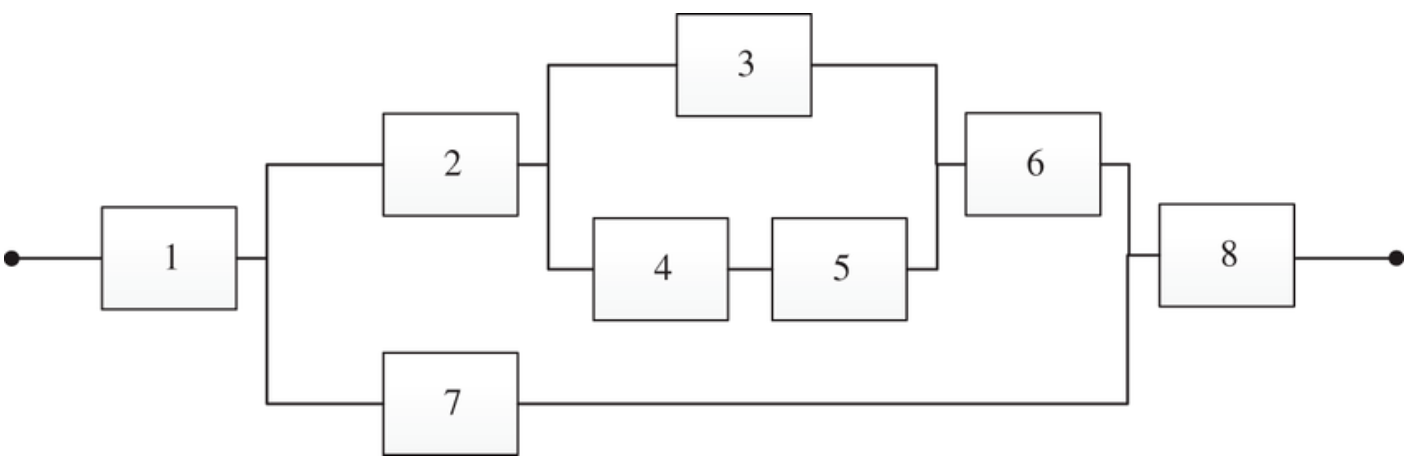
Link to originalReliability for complex process
Consider a process with the following diagram of components in series and parallel:
Use to denote the event that component succeeds.
Suppose the success probabilities per component are given by this chart:
1 2 3 4 5 6 7 8 80% 60% 40% 90% 80% 50% 70% 90% What are the odds of success for the whole process?
Solution
04
Link to originalReliability - Math competition cutoff score
At a high school math competition, students take a test with 10 questions. Each question is worth one point and the probability of a student getting any one question correct is 0.55, independent of the other questions.
(a) Find the probability of a student getting a score of 8 or higher.
(b) Students take the test individually but compete in teams of 2. To proceed to the second round of competition, each student on the team must score at least 8. Each high school can enter 2 teams. If a high school enters two teams, find the probability at least one of their teams will make it to the second round. Assume students’ scores are independent.
Solution
Discrete random variables
06
Link to originalVariance from CDF: Drill bit changes
The bits for a particular kind of drill must be changed fairly often. Let denote the number of holes that can be drilled with one bit. The CDF of is given below:
(a) Find the probability that a bit will be able to drill more than 2 holes.
(b) Find by constructing the PMF.
Solution
Bernoulli process
03
Link to originalRolling until a six
A fair die is rolled until a six comes up.
What are the odds that it takes at least 10 rolls? (Use a geometric random variable.)
Solution
04
Link to originalIntersection accidents
Suppose that the odds of an accident occurring on any given day at the intersection of Ivy and Emmet is 0.05.
What are the odds of the first accident occurring between day 5 and day 10, inclusive? (Use an RV with an appropriate discrete distribution type.)
Solution
08
Link to originalPrize on the Mall
A booth on the Mall is running a secret prize game, in which the passerby wearing a hat wins $1,000.
Passersby wear hats independently of each other and with probability 20%.
Let be a random variable counting how many passersby pass by before a winner is found.
(a) What is the name of the distribution for ? What are the parameters?
(b) What is the probability that the passerby wins the prize?
(c) What is the probability that at least passersby are needed before a winner is found?
Solution
Expectation and variance
02
Link to originalInsurance expected payout
A car insurance analytics team estimates that the cost of repairs per accident is uniformly distributed between $100 and $1500. The manager wants to offer customers a policy that has a $500 deductible and covers all costs above the deductible.
How much is the expected payout per accident?
(Hint: Graph the PDF for the cost of repairs ; write a formula for the payout in terms of using cases; then integrate.)
Solution
04
Link to originalTutoring needs
A course with 6 students offers free one-on-one tutoring to each student for 1 hour the week before the final exam. One tutor, Jim, has been hired to provide this tutoring, but he is available for only 4 hours that week. The instructor of the course will tutor any students that Jim is not able to help. Jim will be paid $20 per hour by the department. The instructor will provide tutoring for free. Let be the number of students that will need tutoring. The PMF of is given below.
(a) Find the probability the instructor will need to provide tutoring.
(b) Find the expected value of the number of students that will need tutoring.
Solution
05
Link to originalExpectation from CDF
The CDF of random variable X is given by:
Compute and (use the shorter formula).
Solution
Poisson process
03
Link to originalApplication of Poisson: meteor shower
The UVA astronomy club is watching a meteor shower. Meteors appear at an average rate of per hour.
(a) Write a short explanation to justify the use of a Poisson distribution to model the appearance of meteors. Why should appearances be Poisson distributed?
(b) What is the probability that the club sees more than 2 meteors in a single hour?
(c) Suppose we find out that over a four hour evening, 13 meteors were spotted. What is the probability that none of them happened in the first hour, conditioned on that information?
Solution
Function on a random variable
01
Link to originalConstants in PDF from expectation
Suppose has PDF given by:
Suppose . Find the only possible values for and . Then find .
Solution
03
Link to originalPDF of derived variable for and
Suppose the PDF of an RV is given by:
(a) Find using the integral formula.
(b) Find , the PDF of (by calculating the CDF first).
(c) Find using .
(d) Find using results of (a) and (c).
Solution
05
Link to originalCDF of derived variable
Suppose is a continuous random variable. Let . Find the CDF of .
Solution
Continuous wait times
04
Link to originalSelling Christmas trees
An online company sells artificial Christmas trees. During the holiday season, the amount of time between sales, , is an exponential random variable with an expected value of 2.5 hours.
(a) Find the probability that the store will sell more than 2 trees in a 1-hour period of time.
(b) Find the probability the time between the sales of two trees will be between 4-5 hours.
Solution
05
Link to originalPotholes on the highway
On a certain terrible stretch of highway, the appearance of potholes can be modeled by a Poisson process. Let the RV denote the distance between successive potholes (measured in miles). The CDF of X is:
(a) What is the mean number of potholes in a 2-mile stretch of the highway?
(b) What is the probability that there will be at least 2 potholes in a 2-mile stretch of the highway?
Solution
Normal distribution
03
Link to originalGeneralized normal
Let be generalized normal variable with and . Using a chart of values, find:
(a)
(b) such that
(c) (Hint: Use and to avoid integration.)
Solution
04
Link to originalNormal distribution - test scores
In a large probability theory exam, the scores are normally distributed with a mean of 75 and a standard deviation of 10.
(a) What is the probability that a student scored between 70 and 80
(b) What is the lowest score a student can achieve to be in the top 5%?
(c) What score corresponds to the 25th percentile?
Solution
05
Link to originalNormal distribution - cars passing toll booth
The number of cars passing a toll booth on Wednesdays has a normal distribution .
(a) What is the probability that on a randomly chosen Wednesday, more than 1,400 cars pass the toll booth?
(b) What is the probability that between 1,000 and 1,400 cars pass the toll booth on a random Wednesday?
(c) Suppose it is learned that at least 1200 cars passed the toll booth last Wednesday. What is the probability that at least 1300 cars passed the toll booth that day?
Solution